

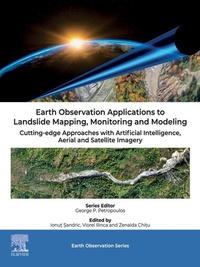
Earth Observation Applications to Landslide Mapping, Monitoring and Modeling
Cutting-edge Approaches with Artificial Intelligence, Aerial and Satellite Imagery
Published on 14. November 2024
400 pages
978-0-12-824198-1 (ISBN)
Description

Earth Observation Applications to Landslide Mapping, Monitoring and Modelling: Cutting-edge Approaches with Artificial Intelligence, Aerial and Satellite Imagery focuses on the applications of drone and satellite imagery for mapping landslides. Topics covered include the use of ultra-high aerial imagery, obtained with drones, for mapping and predicting landslide activity (like runoff, volume displacement, exposure to risk, etc.). Subjects related to EO data assimilations into landslide hazard prediction models are also included. The primary aim of this book is to advance the scientific understanding and application of technologies to address a variety of fields related to landslide mapping and monitoring.Because of the intensification of the catastrophic events in the last 20 years, landslide monitoring gained considerable interest from the geoscience community. This book will be beneficial for the postgraduates, PhD research scholars, professors and scientists, geospatial experts, modelers, oceanography scientists and conservation communities, environmental consultants, big data compilers, and computing experts.
- Recent developments in landslide monitoring and mapping algorithms
- Provides clear and detailed case studies and methods that can be easily replicated and implemented in landslide monitoring systems
- Provides detailed methods for applying research to landslide monitoring and mapping
More details
Other editions
Additional editions
Viorel Ilinca | Zenaida Chitu | Ionut Sandric
Earth Observation Applications to Landslide Mapping, Monitoring and Modeling
Cutting-edge Approaches with Artificial Intelligence, Aerial and Satellite Imagery
Book
11/2024
Elsevier
€155.99
Shipment within 15-20 days
Content
Section 1: Introduction1. A review of UAV-based data applications for landslide mapping and monitoring2. A review of the state-of-the-art use of satellite Earth observation data for landslide mapping and monitoringSection 2: Satellite data in landslide mapping andmonitoring3. On the use of the EGMS data for studying landslides in Great Britain4. Deciphering the kinematics of urban landslides through SAR imagery analysis5. Artificial intelligence applications for landslide mapping/monitoring on satellite EO data6. Mapping landslides on Earth, Moon, and Mars using satellite imagery and deep learning techniquesSection 3: Drone applications for landslide mappingand monitoring7. Landslide volume and runoff monitoring using UAV photogrammetry8. Landslide 3D reconstruction and monitoring using oblique and nadiral drone aerial imagery9. Geomorphic monitoring and assessment of debris flows using drone-based structure from motion10. Machine learning and object-based image analysis for landside mapping using UAV-derived data11. Estimating kinematic uncertainties of landslides using UAV time series12. Detailed landslide kinematics mapping using short-term UAV time-series. Case study: Livadea landslide, RomaniaSection 4: EO data assimilations in landslide susceptibility, hazard mapping and risk assessment13. Building landslide inventory with LiDAR data and deep learning14 Landslide susceptibility mapping using machine-learning algorithms and earth observation data15. Microwave remote sensing for investigating hydrological preconditions triggering landslides: a case study: Ialomita Subcarpathians, Romania16. Use of UAV imagery for the detection and measurement of damages to road networks in landslide areasSection 5: Future challenges and future outlook17. Mapping the existing challenges and pathway forward
