

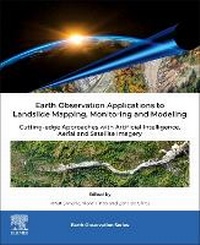
Earth Observation Applications to Landslide Mapping, Monitoring and Modeling
Cutting-edge Approaches with Artificial Intelligence, Aerial and Satellite Imagery
Published on 8. November 2024
Book
Paperback/Softback
400 pages
978-0-12-823868-4 (ISBN)
Description
Earth Observation Applications to Landslide Mapping, Monitoring and Modeling: Cutting-edge Approacheswith Artificial Intelligence, Aerial and Satellite Imagery focuses on the application of drone and satellite imagery for landslide mapping, monitoring, and modeling. The topics covered include the use of ultrahigh spatial resolution imagery acquired by UAVs (Unmanned Aerial Vehicles) for mapping and predicting landslide activity, the use of satellite imagery for monitoring landslide activity, the assimilation of EO (EarthObservation) data into landslide susceptibility and hazard prediction models, and the building of landslide inventories. The primary objective of this book is the advancement of the scientific understanding and application of technologies to address a variety of areas related to landslide mapping and monitoring for robust and sustainable development. Earth Observation Applications to Landslide Mapping, Monitoring and Modeling be useful for PhD students, postdoctoral researchers, professors, and scientists in geoscience.
More details
Series
Language
English
Place of publication
United States
Target group
Professional and scholarly
Geologist, geomorphologists, researchers and practitioners working in environmental modelling and remote sensing Environmental engineers and government and NGOs working on prevention of landslides
Illustrations
Approx. 200 illustrations (120 in full color)
Dimensions
Height: 235 mm
Width: 191 mm
Weight
1000 gr
ISBN-13
978-0-12-823868-4 (9780128238684)
Copyright in bibliographic data and cover images is held by Nielsen Book Services Limited or by the publishers or by their respective licensors: all rights reserved.
Schweitzer Classification
Other editions
Additional editions
Viorel Ilinca | Zenaida Chitu | Ionut Sandric
Earth Observation Applications to Landslide Mapping, Monitoring and Modeling
Cutting-edge Approaches with Artificial Intelligence, Aerial and Satellite Imagery
E-Book
11/2024
Elsevier
€143.00
Available for download
Persons
Viorel Ilinca, PhD in Geography, has a rich background in physical geography and geology. Since joining the Geological Institute of Romania in 2010, he has been an integral part of the Geological Mapping Group, where he focuses on landslide research, geomorphological and geological mapping, GIS, cartography and geoheritage. With extensive experience in both national and international research projects, he has worked on various applications of geomorphology and geological mapping for natural hazard assessment. In the field of landslides, he uses field surveys and earth observation to study different types of landslides.
Zenaida Chi?u, PhD in Geography, has expertise in the integration of physical modeling, GIS, earth observation and ground measurement networks in the monitoring of landslide activity. Her work covers hydrology, climatology and geomorphology, with a special focus on landslides. She has led national research projects aimed at improving our understanding of landslides by combining methods from different disciplines including geomorphology, engineering geology, hydrology and meteorology. Her recent research includes estimating soil moisture using a mix of hydrological modelling, remote sensing and field measurements, and investigating the impact of climate change on different sectors.
Ionu? ?andric, currently an Associate Professor at the Faculty of Geography, University of Bucharest, brings extensive experience in research and commercial projects. He specializes in combining geospatial knowledge with software engineering to develop geospatial environmental models. His research focuses on the spatial and temporal modeling of landslides, including tools for assessing the propagation of uncertainty in landslide hazards. He has led projects on multi-hazard and multi-risk assessment, drone-based landslide feature mapping, agricultural pathogen detection using drone imagery, urban climate applications using satellite imagery, and soil moisture satellite product analysis for Romania.
Zenaida Chi?u, PhD in Geography, has expertise in the integration of physical modeling, GIS, earth observation and ground measurement networks in the monitoring of landslide activity. Her work covers hydrology, climatology and geomorphology, with a special focus on landslides. She has led national research projects aimed at improving our understanding of landslides by combining methods from different disciplines including geomorphology, engineering geology, hydrology and meteorology. Her recent research includes estimating soil moisture using a mix of hydrological modelling, remote sensing and field measurements, and investigating the impact of climate change on different sectors.
Ionu? ?andric, currently an Associate Professor at the Faculty of Geography, University of Bucharest, brings extensive experience in research and commercial projects. He specializes in combining geospatial knowledge with software engineering to develop geospatial environmental models. His research focuses on the spatial and temporal modeling of landslides, including tools for assessing the propagation of uncertainty in landslide hazards. He has led projects on multi-hazard and multi-risk assessment, drone-based landslide feature mapping, agricultural pathogen detection using drone imagery, urban climate applications using satellite imagery, and soil moisture satellite product analysis for Romania.
Content
Section 1: Introduction
1. A review of UAV-based data applications for landslide mapping and monitoring
2. A review of the state-of-the-art use of satellite Earth observation data for landslide mapping and monitoring
Section 2: Satellite data in landslide mapping and
monitoring
3. On the use of the EGMS data for studying landslides in Great Britain
4. Deciphering the kinematics of urban landslides through SAR imagery analysis
5. Artificial intelligence applications for landslide mapping/monitoring on satellite EO data
6. Mapping landslides on Earth, Moon, and Mars using satellite imagery and deep learning techniques
Section 3: Drone applications for landslide mapping
and monitoring
7. Landslide volume and runoff monitoring using UAV photogrammetry
8. Landslide 3D reconstruction and monitoring using oblique and nadiral drone aerial imagery
9. Geomorphic monitoring and assessment of debris flows using drone-based structure from motion
10. Machine learning and object-based image analysis for landside mapping using UAV-derived data
11. Estimating kinematic uncertainties of landslides using UAV time series
12. Detailed landslide kinematics mapping using short-term UAV time-series. Case study: Livadea landslide, Romania
Section 4: EO data assimilations in landslide susceptibility, hazard mapping and risk assessment
13. Building landslide inventory with LiDAR data and deep learning
14 Landslide susceptibility mapping using machine-learning algorithms and earth observation data
15. Microwave remote sensing for investigating hydrological preconditions triggering landslides: a case study: Ialomita Subcarpathians, Romania
16. Use of UAV imagery for the detection and measurement of damages to road networks in landslide areas
Section 5: Future challenges and future outlook
17. Mapping the existing challenges and pathway forward
1. A review of UAV-based data applications for landslide mapping and monitoring
2. A review of the state-of-the-art use of satellite Earth observation data for landslide mapping and monitoring
Section 2: Satellite data in landslide mapping and
monitoring
3. On the use of the EGMS data for studying landslides in Great Britain
4. Deciphering the kinematics of urban landslides through SAR imagery analysis
5. Artificial intelligence applications for landslide mapping/monitoring on satellite EO data
6. Mapping landslides on Earth, Moon, and Mars using satellite imagery and deep learning techniques
Section 3: Drone applications for landslide mapping
and monitoring
7. Landslide volume and runoff monitoring using UAV photogrammetry
8. Landslide 3D reconstruction and monitoring using oblique and nadiral drone aerial imagery
9. Geomorphic monitoring and assessment of debris flows using drone-based structure from motion
10. Machine learning and object-based image analysis for landside mapping using UAV-derived data
11. Estimating kinematic uncertainties of landslides using UAV time series
12. Detailed landslide kinematics mapping using short-term UAV time-series. Case study: Livadea landslide, Romania
Section 4: EO data assimilations in landslide susceptibility, hazard mapping and risk assessment
13. Building landslide inventory with LiDAR data and deep learning
14 Landslide susceptibility mapping using machine-learning algorithms and earth observation data
15. Microwave remote sensing for investigating hydrological preconditions triggering landslides: a case study: Ialomita Subcarpathians, Romania
16. Use of UAV imagery for the detection and measurement of damages to road networks in landslide areas
Section 5: Future challenges and future outlook
17. Mapping the existing challenges and pathway forward