

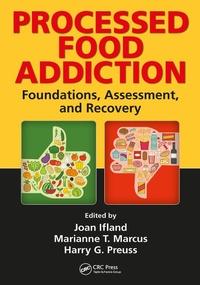
Processed Food Addiction
Foundations, Assessment, and Recovery
1st Edition
Published on 22. December 2017
480 pages
978-1-4987-1997-1 (ISBN)
Description

Obesity and eating disorders have stubbornly refused to respond to treatment since the 1990's. This book organizes the evidence for a possible answer, i.e., that the problem could be one of addiction to processed foods. In a Processed Food Addiction (PFA) model, concepts of abstinence, cue-avoidance, acceptance of lapses, and consequences all play a role in long-term recovery. Application of these concepts could provide new tools to health professionals and significantly improve outcomes.
This book describes PFA recovery concepts in detail. The material bridges the research into practical steps that health professionals can employ in their practices. It contains an evidence-based chapter on concepts of abstinence from processed foods. It rigorously describes PFA pathology according to the DSM 5 Addiction Diagnostic Criteria. It applies the Addiction Severity Index to PFA so that health practitioners can orient themselves to diagnosing and assessing PFA. It contains ground-breaking insight into how to approach PFA in children.
Because the book is evidence-based, practitioners can gain the confidence to put the controversy about food addiction to rest. Practitioners can begin to identify and effectively help their clients who are addicted to processed foods. This is a breakthrough volume in a field that could benefit from new approaches.
This book describes PFA recovery concepts in detail. The material bridges the research into practical steps that health professionals can employ in their practices. It contains an evidence-based chapter on concepts of abstinence from processed foods. It rigorously describes PFA pathology according to the DSM 5 Addiction Diagnostic Criteria. It applies the Addiction Severity Index to PFA so that health practitioners can orient themselves to diagnosing and assessing PFA. It contains ground-breaking insight into how to approach PFA in children.
Because the book is evidence-based, practitioners can gain the confidence to put the controversy about food addiction to rest. Practitioners can begin to identify and effectively help their clients who are addicted to processed foods. This is a breakthrough volume in a field that could benefit from new approaches.
More details
Language
English
Place of publication
London
United Kingdom
Publishing group
Taylor & Francis Ltd
Target group
Professional and scholarly
Illustrations
1 s/w Abbildung, 17 s/w Tabellen
17 Tables, black and white; 1 Illustrations, black and white
File size
4,21 MB
ISBN-13
978-1-4987-1997-1 (9781498719971)
Copyright in bibliographic data and cover images is held by Nielsen Book Services Limited or by the publishers or by their respective licensors: all rights reserved.
Schweitzer Classification
Other editions
Additional editions
Joan Ifland PhD | Marianne T. Marcus | Harry G. Preuss
Processed Food Addiction
Foundations, Assessment, and Recovery
Book
02/2020
1st Edition
CRC Press
€76.90
Shipment within 15-20 days
Joan Ifland PhD | Marianne T. Marcus | Harry G. Preuss
Processed Food Addiction
Foundations, Assessment, and Recovery
Book
02/2018
1st Edition
CRC Press
€250.90
Shipment within 15-20 days
Persons
Joan Ifland is the chief executive officer of Food Addiction Training, LLC. She received her BA in economics and political science from Oberlin College, MBA from Stanford University, and PhD in interdisciplinary studies with a specialization in addictive nutrition from the Union Institute & University. She has innovated in the field of recovery from food addiction. She was the first chair of the Food Addiction Council for the American College of Nutrition. She is the author of the popular book Sugars and Flours: How They Make Us Crazy, Sick, and Fat. She founded Victory Meals in Houston, TX, which is the first prepared meal company to provide abstinent meals. She is currently developing online approaches to recovery at www.foodaddictionreset.com as well as the Facebook Group, Food Addiction Education. Her early career was spent at the Wisconsin State Legislature and the Continental Group, Stamford, CT.
Marianne T. Marcus is professor emerita at the University of Texas Health Science Center, School of Nursing, Houston, TX. She received her BSN from Columbia University, MA and MEd from Teachers College, Columbia University, and EdD from the University of Houston. Dr. Marcus served as chair of the Department of Nursing Systems, director of the Center for Substance Abuse Prevention, Education and Research, and was the John P. McGovern Distinguished Professor of Addiction Nursing. Her academic focus has been the education of interdisciplinary health profes-sionals to deliver prevention, screening, and treatment services related to substance use disorders. She was the principal investigator for three successive faculty development grants funded by the Center for Substance Abuse Prevention (CSAP) and a federal grant to establish an Addictions Focus graduate subspecialty for nursing.
Dr. Marcus' research has focused on therapeutic community treatment for substance use disor-ders, including an NIH-funded behavioral therapies trial to determine the effect of mindfulness-based stress reduction on treatment in the therapeutic community setting. She has also conducted CSAP-funded community-based participatory research to test substance abuse prevention in vul-nerable communities. Her professional honors include membership in the American Academy of Nursing, the University of Texas Academy of Health Science Education, and the Teachers College Nursing Education Alumni Association Hall of Fame.
Harry G. Preuss received his BA and MD from Cornell University, Ithaca, NY, and New York City; trained for three years in internal medicine at Vanderbilt University Medical Center; studied for two years as a fellow in renal physiology at Cornell University Medical; and spent two years in clinical and research training in nephrology at Georgetown University Medical Center. During his training years, he was a special research fellow of the National Institutes of Health (NIH). Following five years as an assistant and associate (tenured) professor of medicine at the University of Pittsburgh Medical Center where he became an established investigator of the American Heart Association, he returned to Georgetown Medical Center. He subsequently performed a six-month sabbatical in molecular biology at the NIH. Dr. Preuss is now a tenured professor in four departments at Georgetown University Medical Center-Biochemistry, Physiology, Medicine, and Pathology.
Marianne T. Marcus is professor emerita at the University of Texas Health Science Center, School of Nursing, Houston, TX. She received her BSN from Columbia University, MA and MEd from Teachers College, Columbia University, and EdD from the University of Houston. Dr. Marcus served as chair of the Department of Nursing Systems, director of the Center for Substance Abuse Prevention, Education and Research, and was the John P. McGovern Distinguished Professor of Addiction Nursing. Her academic focus has been the education of interdisciplinary health profes-sionals to deliver prevention, screening, and treatment services related to substance use disorders. She was the principal investigator for three successive faculty development grants funded by the Center for Substance Abuse Prevention (CSAP) and a federal grant to establish an Addictions Focus graduate subspecialty for nursing.
Dr. Marcus' research has focused on therapeutic community treatment for substance use disor-ders, including an NIH-funded behavioral therapies trial to determine the effect of mindfulness-based stress reduction on treatment in the therapeutic community setting. She has also conducted CSAP-funded community-based participatory research to test substance abuse prevention in vul-nerable communities. Her professional honors include membership in the American Academy of Nursing, the University of Texas Academy of Health Science Education, and the Teachers College Nursing Education Alumni Association Hall of Fame.
Harry G. Preuss received his BA and MD from Cornell University, Ithaca, NY, and New York City; trained for three years in internal medicine at Vanderbilt University Medical Center; studied for two years as a fellow in renal physiology at Cornell University Medical; and spent two years in clinical and research training in nephrology at Georgetown University Medical Center. During his training years, he was a special research fellow of the National Institutes of Health (NIH). Following five years as an assistant and associate (tenured) professor of medicine at the University of Pittsburgh Medical Center where he became an established investigator of the American Heart Association, he returned to Georgetown Medical Center. He subsequently performed a six-month sabbatical in molecular biology at the NIH. Dr. Preuss is now a tenured professor in four departments at Georgetown University Medical Center-Biochemistry, Physiology, Medicine, and Pathology.
Content
Introduction: Learning about Processed Food Addiction (PFA)
Part I. Foundation
Overlap between Drug and Processed Food Addiction (PFA) - Pamela M. Peeke, Joan Ifland
Neurodysfunction in Addiction and Overeating as Assessed by Brain Imaging - Randall J. Ellis, Michale Michaelides, Gene-Jack Wang
Neural Vulnerability Factors for Overeating: Treatment Implications - Eric Stice, Zack Stice
Sugar Consumption: An Important Example Whereby Recognizing Food Addiction May Prove Important in Gaining Optimal Health - Harry G Preuss, Joan R Ifland
Sugar and Fat Addiction - Kristen Ciscitelli, Nicole Avena
Abstinent Food Plans for Processed Food Addiction (PFA) - J. R. Ifland,H.G. Preuss, M.T. Marcus, K.M. Rourke, W.C. Taylor, H. Theresa Wright, K. Sheppard
Mindfulness Therapies for Food Addiction - Marianne T. Marcus
Part II. Diagnosis and Assessment
Introduction to Part II, Diagnosing and Assessing Processed Food Addiction (PFA) - Dennis M. Donovan, Joan Ifland
Assessment of food cravings -Adrian Meule
Case Study: Severe Processed Food Addiction - Natalie Gold
DSM 5 SUD Criterion 1. Uninteded Use - Theresa Wright, Joan Ifland
Criterion 2. Failure to cut back - Diane Rohrback, Joan Ifland
DSM 5 SUD Criterion 3. Time Spent - Elaine Epstein, Joan Ifland
DSM 5 SUD Criterion 4. Cravings - Joan Ifland
DSM 5 SUD Diagnostic Criterion 5. Failure to fulfil roles - Carrie Willy, Joan Ifland
DSM 5 SUD Diagnostic Criterion 6. Interpersonal Problems - Robin Piper, Joan Ifland
DSM5 SUD Diagnostic Criterion 7. Activities Given Up - Rhona Epstein, Joan Ifland
DSM 5 SUD Diagnostic Criterion 8 Hazardous Use - Jennifer Mason Cross, Joan Ifland
DSM 5 SUD Criterion 9 Use in Spite of Consequences - Sue Roselle, Joan Ifland
DSM 5 SUD Criterion 10 Tolerance - Carrie Willey, Joan Ifland
DSM 5 SUD Criterion 11 Withdrawal - Theresa Wright, Joan Ifland
The Addiction Severity Index in the Assessement of Processed Food Addiction - Joan Ifland, Kay Sheppard, Theresa Wright
Part III. Recovery from Processed Food Addiction (PFA)
Introduction to Recovery from Processed Food Addiction - Doug Ziedonis and Joan Ifland
Premises of Recovery for Adults - Douglas M. Ziedonis, Joan Ifland
Avenues to Success for the Practitioner - Doug Ziedonis and Joan Ifland
Adaptation of APA Practise Guidelines for SUD to Processed Food Addiciton (PFA) - Carrie Willey, Joan Ifland
Preparing Adults for Recovery - Robin Piper, Joan Ifland
Insights from the Field - Theresa Wright, Joan Ifland
Adaptation of SUD and ED Practise Parameters to Adolescents and Children with PFA - Joan Ifland, Carrie L. Willey
Strategies for Helping Food-Addicted Children - Joan Ifland
Conclusion: Nurturing The Sapling - H.G. Preuss, M.T. Marcus, J. Ifland
Part I. Foundation
Overlap between Drug and Processed Food Addiction (PFA) - Pamela M. Peeke, Joan Ifland
Neurodysfunction in Addiction and Overeating as Assessed by Brain Imaging - Randall J. Ellis, Michale Michaelides, Gene-Jack Wang
Neural Vulnerability Factors for Overeating: Treatment Implications - Eric Stice, Zack Stice
Sugar Consumption: An Important Example Whereby Recognizing Food Addiction May Prove Important in Gaining Optimal Health - Harry G Preuss, Joan R Ifland
Sugar and Fat Addiction - Kristen Ciscitelli, Nicole Avena
Abstinent Food Plans for Processed Food Addiction (PFA) - J. R. Ifland,H.G. Preuss, M.T. Marcus, K.M. Rourke, W.C. Taylor, H. Theresa Wright, K. Sheppard
Mindfulness Therapies for Food Addiction - Marianne T. Marcus
Part II. Diagnosis and Assessment
Introduction to Part II, Diagnosing and Assessing Processed Food Addiction (PFA) - Dennis M. Donovan, Joan Ifland
Assessment of food cravings -Adrian Meule
Case Study: Severe Processed Food Addiction - Natalie Gold
DSM 5 SUD Criterion 1. Uninteded Use - Theresa Wright, Joan Ifland
Criterion 2. Failure to cut back - Diane Rohrback, Joan Ifland
DSM 5 SUD Criterion 3. Time Spent - Elaine Epstein, Joan Ifland
DSM 5 SUD Criterion 4. Cravings - Joan Ifland
DSM 5 SUD Diagnostic Criterion 5. Failure to fulfil roles - Carrie Willy, Joan Ifland
DSM 5 SUD Diagnostic Criterion 6. Interpersonal Problems - Robin Piper, Joan Ifland
DSM5 SUD Diagnostic Criterion 7. Activities Given Up - Rhona Epstein, Joan Ifland
DSM 5 SUD Diagnostic Criterion 8 Hazardous Use - Jennifer Mason Cross, Joan Ifland
DSM 5 SUD Criterion 9 Use in Spite of Consequences - Sue Roselle, Joan Ifland
DSM 5 SUD Criterion 10 Tolerance - Carrie Willey, Joan Ifland
DSM 5 SUD Criterion 11 Withdrawal - Theresa Wright, Joan Ifland
The Addiction Severity Index in the Assessement of Processed Food Addiction - Joan Ifland, Kay Sheppard, Theresa Wright
Part III. Recovery from Processed Food Addiction (PFA)
Introduction to Recovery from Processed Food Addiction - Doug Ziedonis and Joan Ifland
Premises of Recovery for Adults - Douglas M. Ziedonis, Joan Ifland
Avenues to Success for the Practitioner - Doug Ziedonis and Joan Ifland
Adaptation of APA Practise Guidelines for SUD to Processed Food Addiciton (PFA) - Carrie Willey, Joan Ifland
Preparing Adults for Recovery - Robin Piper, Joan Ifland
Insights from the Field - Theresa Wright, Joan Ifland
Adaptation of SUD and ED Practise Parameters to Adolescents and Children with PFA - Joan Ifland, Carrie L. Willey
Strategies for Helping Food-Addicted Children - Joan Ifland
Conclusion: Nurturing The Sapling - H.G. Preuss, M.T. Marcus, J. Ifland
