

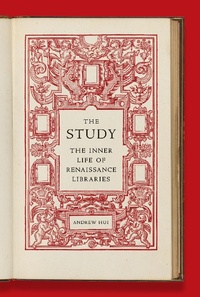
The Study
The Inner Life of Renaissance Libraries
1st Edition
Published on 3. December 2024
336 pages
978-0-691-24333-7 (ISBN)
Description

A uniquely personal account of the life and enduring legacy of the Renaissance library
With the advent of print in the fifteenth century, Europe's cultural elite assembled personal libraries as refuges from persecutions and pandemics. Andrew Hui tells the remarkable story of the Renaissance studiolo-a "little studio"-and reveals how these spaces dedicated to self-cultivation became both a remedy and a poison for the soul.
Blending fresh, insightful readings of literary and visual works with engaging accounts of his life as an insatiable bookworm, Hui traces how humanists from Petrarch to Machiavelli to Montaigne created their own intimate studies. He looks at imaginary libraries in Rabelais, Cervantes, Shakespeare, and Marlowe, and discusses how Renaissance painters depicted the Virgin Mary and St. Jerome as saintly bibliophiles. Yet writers of the period also saw a dark side to solitary reading. It drove Don Quixote to madness, Prospero to exile, and Faustus to perdition. Hui draws parallels with our own age of information surplus and charts the studiolo's influence on bibliographic fabulists like Jorge Luis Borges and Umberto Eco.
Beautifully illustrated, The Study is at once a celebration of bibliophilia and a critique of bibliomania. Incorporating perspectives on Islamic, Mughal, and Chinese book cultures, it offers a timely and eloquent meditation on the ways we read and misread today.
With the advent of print in the fifteenth century, Europe's cultural elite assembled personal libraries as refuges from persecutions and pandemics. Andrew Hui tells the remarkable story of the Renaissance studiolo-a "little studio"-and reveals how these spaces dedicated to self-cultivation became both a remedy and a poison for the soul.
Blending fresh, insightful readings of literary and visual works with engaging accounts of his life as an insatiable bookworm, Hui traces how humanists from Petrarch to Machiavelli to Montaigne created their own intimate studies. He looks at imaginary libraries in Rabelais, Cervantes, Shakespeare, and Marlowe, and discusses how Renaissance painters depicted the Virgin Mary and St. Jerome as saintly bibliophiles. Yet writers of the period also saw a dark side to solitary reading. It drove Don Quixote to madness, Prospero to exile, and Faustus to perdition. Hui draws parallels with our own age of information surplus and charts the studiolo's influence on bibliographic fabulists like Jorge Luis Borges and Umberto Eco.
Beautifully illustrated, The Study is at once a celebration of bibliophilia and a critique of bibliomania. Incorporating perspectives on Islamic, Mughal, and Chinese book cultures, it offers a timely and eloquent meditation on the ways we read and misread today.
More details
Other editions
Person
Andrew Hui is associate professor of humanities at Yale-NUS College, Singapore. He is the author of A Theory of the Aphorism: From Confucius to Twitter (Princeton) and The Poetics of Ruins in Renaissance Literature.
Content
- Cover
- Contents
- To the Reader
- Introduction
- Part I. Bibliophilia
- 1. Antiquity Face-to- Face
- 2. The Invention of the Studiolo
- 3. Bookishness and Sanctity
- Plates
- 4. How to Build a Library with Montaigne
- Part II. Bibliomania
- 5. Ark, Abyss, Abundance
- 6. The World as Text in Don Quixote
- 7. The Tempest as Wunderkammer
- 8. Faustus in His Study
- Epilogue: The Wordless Library
- Acknowledgments
- Bibliographic Essay
- Notes
- Image Credits
- Index
