

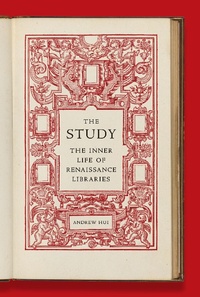
The Study
The Inner Life of Renaissance Libraries
Published on 3. December 2024
Book
Hardback
336 pages
978-0-691-24332-0 (ISBN)
Description
A uniquely personal account of the life and enduring legacy of the Renaissance library
With the advent of print in the fifteenth century, Europe's cultural elite assembled personal libraries as refuges from persecutions and pandemics. Andrew Hui tells the remarkable story of the Renaissance studiolo-a "little studio"-and reveals how these spaces dedicated to self-cultivation became both a remedy and a poison for the soul.
Blending fresh, insightful readings of literary and visual works with engaging accounts of his life as an insatiable bookworm, Hui traces how humanists from Petrarch to Machiavelli to Montaigne created their own intimate studies. He looks at imaginary libraries in Rabelais, Cervantes, Shakespeare, and Marlowe, and discusses how Renaissance painters depicted the Virgin Mary and St. Jerome as saintly bibliophiles. Yet writers of the period also saw a dark side to solitary reading. It drove Don Quixote to madness, Prospero to exile, and Faustus to perdition. Hui draws parallels with our own age of information surplus and charts the studiolo's influence on bibliographic fabulists like Jorge Luis Borges and Umberto Eco.
Beautifully illustrated, The Study is at once a celebration of bibliophilia and a critique of bibliomania. Incorporating perspectives on Islamic, Mughal, and Chinese book cultures, it offers a timely and eloquent meditation on the ways we read and misread today.
With the advent of print in the fifteenth century, Europe's cultural elite assembled personal libraries as refuges from persecutions and pandemics. Andrew Hui tells the remarkable story of the Renaissance studiolo-a "little studio"-and reveals how these spaces dedicated to self-cultivation became both a remedy and a poison for the soul.
Blending fresh, insightful readings of literary and visual works with engaging accounts of his life as an insatiable bookworm, Hui traces how humanists from Petrarch to Machiavelli to Montaigne created their own intimate studies. He looks at imaginary libraries in Rabelais, Cervantes, Shakespeare, and Marlowe, and discusses how Renaissance painters depicted the Virgin Mary and St. Jerome as saintly bibliophiles. Yet writers of the period also saw a dark side to solitary reading. It drove Don Quixote to madness, Prospero to exile, and Faustus to perdition. Hui draws parallels with our own age of information surplus and charts the studiolo's influence on bibliographic fabulists like Jorge Luis Borges and Umberto Eco.
Beautifully illustrated, The Study is at once a celebration of bibliophilia and a critique of bibliomania. Incorporating perspectives on Islamic, Mughal, and Chinese book cultures, it offers a timely and eloquent meditation on the ways we read and misread today.
Reviews / Votes
"[A] stimulating history. . . . Hui makes a convincing case that personal libraries were intimately bound up with Renaissance conceptions of selfhood. Bibliophiles will find much to ponder." * Publishers Weekly * "Impressively erudite, Hui has produced a substantial piece of scholarship. No avid and self-respecting bibliophile should be without this book set snugly on one of their study's many shelves." * Kirkus Reviews, starred review * "[A] delightful, wide-ranging work."---Michael O'Donnell, Wall Street Journal "This is undoubtedly a first class piece of academic research and it is. . .an emotional read - rather like reading about distant family or ancestors."---Terry Potter, The Letterpress Project "Hui's prose is elegant and deliberately styled, melding personal discourse with a considered aesthetic."---Ed Bedford, The Indiependent "[A] fascinating investigation into personal spaces and libraries of the Renaissance. . . . All book and library-loving readers will find passages of interest." * Choice Reviews * "Brilliant. . . . A delightful read that invokes feelings of escapism and intrigue, The Study is a book about bibliophiles for bibliophiles." * All About History * "An exquisite venture into the world of books - not merely as objects of knowledge, but as intimate companions in the intellectual lives of their owners. . . Deeply thoughtful and evocative."---Cassandra Fong, Redbrick "Hui's book is all the richer for its insistence on taking the reader, like a modern Mephistopheles, across the world."---Anthony Grafton, London Review of Books "Wide-ranging and erudite. . . . From the opening sentence, the work is humorously alive to the self-reflexive nature of reading and writing a book about reading and writing."---Ellen Werner, Modern Language Review "Hui's book is an exploration of the scholar's psyche as much as it is of the rooms they inhabited. . . . The result is not a systematic treatise but a "book of books" assembled from fragments, quotations, and reveries. In this sense, The Study itself becomes a kind of studiolo: eccentric, erudite, and quietly haunted by the ambivalence of its own intellectual inheritance. . . . For scholars of intellectual history, book culture, and the longue duree of humanistic inquiry, The Study offers a rich and idiosyncratic contribution."---Trude Dijkstra, History of HumanitiesMore details
Language
English
Place of publication
New Jersey
United States
Target group
College/higher education
Professional and scholarly
Product notice
Trade binding
Illustrations
22 color + 65 b/w illus.
Dimensions
Height: 237 mm
Width: 163 mm
Thickness: 30 mm
Weight
720 gr
ISBN-13
978-0-691-24332-0 (9780691243320)
Copyright in bibliographic data and cover images is held by Nielsen Book Services Limited or by the publishers or by their respective licensors: all rights reserved.
Schweitzer Classification
Other editions
Additional editions
E-Book
12/2024
1st Edition
Princeton University Press
€28.99
Available for download