

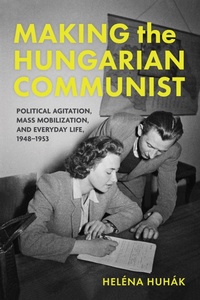
Making the Hungarian Communist
Description

How do political parties integrate propaganda into ordinary citizens' lives? After coming into power in 1948, the communist Hungarian Workers' Party (MDP) drew on tried-and-true Soviet methods of political outreach, mobilizing a network of agitators to circulate communist ideology and report their observations back to party leadership. These agitators produced maps, searched homes, and taught "petty bourgeois" self-criticism and "party-conform" love and hate.
Making the Hungarian Communist studies communist propaganda through the everyday actions of these rank-and-file agitators, offering a nuanced portrait of mass mobilization. Through extensive archival research and personal interviews, Heléna Huhák traces the formation of the agitators' network, the training they received, and the often-gendered language they used to connect communist ideology to people's lived experiences. As the dialogue between the state and ordinary citizens developed through these interactions, the boundaries between political issues and private family life began to blur for both citizens and agitators: far from the state's initial vision of one-way political influence, homes also became a space for advocacy, complaint, and bargaining. Communist Hungary was thus shaped not only by propaganda, but also by the experiences and interests of agitators and even "agitated people."
By focusing on the negotiations between local party functionaries and ordinary people, Making the Hungarian Communist reveals how the practices of agitation and propaganda mutually shaped Hungarian society and politics.
More details
Other editions
Additional editions
Persons
Heléna Huhák is a researcher at the Institute of History, ELTE Research Centre for the Humanities.
Content
Introduction
Part I: The Network and Its Training Program
1. The Document Factory
2. Tell Stories Like a Communist
3. The "Reality" of Reports
Part II: Mapping
4. Propaganda Versus Fieldwork
5. Public and Private Spaces
6. Agitation in Rural Areas
Part III: Language
7. The "Petit Bourgeois"
8. Holocaust Survivors
9. Women
Part IV: Communism on My Mind
10. The Janitor
11. The Controller
12. The Caregiver
Part V: Private Matters
13. The Coziness of Home
14. Complaints and Bargaining
Conclusion
Bibliography
Index
