

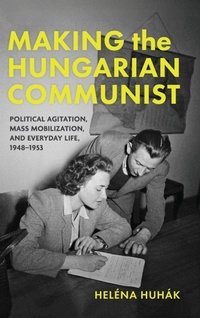
Making the Hungarian Communist
Political Agitation, Mass Mobilization, and Everyday Life, 1948-1953
Will be published approx. on 7. July 2026
Book
Hardback
366 pages
978-0-253-07600-7 (ISBN)
Description
How do political parties integrate propaganda into ordinary citizens' lives? After coming into power in 1948, the communist Hungarian Workers' Party (MDP) drew on tried-and-true Soviet methods of political outreach, mobilizing a network of agitators to circulate communist ideology and report their observations back to party leadership. These agitators produced maps, searched homes, and taught "petty bourgeois" self-criticism and "party-conform" love and hate.
Making the Hungarian Communist studies communist propaganda through the everyday actions of these rank-and-file agitators, offering a nuanced portrait of mass mobilization. Through extensive archival research and personal interviews, Helena Huhak traces the formation of the agitators' network, the training they received, and the often-gendered language they used to connect communist ideology to people's lived experiences. As the dialogue between the state and ordinary citizens developed through these interactions, the boundaries between political issues and private family life began to blur for both citizens and agitators: far from the state's initial vision of one-way political influence, homes also became a space for advocacy, complaint, and bargaining. Communist Hungary was thus shaped not only by propaganda, but also by the experiences and interests of agitators and even "agitated people."
By focusing on the negotiations between local party functionaries and ordinary people, Making the Hungarian Communist reveals how the practices of agitation and propaganda mutually shaped Hungarian society and politics.
Making the Hungarian Communist studies communist propaganda through the everyday actions of these rank-and-file agitators, offering a nuanced portrait of mass mobilization. Through extensive archival research and personal interviews, Helena Huhak traces the formation of the agitators' network, the training they received, and the often-gendered language they used to connect communist ideology to people's lived experiences. As the dialogue between the state and ordinary citizens developed through these interactions, the boundaries between political issues and private family life began to blur for both citizens and agitators: far from the state's initial vision of one-way political influence, homes also became a space for advocacy, complaint, and bargaining. Communist Hungary was thus shaped not only by propaganda, but also by the experiences and interests of agitators and even "agitated people."
By focusing on the negotiations between local party functionaries and ordinary people, Making the Hungarian Communist reveals how the practices of agitation and propaganda mutually shaped Hungarian society and politics.
Reviews / Votes
"Persuasively argued and meticulously researched, Making the Hungarian Communist restores human agency to what has often been described as state-imposed and formulaic propaganda campaigns. Through compelling stories of individual agitators and their diverse audiences during the Stalinist period in Hungary - including rural communities, middle-class urban residents, women, and Holocaust survivors - Helena Huhak reveals how central social relations, private spaces, and intimate conversations were to the construction of communism from the ground up."-Malgorzata Fidelis, author of Women, Communism, and Industrialization in Postwar Poland"Helena Huhak's masterful analysis of everyday agitation offers fascinating insights into the functioning of the Stalinist propaganda machine in Hungary in the 1950s. Rather than focusing on how propaganda was constructed, the book investigates how the messages of the communist party were distributed by individual agitators. By focusing on the lower rungs of propaganda, the book shows the limits of dictatorship, highlights the agency of agitators, and sheds light on the significance of everyday interactions between propagandists and their audience in the micro-milieus of Hungarian Stalinism."-Balazs Apor, author of The Leader Cult in Communist Dictatorships: Stalin and the Eastern Bloc
"Huhak's work gives us a new understanding what the Communist Party was, not by examining the characters, thoughts, and actions of the primary leaders . . . but by looking at the numerous functionaries."-Peter Kenez, author of Before the Uprising: Hungary under Communism, 1949-1956
More details
Series
Language
English
Other
Place of publication
Bloomington, IN
United States
Target group
Professional and scholarly
College/higher education
Illustrations
25 b&w illus.
Dimensions
Height: 229 mm
Width: 152 mm
Weight
644 gr
ISBN-13
978-0-253-07600-7 (9780253076007)
Copyright in bibliographic data and cover images is held by Nielsen Book Services Limited or by the publishers or by their respective licensors: all rights reserved.
Schweitzer Classification
Other editions
Additional editions
Heléna Huhák
Making the Hungarian Communist
Political Agitation, Mass Mobilization, and Everyday Life, 1948-1953
E-Book
approx. 07/2026
Indiana University Press
€53.99
Available for download
Persons
Helena Huhak is a researcher at the Institute of History, ELTE Research Centre for the Humanities.
Content
Introduction
Part I: The Network and Its Training Program
1. The Document Factory
2. Tell Stories Like a Communist
3. The "Reality" of Reports
Part II: Mapping
4. Propaganda Versus Fieldwork
5. Public and Private Spaces
6. Agitation in Rural Areas
Part III: Language
7. The "Petit Bourgeois"
8. Holocaust Survivors
9. Women
Part IV: Communism on My Mind
10. The Janitor
11. The Controller
12. The Caregiver
Part V: Private Matters
13. The Coziness of Home
14. Complaints and Bargaining
Conclusion
Bibliography
Index
Part I: The Network and Its Training Program
1. The Document Factory
2. Tell Stories Like a Communist
3. The "Reality" of Reports
Part II: Mapping
4. Propaganda Versus Fieldwork
5. Public and Private Spaces
6. Agitation in Rural Areas
Part III: Language
7. The "Petit Bourgeois"
8. Holocaust Survivors
9. Women
Part IV: Communism on My Mind
10. The Janitor
11. The Controller
12. The Caregiver
Part V: Private Matters
13. The Coziness of Home
14. Complaints and Bargaining
Conclusion
Bibliography
Index