

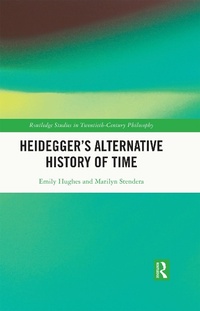
Heidegger's Alternative History of Time
1st Edition
Published on 2. April 2024
242 pages
978-1-040-01035-8 (ISBN)
Description

This book reconstructs Heidegger's philosophy of time by reading his work with and against a series of key interlocutors that he nominates as being central to his own critical history of time. In doing so, it explains what makes time of such significance for Heidegger and argues that Heidegger can contribute to contemporary debates in the philosophy of time.
Time is a central concern for Heidegger, yet his thinking on the subject is fragmented, making it difficult to grasp its depth, complexity, and promise. Heidegger traces out a history that focuses on the conceptualisations of time put forward by Aristotle, Plotinus, Augustine, Kant, Hegel, Bergson, and Husserl - an "alternative history of time" that challenges how time has been defined and studied within both philosophy and the sciences. This book explores what happens when we take seriously Heidegger's claim that these seven figures are essential to any understanding of time, setting out what this can tell us about existence, possibility, and philosophy as a historical discipline.
Heidegger's Alternative History of Time will appeal to scholars and advanced students working on Heidegger, phenomenology, the philosophy of time, and the history of philosophy.
Time is a central concern for Heidegger, yet his thinking on the subject is fragmented, making it difficult to grasp its depth, complexity, and promise. Heidegger traces out a history that focuses on the conceptualisations of time put forward by Aristotle, Plotinus, Augustine, Kant, Hegel, Bergson, and Husserl - an "alternative history of time" that challenges how time has been defined and studied within both philosophy and the sciences. This book explores what happens when we take seriously Heidegger's claim that these seven figures are essential to any understanding of time, setting out what this can tell us about existence, possibility, and philosophy as a historical discipline.
Heidegger's Alternative History of Time will appeal to scholars and advanced students working on Heidegger, phenomenology, the philosophy of time, and the history of philosophy.
More details
Series
Edition
1. Auflage
Language
English
Place of publication
London
United Kingdom
Publishing group
Taylor & Francis Ltd
Target group
College/higher education
ISBN-13
978-1-040-01035-8 (9781040010358)
Copyright in bibliographic data and cover images is held by Nielsen Book Services Limited or by the publishers or by their respective licensors: all rights reserved.
Schweitzer Classification
Other editions
Additional editions
Emily Hughes | Marilyn Stendera
Heidegger's Alternative History of Time
Book
09/2025
1st Edition
Routledge
€63.20
Shipment within 10-20 days
Emily Hughes | Marilyn Stendera
Heidegger's Alternative History of Time
Book
04/2024
1st Edition
Routledge
€193.80
Shipment within 10-20 days
Persons
Emily Hughes is a postdoctoral research associate in philosophy at the University of York working on the AHRC-funded project "Grief: A Study of Human Emotional Experience." Situated at the intersection of existential phenomenology and the philosophy of psychiatry and psychology, Emily has published widely on affective and temporal experience.
Marilyn Stendera is lecturer in philosophy at the University of Wollongong, Australia. She has previously held positions at Deakin University, Monash University, and the University of Melbourne, where she also completed her PhD (on intersections between Heidegger's account of temporality and contemporary debates in cognitive science). She also has degrees in German and Social Theory and is particularly interested in time, especially its role in cognition and its relationship to power.
Marilyn Stendera is lecturer in philosophy at the University of Wollongong, Australia. She has previously held positions at Deakin University, Monash University, and the University of Melbourne, where she also completed her PhD (on intersections between Heidegger's account of temporality and contemporary debates in cognitive science). She also has degrees in German and Social Theory and is particularly interested in time, especially its role in cognition and its relationship to power.
Content
Introduction Section 1: Ancient Thinkers Section 1 Preamble 1. Aristotle 2. Plotinus 3. Augustine Section 2: Early-modern and Modern Thinkers Section 2 Preamble 4. Kant 5. Hegel Section 3: Late-modern Thinkers Section 3 Preamble 6. Bergson 7. Husserl 8. Heidegger
