


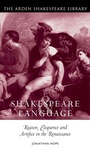
Shakespeare and Language: Reason, Eloquence and Artifice in the Renaissance
Description

'This book is nothing short of brilliant. It is bursting with new observations, pithy readings and sensitive analyses. One of Hope's skills is to show us that 'language' is not separable from 'ideas'; both are systems of representation. This is a book about words, conventions, artifice, mythology, innovation, reason, eloquence, silence, control, communication, selfhood, dialect, 'late style' and much, much more. After reading Hope's book you will never read Shakespeare in the same way.' (Professor Laurie Maguire, Magdalen College, Oxford)
Our understanding of words, and how they get their meanings, relies on a stable spelling system and dictionary definitions - things which simply did not exist in the Renaissance. At that time, language was speech rather than writing; a word was by definition a collection of sounds not letters - and the consequences of this run deep. They explain our culture's inability to fully appreciate Shakespeare's wordplay and they also account for the rift that opened up between Shakespeare and us as language came to be regarded as essentially 'written'.
In Shakespeare and Language, Jonathan Hope considers the ideas about language that separate us from Shakespeare. His comprehensive study explores the visual iconography of language in the Renaissance, the influence of the rhetorical tradition, the extent to which Shakespeare's late style is driven by a desire to increase the subjective content of the text, and contemporary ways of studying his language using computers.
More details
Other editions
Additional editions
Person
Content
- Cover
- CONTENTS
- PREFACE
- A NOTE ON TEXTS
- LIST OF ILLUSTRATIONS
- LIST OF TABLES
- Chapter One: Ideas about Language in the Renaissance
- Chapter Two: Ideas about Language in Shakespeare 1: Discourse, Artifice and Silence
- Chapter Three: Ideas about Language in Shakespeare 2: Words
- Chapter Four: Fritters of English: Variation and Linguistic Judgement
- Chapter Five: Agency and Uncertainty in Shakespeare's Syntax
- Chapter Six The Language of Genre
- AFTERWORD: TOKYO, MARCH 2010
- NOTES
- BIBLIOGRAPHY
- INDEX
- A
- B
- C
- D
- E
- F
- G
- H
- I
- J
- K
- L
- M
- N
- O
- P
- Q
- R
- S
- T
- U
- V
- W
