

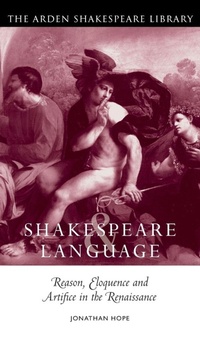
Shakespeare and Language: Reason, Eloquence and Artifice in the Renaissance
Reason, Eloquence and Artifice in the Renaissance
Published on 15. October 2010
Book
Hardback
272 pages
978-1-904271-69-7 (ISBN)
Description
'Much drink may be said to be an equivocator with lechery: it makes him, and it mars him; it sets him on, and it takes him off; it persuades him, and disheartens him; makes him stand to, and not stand to: in conclusion, equivocates him in a sleep, and, giving him the lie, leaves him.' Porter, Macbeth, II i. Why would Elizabethan audiences find Shakespeare's Porter in Macbeth so funny? And what exactly is meant by the name the 'Weird' Sisters? Jonathan Hope, in a comprehensive and fascinating study, looks at how the concept of words meant something entirely different to Elizabethan audiences than they do to us today. In Shakespeare and Language: Reason, Eloquence and Artifice in the Renaissance, he traces the ideas about language that separate us from Shakespeare. Our understanding of 'words', and how they get their meanings, based on a stable spelling system and dictionary definitions, simply does not hold. Language in the Renaissance was speech rather than writing - for most writers at the time, a 'word' was by definition a collection of sounds, not letters - and the consequences of this run deep.
They explain our culture's inability to appreciate Shakespeare's wordplay, and suggest that a rift opened up in the seventeenth century as language came to be regarded as essentially 'written'. The book also considers the visual iconography of language in the Renaissance, the influence of the rhetorical tradition, the extent to which Shakespeare's late style is driven by a desire to increase the subjective content of the text, and new ways of studying Shakespeare's language using computers. As such it will be of great interest to all serious students and teachers of Shakespeare. Despite the complexity of its subject matter, the book is accessibly written with an undergraduate readership in mind.
They explain our culture's inability to appreciate Shakespeare's wordplay, and suggest that a rift opened up in the seventeenth century as language came to be regarded as essentially 'written'. The book also considers the visual iconography of language in the Renaissance, the influence of the rhetorical tradition, the extent to which Shakespeare's late style is driven by a desire to increase the subjective content of the text, and new ways of studying Shakespeare's language using computers. As such it will be of great interest to all serious students and teachers of Shakespeare. Despite the complexity of its subject matter, the book is accessibly written with an undergraduate readership in mind.
More details
Language
English
Place of publication
London
United Kingdom
Publishing group
Bloomsbury Publishing PLC
Target group
Professional and scholarly
Dimensions
Height: 209 mm
Width: 132 mm
Thickness: 18 mm
Weight
378 gr
ISBN-13
978-1-904271-69-7 (9781904271697)
Copyright in bibliographic data and cover images is held by Nielsen Book Services Limited or by the publishers or by their respective licensors: all rights reserved.
Schweitzer Classification
Other editions
Additional editions
E-Book
09/2014
1st Edition
The Arden Shakespeare
€105.99
Available for download
E-Book
09/2014
1st Edition
The Arden Shakespeare
€105.99
Available for download