

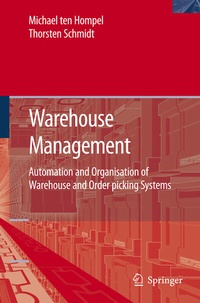
Warehouse Management
Description

Modern warehouse and distribution systems constitute highly complex nodes within the value-added supply chain and have to meet a variety of requirements with regard to time, costs and quality. The efficient operation of such systems is a continuous challenge for anyone in charge. Recent developments of advanced computer-based control technologies have contributed to development of the necessary control and management systems called Warehouse Management Systems (WMS). Nevertheless, due to the high complexity, users often find it hard to handle WMS. The design, choice and operation of a WMS requires extensive know-how and experience because of the large variety of solutions and system requirements. This book gives an overview of possible solutions which help readers to make the right choice. It presents the background and potential, but also the risks and strategies to handle them. It sets the basis for comparisons for all those readers who are responsible for the evaluation and specification of warehouse management systems. Furthermore, it is meant as basic support for students and interested beginners. This book is based on practical knowledge without neglecting the basic context or assuming special technical knowledge. Some basic processes and technologies that are required for a better understanding are described in detail. System-developers will find some new ideas when problems and limits of current developments are discussed. New approaches with regard to the structure and design of WMS are presented.
Readers can expect a simple and well-documented explantion of WMS based on the open-source initiative myWMS. The software can be operated on a common PC independent of the platform and without any obligatory user login data. Thus, the operation, function and benefits of a WMS can be visualized.
More details
Other editions
New editions
Additional editions
Persons
Content
Automation comprises the independent operation of a technical system in line with high performance and economy. With regard to computer-aided and thus mostly stand-alone functions, warehouse management is also a part of automation, however on a superior business management level (cf. Chapter 2 and 7). Here, above all the strategic and anticipated warehouse and distribution functions are automated.
The automation of the material flow aims at controlling and supervising the operative handling of the material flow. This chapter describes the basics of the material flow automation. Based on a hierarchical classification, we present first the main terms, requirements and tasks. The main elements of an automation technology are the control, sensors and drives to record and influence the material flow processes. The basic structure and functioning of the devices is described in the example of a typical application.
5.1 Basics of automation
Technological and economical aspects affect the technical design and operation of material flow systems and in many cases offer a possibility for automation. Although these requirements di.er from case to case the goals are identical:
- Improved system performance (transshipment rate, shorter order lead times)
- Quality assurance (continuous quality of the products and processes, observance of deadlines)
- Cost savings
- Relief of personnel from uniform, strenuous activities
Whether or not these requirements are met mainly depends on the choice, dimensioning and arrangement of the function areas in the warehouse as well as the used conveyors and storage facilities (cf. Chapter 4). The main task of the automation technology is to ensure the smooth functioning of the single conveyors and storage facilities or their components and to coordinate interlinked systems.
Automation does not always make sense since manual solutions may be more simple or economical. An alternative to the in-house transport of pallets, for example, are the manual transport with a hand pallet truck, a semi-automated transport by stacker or the fully automated transport on driven conveyor belts and automated guided transport systems. Which solution should be preferred depends on the frame conditions set by the overall system and is not studied in detail here.
5.1.1 History of the material flow automation
Modern automation technology was largely affected by inventions in the field of electrical engineering and electronics some of which are listed below (cf. Table 5.1). Obviously, computer-aided data processing has had a considerable in.uence on the development of the modern automation technology, above all the development of microprocessors and the introduction of standardized computer architectures [24].
Almost all digital controls which are currently used in material flow technology are based on these principles. Advanced processors and memories in line with an increasing integration of electronic components set the basis for systems the size of a check card and the performance of a common PC. In addition to central process computers, more and more mobile PC and handheld devices are being used. These are described in more detail in section 5.2.3.
