

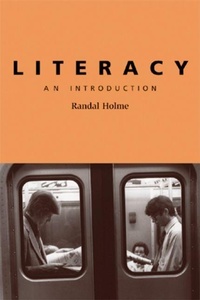
Literacy
An Introduction
1st Edition
Published on 31. July 2019
280 pages
978-1-4744-6926-5 (ISBN)
Description

Literacy studies is a growing field within applied linguistics, education and media studies. Despite the field's new prominence, current treatments are often weighted towards the propagation of a particular view or approach. This book provides a more balanced understanding, arguing that:*literacy must be examined through a balance of approaches if we are to appreciate its true nature*literacy cannot be described simply as situated, social activity*literacy is the sign systems and the uses of language that foster and reflect its social existence. *literacy is a property of mind.The book helps the reader to understand some of the currents of thought, whether post modernist, cognitivist, or Vygotskian, on which its larger analysis is based. Written in an engaging and lucid style, it contains a glossary and exercises to help and develop the reader's understanding.
More details
Other editions
Additional editions
Book
10/2004
Edinburgh University Press
€45.50
Shipment within 15-20 days
Content
- Intro
- Contents
- List of figures
- Introduction
- The elusive nature of literacy
- Analogical literacies
- The socio-economic nature of literacy
- Literacy's use of sign-systems
- Literacy's use of language
- Literarcy and mind
- The many-fold nature of literacy
- PART I: THE SOCIO-ECONOMIC NATURE OF LITERACY
- Chapter 1 Functional Literacy
- Introduction
- Literacy and economy
- Functionality and social change: the lliteracy campaign
- Functionality and economy
- Functionality and development economics
- Functional literacy in the developed world
- Functional literacy and social exclusion
- Problems with the idea of a functional literacy
- Problems with functional literacy: the economic impact
- How do we construct literacy according to what it allows us to do?
- The problem of treating literacy as a set of competencies: the need for a cultural literacy
- Conclusions
- Chapter 2 Critical Literacy
- Introduction
- Two tenets of post-modernism
- Post-moderism and minority movements
- Who we arer shapes how we see: we have no final vocabulary
- Critical discourse analysis
- Systemic functional linguistics
- Metaphor and critical literacy
- Towards a participatory pedagogy
- Critical literacy in practice
- Difficulties with critical literacy
- If 'there is nothing outside the text', how do we know anything?
- Problems with the concept of criticality
- Conclusions
- Chapter 3 From Literacy to Literacies
- Introduction
- Social practice: literacy practice
- The practice as a context of use
- The variety and history o fliteracy practices
- Conclusions
- Chapter 4 Literacy and Language Choice
- Introduction
- Why there is a language choice
- Responding to the language-choice question
- Attitudes to language
- Bilingualism and biliteracy
- How the use of language is predicted upon economic, political and military power relationships
- Conclusions
- PART II: SIGN
- Chapter 5 Understanding Sign
- Introduction
- The nature of sign
- Differenct kinds of sign
- Signs and the development of pre-writing
- Symbol interpretation: categories and prototype theory
- Symbol manipulation: the importance of metonymy
- Metonymn and indexical signs
- Conclusions
- 6 Writing
- Introduction
- Writing systems
- The alphabet
- The syllabary
- Distinguishing syllabaries from alphabets
- The Chinese writing system: a morphpsyllabic script?
- Writing and non-writing: semasiographic systems
- Conventional and iconic seamasiographic systems: the role of metonymy in visual meaning representation
- Conclusions
- 7 Writing through Time
- Introduction
- From accidental to motivated sign-creation
- Early writing systems
- The evolution of the alphabet
- Conclusions
- 8 The Nature of Writing
- Introduction
- Writing systems as technological solutions
- Successful writing systems must represent speech
- The question of phonocentrism and the centrality of writing
- Conclusions
- PART III: THE LANGUAGE OF LITERACY
- 9 Basic Differences between Speech and Writing
- Introduction
- Personal vs. interpersonal
- Monologue vs. dialogue
- Durable vs. ephemeral
- Contextualised vs. decontextualised
- Scannable vs. linearly accessible
- Planned/highly structured vs. spontaneous/loosely structured
- Syntactically complex vs. syntactically simple
- Concerned with past and future not the present
- Formal vs. informal
- Expository- and argument-oriented vs. event- and narrative-oriented
- Abstract vs. concrete
- Syntactically and morphologically complete
- Conclusions
- 10 Dimensions of Difference between Spoken and Written Language
- Introduction
- What is a dimension of difference?
- Narrative vs. non-narrative concerns
- Explicit vs. situation-dependent reference
- Persuasion
- Higher lexical varieties
- Informational elaboration under strict, real-time conditions
- Conclusions
- 11 Written Language in Context
- Introduction
- Understanding genre
- Grammatical metaphor as an expression of how regrister and genre affect text
- Looking at text
- Conclusions
- PART IV LITERARY AS MIND
- 12 Social Practice and a Socio-historical Theory of Mind
- Introduction
- A socio-historical construction of mind
- The zone of proximal development
- Conclusions
- 13 Great Divide Theory
- Introduction
- The historical Great Divide
- The psychological Greats Divide
- Literacy practices and Vygotsky's view of mind
- Scaffolding with literacy practices
- Conclusions
- 14 Literacy and Patterns of Mind
- Introduction
- Frame theory
- Script theory
- Schema theory and narrative frames
- Genre, schema and literary practice
- Image schema
- Conclusions
- 15 PART V CONCLUSIONS
- 15 The Social Nature of Literacy
- Introduction
- Literacy as skill, practice and socio-economic function
- Participatory appraisal: the model in practice
- Text as a forum of the literacy practice
- Conclusions
- Glossary
- References
- Index
