

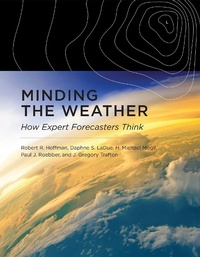
Minding the Weather
Description

This book argues that the human cognition system is the least understood, yet probably most important, component of forecasting accuracy. Minding the Weather investigates how people acquire massive and highly organized knowledge and develop the reasoning skills and strategies that enable them to achieve the highest levels of performance.
The authors consider such topics as the forecasting workplace; atmospheric scientists' descriptions of their reasoning strategies; the nature of expertise; forecaster knowledge, perceptual skills, and reasoning; and expert systems designed to imitate forecaster reasoning. Drawing on research in cognitive science, meteorology, and computer science, the authors argue that forecasting involves an interdependence of humans and technologies. Human expertise will always be necessary.
More details
Other editions
Additional editions
Persons
Daphne S. LaDue is a Research Scientist at the University of Oklahoma's Center for Analysis and Prediction of Storms and Director of the Research Experiences for Undergraduates Program at the National Weather Center in Norman, Oklahoma.
H. Michael Mogil is currently a consulting meteorologist focusing on meteorological education in the primary and secondary school systems.
Paul J. Roebber is Distinguished Professor of Atmospheric Sciences at the University of Wisconsin-Milwaukee.
J. Gregory Trafton is Cognitive Scientist at the Naval Research Laboratory in Washington, D.C.
Content
Preface xi
Acknowledgments xiii
1 Introduction 1
2 What Is the Forecasting Workspace Like? 27
3 How Do People Come to Be Forecasters? 49
4 How Do Forecasters Describe How They Reason? 81
5 How Well Do Forecasters (and Forecasts) Perform? 101
6 What Characterizes Expertise? 129
7 How Do Forecasters Get to Be Expert Forecasters? 151
8 What Does Research on Forecaster Knowledge Tell Us? 191
9 What Does Research on Forecaster Perception Tell Us? 211
10 What Does Research on Forecaster Reasoning Tell Us? 243
11 Can a Machine Imitate the Human? 287
12 Can a Machine Replace the Human? 305
13 Forecaster-Computer Interdependence 337
14 Conclusions and Prospects 349
Appendix A: List of Acronyms 361
Appendix B: Extended Narratives of Two Cases of Forecasting Severe Weather 365
Appendix C: Example Synoptic Analyses of GOES Visible Images 389
Appendix D: A Case Study in Human-Machine Interdependence 395
Appendix E: References on Visualization Design and Display Technology 399
References 409
Index 463
