

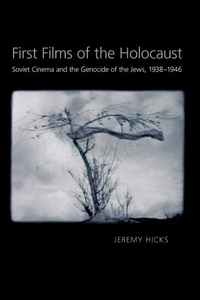
First Films of the Holocaust
Soviet Cinema and the Genocide of the Jews, 1938-1946
Published on 3. December 2019
313 pages
978-0-8229-7808-4 (ISBN)
Description

Most early Western perceptions of the Holocaust were based on newsreels filmed during the Allied liberation of Germany in 1945. Little, however, was reported of the initial wave of material from Soviet filmmakers, who were in fact the first to document these horrors. In First Films of the Holocaust, Jeremy Hicks presents a pioneering study of Soviet contributions to the growing public awareness of the horrors of Nazi rule.
Even before the war, the Soviet film Professor Mamlock, which premiered in the United States in 1938 and coincided with the Kristallnacht pogrom, helped reinforce anti-Nazi sentiment. Yet, Soviet films were often dismissed or even banned in the West as Communist propaganda. Ironically, in the brief 1939-1941 period of Nazi and Soviet alliance, such films were also banned in the Soviet Union, only to be reclaimed after the Nazi attack on the Soviet Union in 1941, and suppressed yet again during the Cold War.
Jeremy Hicks recovers much of the major film work in Soviet depictions of the Holocaust and views them within their political context, both locally and internationally. Overwhelmingly, wartime films were skewed to depict Soviet resistance, "Red funerals," and calls for vengeance, rather than the singling out of Jewish victims by the Nazis. Almost no personal testimony of victims or synchronous sound was recorded, furthering the disconnection of the viewer to the victims.
Hicks examines correspondence, scripts, reviews, and compares edited with unedited film to unearth the deliberately hidden Jewish aspects of Soviet depictions of the German invasion and occupation. To Hicks, it's in the silences, gaps, and ellipses that the films speak most clearly. Additionally, he details the reasons why Soviet Holocaust films have been subsequently erased from collective memory in the West and the Soviet Union: their graphic horror, their use as propaganda tools, and the postwar rise of the Red Scare in the United States and anti-Semitic campaigns in the Soviet Union.
Even before the war, the Soviet film Professor Mamlock, which premiered in the United States in 1938 and coincided with the Kristallnacht pogrom, helped reinforce anti-Nazi sentiment. Yet, Soviet films were often dismissed or even banned in the West as Communist propaganda. Ironically, in the brief 1939-1941 period of Nazi and Soviet alliance, such films were also banned in the Soviet Union, only to be reclaimed after the Nazi attack on the Soviet Union in 1941, and suppressed yet again during the Cold War.
Jeremy Hicks recovers much of the major film work in Soviet depictions of the Holocaust and views them within their political context, both locally and internationally. Overwhelmingly, wartime films were skewed to depict Soviet resistance, "Red funerals," and calls for vengeance, rather than the singling out of Jewish victims by the Nazis. Almost no personal testimony of victims or synchronous sound was recorded, furthering the disconnection of the viewer to the victims.
Hicks examines correspondence, scripts, reviews, and compares edited with unedited film to unearth the deliberately hidden Jewish aspects of Soviet depictions of the German invasion and occupation. To Hicks, it's in the silences, gaps, and ellipses that the films speak most clearly. Additionally, he details the reasons why Soviet Holocaust films have been subsequently erased from collective memory in the West and the Soviet Union: their graphic horror, their use as propaganda tools, and the postwar rise of the Red Scare in the United States and anti-Semitic campaigns in the Soviet Union.
More details
Other editions
Additional editions
Book
11/2012
University of Pittsburgh Press
€58.00
Article not available at the moment
Person
Jeremy Hicks is professor of Russian culture and film at Queen Mary University of London. He is the author of First Films of the Holocaust, Dziga Vertov: Defining Documentary Film, and Mikhail Zoshchenko and the Poetics of Skaz.
Content
- Intro
- Contents
- Acknowledgments
- A Note on Transliteration
- Introduction
- 1. "Right off the Top of the News": Professor Mamlock and Soviet Antifascist Film
- 2. "The Beasts Have Taken Aim at Us": Soviet Newsreels Screen the War and the Holocaust
- 3. Imagining Occupation: Partisans and Spectral Jews
- 4. Dovzhenko: Moving the Boundaries of the Acceptable
- 5. Mark Donskoi's Reconstruction of Babyi Iar: The Unvanquished
- 6. Liberation of the Camps
- 7. "The Dead Never Lie": Soviet Film, the Nuremberg Tribunal, and the Holocaust
- Epilogue
- Notes
- Bibliography
- Filmography
- Index
