

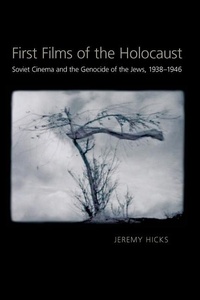
First Films of the Holocaust
Soviet Cinema and the Genocide of the Jews, 1938-1946
Will be published approx. on 15. November 2012
Book
Paperback/Softback
312 pages
978-0-8229-6224-3 (ISBN)
Description
Most early Western perceptions of the Holocaust were based on newsreels filmed during the Allied liberation of Germany in 1945. Little, however, was reported of the initial wave of material from Soviet filmmakers, who were in fact the first to document these horrors. In First Films of the Holocaust, Jeremy Hicks presents a pioneering study of Soviet contributions to the growing public awareness of the horrors of Nazi rule.
Even before the war, the Soviet film Professor Mamlock, which premiered in the United States in 1938 and coincided with the Kristallnacht pogrom, helped reinforce anti-Nazi sentiment. Yet, Soviet films were often dismissed or even banned in the West as Communist propaganda. Ironically, in the brief 1939-1941 period of Nazi and Soviet alliance, such films were also banned in the Soviet Union, only to be reclaimed after the Nazi attack on the Soviet Union in 1941, and suppressed yet again during the Cold War.
Jeremy Hicks recovers much of the major film work in Soviet depictions of the Holocaust and views them within their political context, both locally and internationally. Overwhelmingly, wartime films were skewed to depict Soviet resistance, \u201cRed funerals,\u201d and calls for vengeance, rather than the singling out of Jewish victims by the Nazis. Almost no personal testimony of victims or synchronous sound was recorded, furthering the disconnection of the viewer to the victims.
Hicks examines correspondence, scripts, reviews, and compares edited with unedited film to unearth the deliberately hidden Jewish aspects of Soviet depictions of the German invasion and occupation. To Hicks, it's in the silences, gaps, and ellipses that the films speak most clearly. Additionally, he details the reasons why Soviet Holocaust films have been subsequently erased from collective memory in the West and the Soviet Union: their graphic horror, their use as propaganda tools, and the postwar rise of the Red Scare in the United States and anti-Semitic campaigns in the Soviet Union.
Even before the war, the Soviet film Professor Mamlock, which premiered in the United States in 1938 and coincided with the Kristallnacht pogrom, helped reinforce anti-Nazi sentiment. Yet, Soviet films were often dismissed or even banned in the West as Communist propaganda. Ironically, in the brief 1939-1941 period of Nazi and Soviet alliance, such films were also banned in the Soviet Union, only to be reclaimed after the Nazi attack on the Soviet Union in 1941, and suppressed yet again during the Cold War.
Jeremy Hicks recovers much of the major film work in Soviet depictions of the Holocaust and views them within their political context, both locally and internationally. Overwhelmingly, wartime films were skewed to depict Soviet resistance, \u201cRed funerals,\u201d and calls for vengeance, rather than the singling out of Jewish victims by the Nazis. Almost no personal testimony of victims or synchronous sound was recorded, furthering the disconnection of the viewer to the victims.
Hicks examines correspondence, scripts, reviews, and compares edited with unedited film to unearth the deliberately hidden Jewish aspects of Soviet depictions of the German invasion and occupation. To Hicks, it's in the silences, gaps, and ellipses that the films speak most clearly. Additionally, he details the reasons why Soviet Holocaust films have been subsequently erased from collective memory in the West and the Soviet Union: their graphic horror, their use as propaganda tools, and the postwar rise of the Red Scare in the United States and anti-Semitic campaigns in the Soviet Union.
Reviews / Votes
"First Films of the Holocaust tackles a little known but deeply important subject-Soviet filmmakers, who were the first ones to visualize the mass murder of Jews and others on the Eastern front, the event we now call the Holocaust. In this important book, Jeremy Hicks shows how the filmmakers documented their horrible subject and then how the Soviet government used this frightening footage to galvanize a population. A fusion of film analysis and history, this book will be a must-have for anyone interested in filmic representations of the Holocaust." * David Shneer, University of Colorado * Words like 'pioneering' and 'foundational' aptly describe Hick's extraordinary account of the long-forgotten but historically important corpus of Soviet documentary and fiction films about Nazi atrocities. . . . Splendid archival research and an excellent filmography make this a superb resource for students of history as well as film. Essential. * <i>Choice</i> * Feeling utterly satisfied with a book after finishing it is a very rare thing, and if a glaring gap in the historiography is filled, that satisfaction goes together with an impression of scientific achievement. This is exactly how I felt after reading ['First Films of the Holocaust']. . . .It is my belief that the author's clear and convincing presentation shall reinstate these images in the field of international studies of the Holocaust, since they form a crucial chapter of the history of Soviet cinema. * <i>Studies in Russian and Soviet Cinema</i> * Hick's analysis of the narrative tropes of the first films of the Holocaust helps illuminate the visual discourse of the Holocaust and provides documentation about the Holocaust itself. Despite its difficult, traumatic subject matter, the book is very easy to read. A valuable, well-organized, and well-researched source of information about Russian cinema of this period. * <i>Slavic and East European Journal</i> * Significantly expands our understanding of the Holocaust, both in the East and in the West. * <i>The Russian Review</i> *More details
Series
Language
English
Place of publication
Pittsburgh PA
United States
Target group
College/higher education
Product notice
Paperback (trade)
Dimensions
Height: 228 mm
Width: 154 mm
Thickness: 17 mm
Weight
579 gr
ISBN-13
978-0-8229-6224-3 (9780822962243)
Copyright in bibliographic data and cover images is held by Nielsen Book Services Limited or by the publishers or by their respective licensors: all rights reserved.
Schweitzer Classification
Other editions
Additional editions
E-Book
12/2019
David & Charles
€58.99
Available for download