

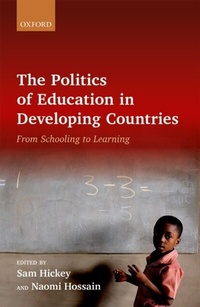
The Politics of Education in Developing Countries
From Schooling to Learning
1st Edition
Published on 21. February 2019
316 pages
978-0-19-257260-8 (ISBN)
Description

Why have many developing countries that have succeeded in expanding access to education made such limited progress on improving learning outcomes? There is a growing recognition that the learning crisis constitutes a significant dimension of global inequality and also that educational outcomes in developing countries are shaped by political as well as socio-economic and other factors. The Politics of Education in Developing Countries focuses on how politics shapes the capacity and commitment of elites to tackle the learning crisis in six developing countries: Bangladesh, Cambodia, Ghana, Rwanda, South Africa, and Uganda.
The problem of education quality is serious across the Global South. The Politics of Education in Developing Countries: From Schooling to Learning deploys a new conceptual framework-the domains of power approach-to show how the type of political settlement shapes the level of elite commitment and state capacity to improving learning outcomes. The domain of education is prone to being highly politicized, as it offers an important source of both rents and legitimacy to political elites, and can be central to paradigmatic elite ideas around nation-building and modernity. Of particular importance is the relative strength of coalitions pushing for access as against those focused on issues of higher quality education. This book concludes with a discussion of entry points and strategies for thinking and working politically in relation to education quality reforms and critical commentaries.
More details
Other editions
Additional editions
Sam Hickey | Naomi Hossain
The Politics of Education in Developing Countries
From Schooling to Learning
Book
03/2019
Oxford University Press
€124.70
Shipment within 15-20 days
Persons
Sam Hickey is Professor of Politics and Development in the Global Development Institute, University of Manchester, and Research Director of the DFID-UK-funded Effective States and Inclusive Development (ESID) Research Centre. His recent work on the politics of development has been published in African Affairs, Journal of Development Studies, and World Development. He has edited or co-edited six collections, including The Politics of Inclusive Development: Interrogating the Evidence (Oxford University Press, 2015, with Kunal Sen and Badru Bukenya).
Naomi Hossain is a political sociologist and Research Fellow at the Institute of Development Studies at the University of Sussex. Her work focuses on the state-society relations that make pro-poor development possible, with a focus on the provision of food security, mass education, and social protection. She is the author of The Aid Lab: Understanding Bangladesh's Unexpected Success (OUP, 2017).
Content
- Cover
- The Politics of Education in Developing Countries: From Schooling to Learning
- Copyright
- Dedication
- Preface and Acknowledgements
- Contents
- List of Figures
- List of Tables
- List of Abbreviations
- List of Contributors
- 1: The Problem of Education Quality in Developing Countries
- Introduction
- The Global Learning Crisis
- Roots of the Learning Crisis: Lessons from Efforts at Reform
- Understanding the Political Economy of Education Quality Reforms
- Conclusion: Understanding Education Quality Reform Demandsa Political Approach
- References
- 2: Researching the Politics of Education Quality in Developing Countries: Towards a New Conceptual and Methodological Approach
- Introduction
- Rethinking the Politics of Education: A 'Domains of Power' Approach
- Political Settlements
- Policy Domains
- The Cross-cutting Role of Ideas
- Researching the Politics of Education
- Process Tracing and Comparative Case Study Analysis
- Conclusion
- References
- 3: Decentralization and Teacher Accountability: The Political Settlement and Sub-national Governance in Ghana's Education Sector
- Introduction
- The Political Settlement and the Education Sector in Ghana
- Mapping Key Actors within Decentralized Education Governance in Ghana
- The Politics of Education in Ghana: A District- and School-level Analysis
- The Politics of Tackling Teacher Absenteeism in Ghana: The Role of Coalitions
- Significance of Political Competition
- The Roles of District-level 'Developmental Coalitions'
- Community-level Dynamics
- Conclusion
- References
- 4: The Politics of Learning Reforms in Bangladesh
- Introduction
- The Problem of Education Quality in Bangladesh
- Political Settlement and Education Policy
- Elite Consensus on Mass Education across Political Settlements
- Demand for Skills: Weak Support from Business
- Teachers and Schools in the Political Settlement
- Party Political Competitive and Local Clientelistic Pressures
- Education Policy Reforms
- Recent Reforms: PEDP3
- National Level
- Field Administration
- Reforms at the School Level
- Conclusion
- References
- 5: The Downsides of Dominance: Education Quality Reforms and Rwanda's Political Settlement
- Introduction
- The Political Settlement and the Education Policy Domain
- Education Reform and Quality
- The Switch from French to English: Causes and Effects
- Training of Primary School Teachers
- Frontline School Management and Performance
- Urban District
- HIGH-PERFORMING SCHOOL IN THE URBAN DISTRICT
- LOW-PERFORMING SCHOOL IN THE URBAN DISTRICT
- Rural District
- HIGH-PERFORMING SCHOOL IN THE RURAL DISTRICT
- LOW-PERFORMING SCHOOL IN THE RURAL DISTRICT
- Discussion and Conclusions
- References
- 6: Political Transformation and Education Sector Performance in South Africa
- Introduction
- Education Outcomes: South Africa's Quality Challenge
- The National Level: Political Settlements and Policymaking
- The Provincial Level: Divergent Contexts, Divergent Bureaucratic Capabilities
- Demand-side Pressures for Performance
- Politics, Institutional Inheritances, and the Supply of Services
- Is Bureaucracy Destiny? Educational Outcomes and School-level Governance
- Assessing the Determinants of Educational Outcomes
- School-level Governance Dynamics
- Conclusion
- References
- 7: The Political Economy of Primary Education Reform in Cambodia
- Introduction
- The Politics of Education Policy in Cambodia
- Sihanouk Dominant (1953-70)
- Khmer Rouge Dominant (1975-9)
- Kampuchean People's Revolutionary Party Dominant (1979-89)
- Competitive Power Sharing (1991-8)
- CPP Dominant, 1998-2013
- The Politics of Cambodia's Education Domain, 1998-2013
- Child Friendly Schools
- Teacher Quality in Cambodia
- The Teacher Policy Action Plan
- Conclusion
- References
- 8: The Political Economy of Education Quality Initiatives in Uganda
- Introduction
- The Problem of Education Quality in Uganda
- The Political Settlement and the Education Policy Domain
- Education Policy Reforms Aimed at Improving Learning: Implementation at National and Local Levels
- Decentralized Rent Management
- The Policy Legacy of Fee-free Education
- Weak Policy Coalitions to Push through Quality-focused Reforms
- Variation in School Performance
- Conclusion
- References
- 9: Identifying the Political Drivers of Quality Education: A Comparative Analysis
- Introduction
- Elite Commitment to Education Reform is Shaped by the Political Settlement
- Informal Power and Politics are Critical
- Diverse Actors Play Important Roles
- Levels of Political Competition Influence the Incentives and Constraints to Reform
- Political Competition and Dominance Influence Reforms in Complex Ways
- We Need to Acknowledge Idiosyncratic Factors
- Elite Cohesion, Drivers and Limits to Education Reform
- Weak Coalitions for Quality Reform
- Rents and Competitive Pressures
- Political Dominance: Constraints and Opportunities
- Institutional and Policy Legacies
- Understanding Micro Variations in Education
- Accountability and Local-level Partnerships
- Citizen-State Relations: The Sociology of Schools
- Human Resource Capacity
- Strategic and Analytical Implications
- Realigning the Reform Agenda within Political Settlements
- Building Coalitions
- Decentralization and Accountability
- Local-level Initiatives
- Conclusion
- References
- 10: Understanding the Politics of the Learning Crisis: Steps Ahead on a Long Road
- From Schooling to Learning
- Policy Domains
- Political Settlement
- References
- 11: Similarities and Differences in Policy Reform Destinies: What Do Political Settlements and Domain Politics Explain?
- A General Story of Similarities
- A Particular Story of Differences
- When Politics Defeats Policy, What Can Be Done?
- References
- Index
