

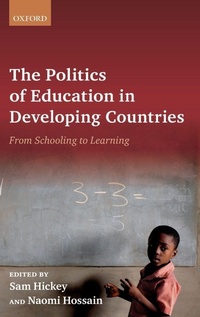
The Politics of Education in Developing Countries
From Schooling to Learning
Published on 22. March 2019
Book
Hardback
256 pages
978-0-19-883568-4 (ISBN)
Description
Why have many developing countries that have succeeded in expanding access to education made such limited progress on improving learning outcomes? There is a growing recognition that the learning crisis constitutes a significant dimension of global inequality and also that educational outcomes in developing countries are shaped by political as well as socio-economic and other factors. The Politics of Education in Developing Countries focuses on how politics shapes the capacity and commitment of elites to tackle the learning crisis in six developing countries: Bangladesh, Cambodia, Ghana, Rwanda, South Africa, and Uganda.
The problem of education quality is serious across the Global South. The Politics of Education in Developing Countries: From Schooling to Learning deploys a new conceptual framework-the domains of power approach-to show how the type of political settlement shapes the level of elite commitment and state capacity to improving learning outcomes. The domain of education is prone to being highly politicized, as it offers an important source of both rents and legitimacy to political elites, and can be central to paradigmatic elite ideas around nation-building and modernity. Of particular importance is the relative strength of coalitions pushing for access as against those focused on issues of higher quality education. This book concludes with a discussion of entry points and strategies for thinking and working politically in relation to education quality reforms and critical commentaries.
The problem of education quality is serious across the Global South. The Politics of Education in Developing Countries: From Schooling to Learning deploys a new conceptual framework-the domains of power approach-to show how the type of political settlement shapes the level of elite commitment and state capacity to improving learning outcomes. The domain of education is prone to being highly politicized, as it offers an important source of both rents and legitimacy to political elites, and can be central to paradigmatic elite ideas around nation-building and modernity. Of particular importance is the relative strength of coalitions pushing for access as against those focused on issues of higher quality education. This book concludes with a discussion of entry points and strategies for thinking and working politically in relation to education quality reforms and critical commentaries.
Reviews / Votes
Scholars have for years lamented the scarcity of research on politics in education, especially in developing countries. Hickey and Hossain bring together a volume that makes a major contribution to filling that gap. Brimming with insights, both practical and theoretical, this book will be of keen interest to anyone concerned with the complex and contentious politics of improving education or enhancing public services generally * Ben Ross Schneider, Ford International Professor, Department of Political Science, and Director, MIT Brazil Program, MIT, US * This is a major contribution to the international literature on how politics shapes education policy and practice in developing countries. It unpacks the critical questions on current debates about the learning crisis that confronts education systems in developing countries and brings into sharp focus the centrality of political economy arguments in understanding the global learning crisis. Not only are the overall analysis and arguments presented in the book both novel and well informed, the book is vitally important and timely for analysts and researchers studying education reforms in developing countries. * Kwame Akyeampong, Professor of International Education and Development, Centre for International Education, University of Sussex, UK * This excellent, well-researched, and wide ranging series of case studies sheds light on a key issue of our time, namely how to transform the political economy of education systems to enable learning for all. * Leon Tikly, Professor in Education, School of Education, University of Bristol, UK *More details
Language
English
Place of publication
Oxford
United Kingdom
Target group
College/higher education
Dimensions
Height: 240 mm
Width: 161 mm
Thickness: 18 mm
Weight
552 gr
ISBN-13
978-0-19-883568-4 (9780198835684)
Copyright in bibliographic data and cover images is held by Nielsen Book Services Limited or by the publishers or by their respective licensors: all rights reserved.
Schweitzer Classification
Other editions
Additional editions
Sam Hickey | Naomi Hossain
The Politics of Education in Developing Countries
From Schooling to Learning
E-Book
02/2019
1st Edition
OUP eBook
€0.00
Available for download
Sam Hickey | Naomi Hossain
The Politics of Education in Developing Countries
From Schooling to Learning
E-Book
02/2019
1st Edition
OUP eBook
€76.49
Available for download
Persons
Sam Hickey is Professor of Politics and Development in the Global Development Institute, University of Manchester, and Research Director of the DFID-UK-funded Effective States and Inclusive Development (ESID) Research Centre. His recent work on the politics of development has been published in African Affairs, Journal of Development Studies, and World Development. He has edited or co-edited six collections, including The Politics of Inclusive Development: Interrogating the Evidence (Oxford University Press, 2015, with Kunal Sen and Badru Bukenya).
Naomi Hossain is a political sociologist and Research Fellow at the Institute of Development Studies at the University of Sussex. Her work focuses on the state-society relations that make pro-poor development possible, with a focus on the provision of food security, mass education, and social protection. She is the author of The Aid Lab: Understanding Bangladesh's Unexpected Success (OUP, 2017).
Naomi Hossain is a political sociologist and Research Fellow at the Institute of Development Studies at the University of Sussex. Her work focuses on the state-society relations that make pro-poor development possible, with a focus on the provision of food security, mass education, and social protection. She is the author of The Aid Lab: Understanding Bangladesh's Unexpected Success (OUP, 2017).
Content
1: Naomi Hossain and Sam Hickey: The Problem of Education Quality in Developing Countries
2: Sam Hickey and Naomi Hossain: Researching the Politics of Education Quality in Developing Countries: Towards a New Conceptual and Methodological Approach
3: Edward Ampratwum, Mohammed Awal, and Franklin Oduro: Decentralization and Teacher Accountability: The Political Settlement and Sub-national-level Governance in the Education Sector in Ghana
4: Naomi Hossain, Mirza Hassan, Md Ashikur Rahman, Khondoker Shakhawat Ali, and M. Sajidul Islam: The Politics of Learning Reforms in Bangladesh
5: Timothy P. Williams: The Downsides of Dominance: Education Quality Reforms and Rwanda's Political Settlement
6: Brian Levy, Robert Cameron, Ursula Hoadley, and Vinothan Naidoo: Political Transformation and Education Sector Performance in South Africa
7: Tim Kelsall, Sothy Khieng, Chuong Chantha, and Tieng Tek Muy: The Political Economy of Primary Education Reform in Cambodia
8: Anne Mette Kjaer and Nansozi K. Muwanga: The Political Economy of Education Quality Initiatives in Uganda
9: Sam Hickey, Naomi Hossain, and David Jackman: Identifying the Political Drivers of Quality Education: A Comparative Analysis
10: Lant Pritchett: Understanding the Politics of the Learning Crisis: Steps Ahead on a Long Road
11: Merilee S. Grindle: Similarities and Differences in Policy Reform Destinies: What do Political Settlements and Domain Politics Explain?
2: Sam Hickey and Naomi Hossain: Researching the Politics of Education Quality in Developing Countries: Towards a New Conceptual and Methodological Approach
3: Edward Ampratwum, Mohammed Awal, and Franklin Oduro: Decentralization and Teacher Accountability: The Political Settlement and Sub-national-level Governance in the Education Sector in Ghana
4: Naomi Hossain, Mirza Hassan, Md Ashikur Rahman, Khondoker Shakhawat Ali, and M. Sajidul Islam: The Politics of Learning Reforms in Bangladesh
5: Timothy P. Williams: The Downsides of Dominance: Education Quality Reforms and Rwanda's Political Settlement
6: Brian Levy, Robert Cameron, Ursula Hoadley, and Vinothan Naidoo: Political Transformation and Education Sector Performance in South Africa
7: Tim Kelsall, Sothy Khieng, Chuong Chantha, and Tieng Tek Muy: The Political Economy of Primary Education Reform in Cambodia
8: Anne Mette Kjaer and Nansozi K. Muwanga: The Political Economy of Education Quality Initiatives in Uganda
9: Sam Hickey, Naomi Hossain, and David Jackman: Identifying the Political Drivers of Quality Education: A Comparative Analysis
10: Lant Pritchett: Understanding the Politics of the Learning Crisis: Steps Ahead on a Long Road
11: Merilee S. Grindle: Similarities and Differences in Policy Reform Destinies: What do Political Settlements and Domain Politics Explain?