

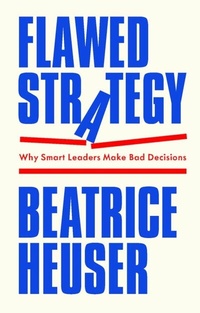
Flawed Strategy
Description

Why did Volodymyr Zelensky doubt that Russia was preparing a full-scale invasion of Ukraine in 2022? Why did British Prime Minister Neville Chamberlain decide to 'do business with Herr Hitler' in Munich in 1938? And how was it that Israeli elites dismissed intelligence warnings of the Hamas attack in 2023? Had they not learned their lesson from the Egyptian¿Syrian attack on Yom Kippur fifty years earlier?
In all these cases, smart decision makers misjudged their adversaries, largely because they failed to understand how their enemies' actions and strategies were shaped by different values and beliefs to their own. We may think such beliefs are irrational merely because we do not share them. They may appear confusing and ill judged. But as Beatrice Heuser ably shows in this pithy book, strategy making is a tricky business, marred by bias, irrationality, bureaucratic politics, colliding government interests, and complex procedures and structures. Assessing our adversaries as not only irrational but also illogical is a dangerous game that can lead to flawed and, on occasions, catastrophically bad decisions. This book explains why.
More details
Other editions
Additional editions
Person
Content
Preface
Introduction
1 The Rational/Irrational Actor Fallacy
2 Our Biases
3 Knowns and Unknowns (And How We Use Them)
4 Flaws and Quandries of Strategy Making
Epilogue
Select Bibliography
Endnotes
Introduction
War, just like a non-violent conflict that may turn into armed conflict, is a dialectic activity - between at least two parties. Each side tries, through a strategy of its own, to force the enemy to do its will, as Carl von Clausewitz put it. The point may come where the enemy is completely disarmed and has no choice other than to do our will. Short of such a situation, however, each side tries to influence the behaviour of the other until the other gives up, gives in, surrenders, agrees to an armistice or to some other form of compromise. Influencing the other side through strategy - the use of force and/or of non-violent means - assumes an action-reaction mechanism, in which we can somehow trigger reactions advantageous to us on the part of the enemy and avoid reactions that will be detrimental, perhaps even devastating, for us. Especially when confronted with an adversary armed with nuclear weapons, but not only then, strategy making is a precarious balancing act in which it is vital to anticipate an adversary's reactions to one's every move, both in times of crisis and actual war. In war, and to manage difficult relationships that could lead to war, we therefore need to understand what our adversaries think, want and do. We need to understand their strategies and their strategic reasoning. It is no good just to know what aims we have in mind, even if we have very smart minds. That is likely to lead to flawed strategy, bad decision making on the part of leaders that, at times, has serious domestic and international consequences.
Dealing with a nuclear-armed adversary is an extreme case, of course. Even armed conflict is extreme. Much more frequent are situations in international relations in which national leaders or representatives of a government or an international organization are dealing with one another in non-violent ways, negotiating over issues that might well lead to outcomes of mutual benefits, to 'win-win' situations, rather than ones in which one side imposes its will upon the other. But there, too, when differing approaches and attitudes meet, 'the trick' (as British diplomat Baroness Neville-Jones calls it) is to see where adversaries are coming from, and how they think and why.
The first step to understanding an adversary is usually to put ourselves in their shoes, to empathize, to imagine how we would think and do in their place. Often enough, however, adversaries do not oblige us by thinking or behaving as we would, leading to great puzzlement on our side. As in the fairy tale Cinderella, we might have to chop off toes or heels, that is, our own preconceptions and assumptions, for the shoe to fit.
Under the influence of economists who have exerted a strong influence on Strategic Studies ever since we entered the nuclear age, most literature on strategy still assumes 'rational actors' on both sides of a conflict. Strategic Studies is usually seen as a sub-discipline of the study of the interaction of governments. For that is the essence of the discipline we call International Relations (IR), even though it is rarely about the relations between nations unless they are engaged in 'total' wars with one another where the whole of the nation is mobilized. Key IR theories, especially those derived directly from game theories, assume that decision making is a predictable game. Economists assume that there is a Homo economicus who will choose which espresso machine he will buy, or which university to apply to, by doing extensive market research, his decision guided only by applying criteria such as cost, customer satisfaction feedback on the machine, or the university's standing in league tables. Key IR theories assume that similar cost-benefit criteria are applied when decision makers ponder whether to invade another country or to use nuclear weapons. Strategic concepts such as deterrence, dissuasion, coercion, compulsion or the whole notion of crisis management are built on the assumption that one is playing a game of chess or a similar highly rule-bound game - hence the importance of game theory, imported from economics - in which moves are expected to produce rational, calculable responses. In reality, such theories and concepts are built on sand: they are profoundly challenged by adversaries holding fundamental beliefs which we do not share, not to mention the many considerations they may have that we have not thought of.1 Moreover, as we shall see in the following chapters, the processes of arriving at decisions collectively are in themselves obstacles to the pursuit of a single logic, or rational reasoning.
By contrast, historians exposed to IR theories are usually astounded by the claim that these theories can provide monocausal explanations.2 Historians since Thucydides have been aware that strategic decisions are not made based on a single issue. Strategy making is all about prioritization, weighing expected consequences and choosing what one thinks might be the lesser evil. Moreover, historians are all too aware that, of course, emotions and notions of pride and reputation colour and distort decision makers' thinking. Already, Thucydides evoked 'fear, honour and interest' as the three great factors motivating humans to go to war. Therefore, what outsiders might see as rational cost-benefit calculations are so often squeezed out by blind fury, fear and interests, clearly not those of the nation as a whole.3 This lesson was learned a long time ago by those who read Ivan Bloch's work written on the eve of the First World War that explained how utterly irrational and self-destructive it would be for the prosperous, commercially interconnected European states to go to war with one another,4 or Norman Angell's argument that it was a 'great illusion' to think that any nation could benefit truly from such a war.5
Diplomatic historians - historians burrowing deep into government archives, often with a view to understanding the origins of a particular war or the obstacles to making peace - have long been aware that decisions are made at the highest level with incomplete knowledge about what an adversary has in terms of means, what he intends to do or what the comparative costs and benefits would be to one's own side if one tried to stop his expansionism now or later. The very title of a recent bestseller on the origins of the First World War, The Sleepwalkers,6 sums this up neatly. And the debate about whether Britain and France would have been better off if they had refused Hitler's demand for the Sudetenland to be ceded to neighbouring Germany by Czechoslovakia in late 1938, rather than declaring war on Germany a year later when Hitler invaded Poland after the Wehrmacht had occupied the rest of Czechoslovakia and turned its east into a 'protectorate', is continuing.7
Box 0.1: The Eve of the Second World War
After the First World War, a democratic Germany had gradually gained the confidence of its neighbours until the economic crisis following the Wall Street Crash of 1929 led to the rise of the extreme left and right. Hitler, heading the racist National Socialist ('Nazi') Party, came to power in Germany in 1933. While successive French governments were wary, British governments continued to show goodwill towards Germany, hoping that condoning Hitler's piecemeal dismantlement of Germany's limitations imposed by the post-First World War peace treaty signed at Versailles would appease him.
In 1936, Germany annexed the Rhineland - according to the Versailles Treaty, this was to remain demilitarized - and then, in 1938, Austria - a separate state. Hitler then demanded that Czechoslovakia cede the Sudetenland to Germany, a mountainous region along the Czech-German border, in part populated by German speakers of Austrian culture. The British Prime Minister Sir Neville Chamberlain and, persuaded by him, the French head of government Edouard Daladier, at a conference in Munich in September 1938 pressed the Czech President Edvard Benes to comply with Hitler's demands.
Hitler promised that this was his last territorial demand, but only weeks later he ordered plans to be drawn up to 'finish off' the rest of Czechoslovakia. In March 1939, these orders were carried out; the Wehrmacht invaded Czechoslovakia, which was now unable to put up a proper defence against the superior force descending from the western and northern heights of the Sudetenland. This finally persuaded Chamberlain and Daladier to stop appeasement and instead to draw a red line: if Germany now attacked Poland, its next victim, as German propaganda indicated, Britain and France would declare war on Germany. Hitler did not believe they would, proceeded to attack Poland on 1 September 1939 and was surprised when the British and French declarations of war were duly made.
Then psychologists, most prominently the Nobel prizewinning Daniel Kahneman, articulated their astonishment at the assumptions underlying rational actor theory or rational choice theory (these terms are used synonymously in the following).8 They have shown that, however smart we are, none of us are fully 'rational actors' as we are subject to a wide range of biases affecting our - and governments' - interpretations of the world and our behaviour.9 As a consequence, smart leaders and their representatives sometimes make bad...
