

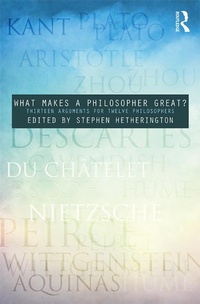
What Makes a Philosopher Great?
Thirteen Arguments for Twelve Philosophers
Published on 10. November 2017
282 pages
978-1-317-38684-1 (ISBN)
Description

This book is inspired by a single powerful question. What is it to be great as a philosopher? No single grand answer is presumed to be possible; instead, rewardingly close studies of philosophical greatness are developed. This is a scholarly yet accessible volume, blending metaphilosophy with the long history of philosophy and traversing centuries and continents. The result is a series of case studies by accomplished scholars, each chapter trying to understand and convey a particular philosopher's greatness:
Lloyd P. Gerson on Plato
Karyn Lai on Zhuangzi
David Bronstein on Aristotle
Jonardon Ganeri on Buddhaghosa
Jeffrey Hause on Aquinas
Gary Hatfield on Descartes
Karen Detlefsen on du Chatelet
Don Garrett on Hume
Allen Wood on Kant (as a moral philosopher)
Nicholas F. Stang on Kant (as a metaphysician)
Ken Gemes on Nietzsche
Cheryl Misak on Peirce
David Macarthur on Wittgenstein
This also serves a larger philosophical purpose. Might we gain increased clarity about what philosophy is in the first place? After all, in practice we individuate philosophy partly through its greatest practitioners' greatest contributions.
The book does not discuss every philosopher who has been regarded as great. The point is not to offer a definitive list of The Great Philosophers, but, rather, to learn something about what great philosophy is and might be, from illuminated examples of past greatness.
Lloyd P. Gerson on Plato
Karyn Lai on Zhuangzi
David Bronstein on Aristotle
Jonardon Ganeri on Buddhaghosa
Jeffrey Hause on Aquinas
Gary Hatfield on Descartes
Karen Detlefsen on du Chatelet
Don Garrett on Hume
Allen Wood on Kant (as a moral philosopher)
Nicholas F. Stang on Kant (as a metaphysician)
Ken Gemes on Nietzsche
Cheryl Misak on Peirce
David Macarthur on Wittgenstein
This also serves a larger philosophical purpose. Might we gain increased clarity about what philosophy is in the first place? After all, in practice we individuate philosophy partly through its greatest practitioners' greatest contributions.
The book does not discuss every philosopher who has been regarded as great. The point is not to offer a definitive list of The Great Philosophers, but, rather, to learn something about what great philosophy is and might be, from illuminated examples of past greatness.
Reviews / Votes
"What is the difference between a merely good philosopher and a great one? Lists of the great (and usually dead) philosophers presuppose an answer to this question but it's far from obvious what the answer is. The distinguished contributors to this terrific volume advance our understanding of what great philosophy is and explain the greatness of some of the greatest philosophers."--Quassim Cassam, University of Warwick
More details
Language
English
Place of publication
London
United Kingdom
Publishing group
Taylor & Francis Ltd
Target group
College/higher education
Illustrations
1 Tables, black and white
File size
1,14 MB
ISBN-13
978-1-317-38684-1 (9781317386841)
Copyright in bibliographic data and cover images is held by Nielsen Book Services Limited or by the publishers or by their respective licensors: all rights reserved.
Schweitzer Classification
Other editions
Additional editions
Book
11/2017
1st Edition
Routledge
€206.70
Shipment within 10-20 days
Book
11/2017
1st Edition
Routledge
€63.60
Shipment within 10-20 days
Person
Stephen Hetherington is Professor of Philosophy at the University of New South Wales. His publications include Epistemology's Paradox (1992), Good Knowledge, Bad Knowledge (2001), How to Know (2011), and Knowledge and the Gettier Problem (2016).
Content
CONTENTS
Preface and acknowledgements
List of contributors
Philosophical greatness: Introducing the very idea
Stephen Hetherington
Plato, Platonism, and the history of philosophy
Lloyd P. Gerson
Zhuangzi's suggestiveness: Sceptical questions
Karyn Lai
Aristotle as systematic philosopher: Essence, necessity, and explanation in theory and practice
David Bronstein
Attention to greatness: Buddhaghosa
Jonardon Ganeri
Aquinas's complex web
Jeffrey Hause
Descartes as a great philosopher: Comprehensive physics, mechanistic embodiment, and methodological systematicity
Gary Hatfield
Emilie du Chatelet on women's minds and education
Karen Detlefsen
What's so great about Hume?
Don Garrett
Is Kant a great moral philosopher?
Allen Wood
'How is metaphysics possible?' Kant's great question and his great answer
Nicholas F. Stang
Nietzsche: This time it's personal
Ken Gemes
What makes Peirce a great philosopher?
Cheryl Misak
Wittgenstein's un-ruley solution to the problem of philosophy
David Macarthur
Preface and acknowledgements
List of contributors
Philosophical greatness: Introducing the very idea
Stephen Hetherington
Plato, Platonism, and the history of philosophy
Lloyd P. Gerson
Zhuangzi's suggestiveness: Sceptical questions
Karyn Lai
Aristotle as systematic philosopher: Essence, necessity, and explanation in theory and practice
David Bronstein
Attention to greatness: Buddhaghosa
Jonardon Ganeri
Aquinas's complex web
Jeffrey Hause
Descartes as a great philosopher: Comprehensive physics, mechanistic embodiment, and methodological systematicity
Gary Hatfield
Emilie du Chatelet on women's minds and education
Karen Detlefsen
What's so great about Hume?
Don Garrett
Is Kant a great moral philosopher?
Allen Wood
'How is metaphysics possible?' Kant's great question and his great answer
Nicholas F. Stang
Nietzsche: This time it's personal
Ken Gemes
What makes Peirce a great philosopher?
Cheryl Misak
Wittgenstein's un-ruley solution to the problem of philosophy
David Macarthur
