

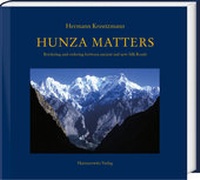
Hunza matters
Ordering and bordering between ancient and new Silk Roads
1st Edition
Published on 1. April 2020
570 pages
978-3-447-19961-2 (ISBN)
Description

Since the mid-19th century, boundary-making in the Pamirian Crossroads had involved the redefining of contested spheres of influence between Great Britain and Russia. Remote mountain microstates had enjoyed a comparatively high degree of autonomy from their immediate neighbours. The incorporation of the Hunza Valley into the British-Kashmirian realm followed a successful military intervention. The colonial project has significantly affected living conditions in the Hunza Valley.
Hunza matters addresses the transformation from four perspectives. First, the changing physical infrastructure are analysed from a road perspective. Initially, pack animals and porterage were involved in crossing high passes. Daring geostrategic projects emerged, shedding light on early plans for connecting British India with China by motor road. Much later the Karakoram Highway was built. The latest stage of infrastructure development is the China-Pakistan Economic Corridor. Second, environmental resource utilisation strategies have changed over time. Emphasis has shifted from a predominantly agriculture-based economy towards a market-oriented income generation including extractivism, remittances and services. Third, bordering and ordering is strongly linked to actors and factors. Fourth, new light is shed on prevalent myths that are associated with Alexander the Great and the Silk Roads, longevity and an ideal state. A developmentalism discourse has been transformed in Chinese occupation narrative. All four perspectives are displayed on the basis of archival evidence that has been collected from a wide range of sources, augmented by empirical material collected during four decades.
More details
Other editions
Additional editions

Book
04/2020
1st Edition
Harrassowitz Verlag
€98.00
Shipment within 5-7 days
Content
- Cover
- Titel
- Imprint
- Contents
- Avant-propos
- Approaching Hunza and Nagar
- Personal passage to the Hunza Valley
- Changing knowledge production over time
- Illustrations - mapping and visualisation
- Acknowledgments
- Introduction
- The Hunza Valley - an area between bordering and ordering
- Modernisation strategies as instruments for access, control and exchange
- Setting the stage - four perspectives
- From Hunza Road to China-Pakistan Economic Corridor
- Routes to roads - changing perceptions ~? Antecedents
- Antecedents
- Forbidden routes - explorers as trespassers
- Pre-colonial route development and the battle for knowledge
- The second Gilgit Agency and the 'paci cation' of Hunza
- A Russian threat? - fellow explorers on the Hunza Road
- After the Great Game - triangulation for a common grid
- Colonial competition over accessibility and dominance
- Three routes compared - Chitral, Gilgit, and Leh
- Colonial modernisation of trafc infrastructure
- Preparing and maintaining a sophisticated route
- Searching for alternative routes
- The advent of motor transport - initially by air only
- Innovations and constraints in Central Asia during the 1930s
- "Croisière jaune" - a terrestrial attempt to cross the Karakoram
- The Gilgit Road in the wake of the lease of the Gilgit Agency in 1935
- From Pamir Highway to Stalin Road
- Support axis for General Chiang Kai-shek - a road through the Hunza Valley
- Recon guration in Xinjiang
- Improving the Hunza Road for motor transport
- Post-colonial nation-building through traf c networks
- Strategic roads - the Indus Valley Road as a beginning
- Contextual changes in boundary-making - con ict and war in Western High Asia
- From Indus Valley Road to Karakoram Highway
- Road and rural development
- Becoming internationally connected
- Resuming the China trade
- Environmental challenges and geo-hazards
- Connecting networks to make an international highway
- Socio-political reforms along the road
- Two inaugurations - occasions for celebrations and speeches
- Link roads connect people, villages and highway
- New highway and old problems
- Sectarian clashes
- Domestic infrastructure development and trade
- Karakoram Highway Improvement Project - the second phase
- A web of mountain arteries in the age of global silk roads
- Resource perspective - Spatial patternsin a diverse environment
- Local assets and external resources: Constraints and coping
- Living in a harsh environment
- Hunza Valley - from risk to potential
- Karakoram or Muztagh - life among boulders and glaciers
- Utilisation of verticality in a high mountain desert
- Temperature variation in a mountain desert
- Ecological differentiation along the Hunza Valley
- Human diversity in the Karakoram
- A mosaic of languages - autochthonous enclaves and emerging patterns across the Hindukush-Karakoram
- The positioning of small languages challenged by globalisation, language and minority policies
- Mobility and language diversity
- A survey of linguistic and denominational diversity
- Language and script
- Scripted vernaculars in new media
- Denominational diversity
- Settlement processes - appropriation, colonisation, immigration and occupation
- Period of nuclear villages
- Pre-colonial phase of oasis expansion and internal colonisation
- Settlement concentration processes under colonial supremacy
- Letting people leave - initial out-migration
- Hunza and Nagar compared
- Village growth and response to improved communication systems
- Water - lifeline for village dwellers and backbone for oasis agriculture
- Water management in Central Hunza
- Evolution of the channel network and adaptation of irrigation rules in Central Hunza
- Seasonal and territorial rules for irrigation
- Organisational aspects of water management
- Recent developments in the irrigated oases of Hunza
- Combined mountain agriculture - an ideal model?
- Pastoral practices in decline - adaptation and landscape management
- Livestock taxes - a major source of revenue in Hunza State
- Importance and quantitative decline of animal husbandry in Hunza
- High pastures and their part in the commons
- Disputes about the commons
- Recent changes and future prospects for high mountain pastoralism
- Beyond the two main pillars - resources in hunting and prospecting
- From factors to actors - Karakoram con?gurations
- Pre-colonial expansion from Central Hunza to the north
- Excursus - Safdar Ali Khan in exile, a place of no return
- Colonial assistance - strengthening the position of the "tham"
- The long rule of tham Nazim Khan
- The final two decades - "tham" Nazim Khan's authoritarian rule
- The enmity and verdicts of Reginald Schomberg
- Successors of Nazim Khan in Hunza and Sikandar Khan in Nagar
- Ghazan Khan - "tham" without fortune
- Jamal Khan - the last "tham"
- Post-colonial transformations - launching accession to Pakistan
- Hereditary authority challenged - survival strategies and failures
- Winds of change - abolition of princely states
- The endgame of hereditary rule
- After the Hunza State - elite struggle to maintain inuence
- The Aga Khan's connections with Hunza
- Community integration and reforms
- Ismaili modernisation for Hunza
- Hunza as one element in the Ismaili global assemblage
- Actors and factors in transition
- A plethora of Hunza myths revisited
- Gratitude to Alexander the Great
- Mythical longevity - 'Hunza humbug'
- From longevity to developmentalism myth
- The Chinese occupation of Gilgit-Baltistan myth
- Epilogue
- Glossary
- Bibliography
- Index
- Backcover
