

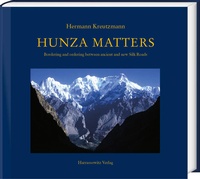
Hunza matters
Bordering and ordering between ancient and new Silk Roads
1st Edition
Published on 1. April 2020
Book
Hardback
570 pages
978-3-447-11369-4 (ISBN)
Description
Since the mid-19th century, boundary-making in the Pamirian Crossroads had involved the redefining of contested spheres of influence between Great Britain and Russia. Remote mountain microstates had enjoyed a comparatively high degree of autonomy from their immediate neighbours. The incorporation of the Hunza Valley into the British-Kashmirian realm followed a successful military intervention. The colonial project has significantly affected living conditions in the Hunza Valley.
Hunza matters addresses the transformation from four perspectives. First, the changing physical infrastructure are analysed from a road perspective. Initially, pack animals and porterage were involved in crossing high passes. Daring geostrategic projects emerged, shedding light on early plans for connecting British India with China by motor road. Much later the Karakoram Highway was built. The latest stage of infrastructure development is the China-Pakistan Economic Corridor. Second, environmental resource utilisation strategies have changed over time. Emphasis has shifted from a predominantly agriculture-based economy towards a market-oriented income generation including extractivism, remittances and services. Third, bordering and ordering is strongly linked to actors and factors. Fourth, new light is shed on prevalent myths that are associated with Alexander the Great and the Silk Roads, longevity and an ideal state. A developmentalism discourse has been transformed in Chinese occupation narrative. All four perspectives are displayed on the basis of archival evidence that has been collected from a wide range of sources, augmented by empirical material collected during four decades.
Hunza matters addresses the transformation from four perspectives. First, the changing physical infrastructure are analysed from a road perspective. Initially, pack animals and porterage were involved in crossing high passes. Daring geostrategic projects emerged, shedding light on early plans for connecting British India with China by motor road. Much later the Karakoram Highway was built. The latest stage of infrastructure development is the China-Pakistan Economic Corridor. Second, environmental resource utilisation strategies have changed over time. Emphasis has shifted from a predominantly agriculture-based economy towards a market-oriented income generation including extractivism, remittances and services. Third, bordering and ordering is strongly linked to actors and factors. Fourth, new light is shed on prevalent myths that are associated with Alexander the Great and the Silk Roads, longevity and an ideal state. A developmentalism discourse has been transformed in Chinese occupation narrative. All four perspectives are displayed on the basis of archival evidence that has been collected from a wide range of sources, augmented by empirical material collected during four decades.
More details
Language
English
Place of publication
Wiesbaden
Germany
Target group
Professional and scholarly
Product notice
Cloth over boards
sewn/stitched
With dust jacket
Illustrations
193 ill., 379 photos, 7 tables
Dimensions
Height: 24 cm
Width: 26.5 cm
Weight
2905 gr
ISBN-13
978-3-447-11369-4 (9783447113694)
Schweitzer Classification
Other editions
Additional editions

E-Book
04/2020
1st Edition
Harrassowitz Verlag
€98.00
Available for download