

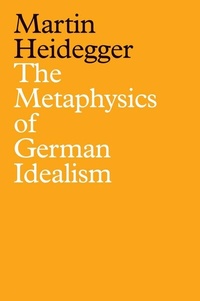
The Metaphysics of German Idealism
Description

This volume comprises the lecture course that Heidegger gave in 1941 on the metaphysics of German Idealism. The first part of the lecture course contains a preliminary consideration of the distinction between ground and existence. The elucidation of the conceptual history includes a striking confrontation with Kierkegaard's and Jaspers' concepts of existence, as well as an elucidation of the concept of existence in Being and Time, which Heidegger distinguishes from the former concepts. Heidegger's self-interpretation is not an end in itself, however, but rather a way of pointing to Schelling's distinction between ground and existence, whose root and inner necessity and whose various versions Heidegger discusses subsequently.
The second part of the lecture course is focused on Schelling's "freedom treatise," which Heidegger regards as the pinnacle of the metaphysics of German Idealism. Heidegger's consideration of Schelling's distinction between ground and existence finds its guiding thread in the introduction of the realms of being - eternal or finite, each being is a joining of the ground of existence and existence itself. In a subsequent overview, Heidegger discusses the relation of the distinction between ground and existence to the essence of human freedom and to the essence of the human. On the basis of this discussion, it becomes possible to grasp the connection between freedom and evil in Schelling's system.
This important work by Heidegger, published here in English for the first time, will be of great interest to students and scholars of philosophy and to anyone interested in Heidegger's work.
More details
Other editions
Additional editions
Persons
Martin Heidegger (1889-1976) was one of the most influential philosophers of the twentieth century and the author of numerous works including Being and Time.
Content
Translators' Introduction INTRODUCTION THE NECESSITY OF A HISTORICAL THINKING § 1. Schelling's Treatise as the Peak of the Metaphysics of German Idealism § 2. Historical Thinking, Historiographic Explanation, Systematic Reflection § 3. Elucidations of the Title of the Treatise § 4. The Organization of the Treatise § 5. Brief Excursus on a Further Misgiving (the Historiographic - the Current - That Which Has Been) PART I PRELIMINARY REFLECTION ON THE DISTINCTION BETWEEN GROUND AND EXISTENCE § 6. The Core Section of the Treatise: The Distinction between Essence Insofar as It Exists and Essence Insofar as it Is Merely Ground of Existence § 7. The Organization of the Preliminary Reflection First Chapter The Conceptual-Historical Elucidation of Ground and Existence § 8. Essentia and Existentia § 9. "Existence" and "Philosophy of Existence" (K. Jaspers) § 10. Kierkegaard's Concept of Existence § 11. Kierkegaard, "Philosophy of Existence," and Being and Time (1927) a) What Occasion Is There for Classifying Being and Time as "Philosophy of Existence"? ) Analytic of Existence
) Existence - As Understood in the Sense of Kierkegaard's Restriction of It ) Philosophy of Anxiety, of the Nothing, of Death, of Care . . . ) Philosophical Anthropology b) Rejection of the Classification of Being and Time as Philosophy of Existence by Way of an Elucidation of the Concepts of Existence and Da-sein (Elucidations of Being and Time) ) Existence and Dasein as Meaning "Actuality in General" (As Understood in Traditional Usage of Language) ) Dasein as the Bodily-Psychic-Rational Being-Actual of the Human, and Existence as the Subjectivity of Self-Being (Jaspers) ) "Existentiell" and "Existential" Concepts of Existence ) "Understanding of Being" as the Decisive Determination of Dasein and Existence in Being and Time ) Dasein, Temporality, and Time ) Temporality, Da-sein, Existence ) Anxiety, Death, Guilt, the Nothing within the Realm of Questioning in Being and Time ) The "Essence" of Da-sein ) Understanding of Being, and Being ) Being and the Human - Anthropomorphism § 12. Preliminary Interpretation of Schelling's Concept of Existence § 13. The Inceptive Impetuses Determining the Essence of Ground and Their Historical Transformation Second Chapter The Root of Schelling's Distinction between Ground and Existence § 14. Elucidation of the Essential Determination of Being as Willing a) The Essential Predicates of Being ) Ground-lessness ) Eternity ) Independence from Time ) Self-Affirmation b) Justification of the Predicates of Being c) In What Way Willing Is Sufficient for the Predicates of Being d) Being in Its Highest and Ultimate Jurisdiction § 15. Being as Willing as the Root of the Distinction between Ground and Existence Third Chapter The Inner Necessity of Schelling's Distinction between Ground and Existence Fourth Chapter The Various Formulations of Schelling's Distinction between Ground and Existence § 16. The Proper Aim of the Interpretation of the Freedom Treatise: Reaching the Fundamental Position of the Metaphysics of German Idealism. Evil and the System § 17. Transition from the Preliminary Reflection to the Interpretation of the Core Section of the Treatise and of the Latter Itself PART II AN INTERPRETATION OF THE CORE SECTION, "THE ELUCIDATION OF THE DISTINCTION" BETWEEN GROUND AND EXISTENCE § 18. The "Elucidation of the Distinction" as the Presentation of Beings as a Whole (God, World, Human) First Chapter The Reflection that Takes God as a Starting Point § 19. The Direct Elucidation: The Presentation of the Being of Beings "in" God. Philosophy as Unconditional Knowledge of the Absolute in Contrast to Theology and Mathematics. The Various Senses of the Word "Nature" a) Philosophy and Theology b) Philosophy and Mathematics c) The Concept of the Absolute in Schelling and Hegel § 20. The Analogical Elucidation: Presentation of the Correspondence Between the Stations of the Being of the Absolute § 21. The Circularity of the Distinction Between Ground and Existence § 22. Summary of What Was Said about the Distinction in God § 23. Excursus: The Unconditional Precedence of the Certainty (That Is to Say, Concurrently: the Beingness) of the Absolute Second Chapter The Reflection that Takes its Point of Departure from Things § 24. The Ground in God as "Originary Yearning" § 25. Creation as Formation through the Imagination; the Creature as "Image" Third Chapter The Reflection that Takes its Point of Departure from the Human § 26. The Necessity of Creation and the Essence of the Human as the Proper Creature in which God Himself Reveals Himself § 27. Human Will as "Divine Glimpse of Life" and "Seed of God" CONCLUSION OVERVIEW § 28 The "Distinction" and the Essence of Freedom and of Human Freedom in Particular § 29 The "Distinction" in its Full Essence § 30. The "Distinction" and the Essence of the Human § 31. The Essence of Evil § 32. Evil and the System § 33. The System and the Truth (Certainty) of Beings as a Whole § 34. What Confrontation Means with Respect to Metaphysics RECAPITULATIONS AND COURSE OF THE INTERPRETATION Recapitulation of 14 January Recapitulation of 21 January Recapitulation of 28 January Recapitulation of 4 February Recapitulation of 11 February Recapitulation of 18 February Recapitulation of 25 February Recapitulation of 4 March Recapitulation of 11 March APPENDIX Preliminary Glimpses and Directives Transitional Reflection on Hegel The Confrontation with the Metaphysics of German Idealism and with Metaphysics in General Supplement (Leibniz) German-English Glossary English-German Glossary Greek/Latin-English Lexicon
Translators' Introduction
The decision to translate Heidegger into English is in many respects a difficult one. Not simply because Heidegger's thought remains irreducibly tied to language and to a certain artisanal craft of writing - a "Hand-werk der Schrift," as he calls it in "The Letter on 'Humanism'"1 - but also because English, to all appearances, at least, was not a language Heidegger particularly esteemed. This would be philosophically irrelevant were it not for the utmost significance Heidegger himself ascribes to "the essential danger" that the "English-American" language poses, a threat to nothing less than the "shrine" of being in which "the essence of the human is held in store."2 It is difficult to overlook, then, a certain irony at the heart of any English translation of Heidegger, particularly of a Heidegger text, such as The Metaphysics of German Idealism, dating back to the early 1940s, when Heidegger's most explicit condemnation of English takes place. Would it not be an ontological disaster to translate the thinker of this ontological disaster precisely into the language in which this disaster is supposed to unfold?
Yet we maintain that such an undertaking is nevertheless in keeping with another Heidegger, more open to a non-Greek other and capable of writing - in 1946 - that "in the most diverse ways, being speaks everywhere and always, through all language," even, dare we say, the English language?3
Translated here in its entirety for the first time is volume forty-nine of Heidegger's Gesamtausgabe or "Collected Works," a volume comprised of a lecture course delivered at the University of Freiburg in the first trimester of 1941 and of material for a seminar held there in the summer semester of that year. Previously, excerpts from this volume, occasionally revised, had appeared in the appendix to Heidegger's first lecture course on Schelling from 1936, whose 1971 publication (English 1985) was overseen by Heidegger himself.4 As indicated by the title of the present volume, here Heidegger again takes up Schelling's 1809 treatise on freedom, which, he argues, marks the peak of German Idealism. Only, this time, Heidegger more explicitly distinguishes his own thought from that of his German predecessor, whose work he situates within the continuum of Western metaphysics. Along the way, taking up Schelling's important distinction between ground and existence, Heidegger provides an extensive history of the concepts of existence and ground, with detailed discussions of Jaspers, Kierkegaard, Hegel, and his own opus magnum Being and Time - including its unpublished third division.
The style of the present volume is uneven. Some of the material appears as fully worked-out prose. Other portions resemble notes. We have endeavored to remain faithful to the character of the text, at the expense of occasional inelegance or grammatical incompleteness.
The reader can consult the glossaries to see how we have typically rendered Heidegger's terminology, but there are four sets of terms which we believe it will prove helpful to discuss in advance.
1. We have rendered the noun das Sein as "being" and the nominalized present participle das Seiende as "beings," "the being," or "that which is." When it is unclear in the English which is meant, as in the phrases "the being {Sein} that human Dasein itself is" and "the proper being {Seiende} in itself," we have, as here, inserted the German. Heidegger's use of the archaic German spelling Seyn has been translated by the obsolete English beyng. Since, in Schelling's time, Seyn, with a "y," was standard, we have used "being" when translating authors from that period, although here too we have included the German. The abstract Seiendheit appears as "beingness." Although, in Schelling's later philosophy, which Heidegger occasionally references, Schelling does not use Sein and Seiendes in the same way Heidegger does, we thought it important to maintain terminological consistency. In cases where confusion might result, we have interpolated the German.
2. Heidegger uses numerous words for existence and for the human being in particular. In order to keep them apart, we have, with two exceptions, consistently rendered Existenz as "existence," Ex-sistenz as "ex-sistence," existenzial as "existential," existenziell as "existentiell," Mensch as "human," and Menschsein as "the being of the human," "human being" (no article), or, in one instance, "being-human." (In two cases, in which we include the German, it seemed more appropriate to translate das Existenzielle in Schelling as "the existential.") Unless indicated by a German interpolation, we have, as in point 1, left Dasein and Da-sein in the original. In § 11, ?, Heidegger claims this term is "untranslatable," although he does provide - translating from within German, as it were - an explanation as to how one should understand it, which we reproduce here:
The word "Da" {there, here}, the "Da," means precisely this clearing for Sein {being}. The essence of Da-sein is to be this "Da." The human takes this on, namely, to be the Da, insofar as he exists {.}. What is meant is not "Dasein" in the sense of the presence of a thing or of the human that is here and there and "da"; rather, what is being thought is "Da-sein," that the clearing for being in general essences and is (p. 47).
3. The verb essences translates the rare verb wesen, which, in its noun form, Wesen, means "essence." Although Wesen can refer to a being, as in the term Lebewesen, "creature" or "living being," we have either translated it as "essence" or, when not, supplied the German, since this is a crucial term for both Heidegger and Schelling. Heidegger occasionally accentuates the verbal character of the word with the noun Wesung, which we have translated by "essencing." "Presencing" and "to presence" translate Anwesung and anwesen.
4. Heidegger exploits the etymology of numerous words built on the root verb stellen, "to place." Darstellen appears as "presenting" or, when hyphenated, as "presenting forth"; Vorstellen appears as "representing" or, when hyphenated, as "re-presenting," although one should bear in mind that it also has the literal spatial sense of "placing before"; Herstellen appears as "producing"; and Zustellen as "delivering."
Since Heidegger uses both parentheses and square brackets, we have placed all of our notes and interpolations in curly brackets. We have also included, in the margins, the pagination of the original German.5 For foreign phrases that cannot readily be found in a lexicon, we have provided common translations in footnotes. For individual Greek and Latin words, we have supplied, at the end of the volume, a lexicon with typical translations. Readers consulting the lexicon should bear in mind that it is intended as a resource for beginning to work through Heidegger's own use and interpretation of these words, not as a replacement or definitive rendering.
Following Anglophone conventions, we have italicized foreign words and phrases. When Heidegger himself emphasizes them, or when the words are already emphasized in material he is quoting, we have added underlining. In his citations of Leibniz, several words are written gesperrt, spaced out for emphasis. We have retained this spacing in order to distinguish it from other types of emphasis. Words appearing in Greek script have been transliterated.
We would like to thank Katie Chenoweth, Tobias Keiling, Richard Polt, Philipp Schwab, Tim Steinebach, and two anonymous reviewers for their helpful comments on the translation.
Ian Alexander Moore
Rodrigo Therezo
- 1. Martin Heidegger, "Brief über den 'Humanismus,'" in Wegmarken, Gesamtausgabe vol. 9, ed. Friedrich-Wilhelm von Herrmann (Frankfurt am Main: Vittorio Klostermann, 1976), p. 344.
- 2. Heidegger, Hölderlins Hymne "Der Ister," Gesamtausgabe vol. 53, ed. Walter Biemel (Frankfurt am Main: Vittorio Klostermann, 1984), pp. 80-81.
- 3. Heidegger, "Der Spruch des Anaximander," in Holzwege, Gesamtausgabe vol. 5, ed. Friedrich-Wilhelm von Herrmann (Frankfurt am Main: Vittorio Klostermann, 1977), p. 338 (emphasis added).
- 4. Martin Heidegger, Schellings Abhandlung über das Wesen der menschlichen Freiheit (1809), ed. Hildegard Feick (Tübingen: Max Niemeyer, 1971) / Schelling's Treatise on the Essence of Human Freedom, trans. Joan Stambaugh...
