

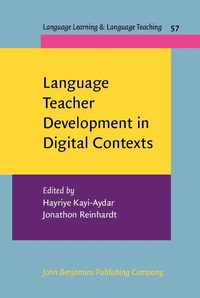
Language Teacher Development in Digital Contexts
1st Edition
Published on 20. January 2022
206 pages
978-90-272-5824-3 (ISBN)
Description

This volume demonstrates how various methodologies and tools have been used to analyze the multidimensional, dynamic, and complex nature of identities and professional development of language teachers in digital contexts that have not been adequately examined before. It therefore offers new understandings and conceptualizations of language teacher development and learning in varied digital environments. The collection of pieces illustrates a field that is recognizing that digital environments are the contexts of teacher learning, not simply the object of it, and that issues of identity and agency are central to that learning. As an excellent resource on digital technologies, CALL, gaming, or language teacher identity and agency, the book can be used as a textbook in various applied linguistics courses and graduate seminars.
More details
Other editions
Additional editions
Hayriye Kayi-Aydar | Jonathon Reinhardt
Language Teacher Development in Digital Contexts
Book
01/2022
John Benjamins Publishing Co
€119.20
Shipment within 10-15 days
Content
- Intro
- Language Teacher Development in Digital Contexts
- Editorial page
- Title page
- Copyright page
- Table of contents
- Contributors
- Introduction
- Overview of the chapters
- References
- Chapter 1. Negotiating equitable language teaching practices: Membership and epistemic stance in asynchronous online discussions
- Equity-enriched orientations to language teaching
- Equity-enriched orientations to teacher education
- Post-cognitive view on epistemic stance
- Theoretical framework
- Methods
- Context and participants
- Data analysis and warrants
- Findings
- Embracing linguistic pluralism and opposing English-only practices
- Highlighting linguistic pluralism as an equity-enriched practice
- Being conflicted as a language teacher
- Discussion and implications for language teacher education in digital contexts
- Conclusion
- References
- Chapter 2. "Sitting in the back of the class": Positional identities in an online MA TESOL program
- Theoretical framework
- Methods
- Participants and context
- Data collection
- Data analysis
- Findings
- Pre-positioning
- Moment-to-moment practices
- Characterizations of practice
- Patterns of participation
- Positional identities
- Discussion
- References
- Chapter 3. Gameful teaching: Exploring language teacher identity and agency through video games
- Language teacher identity and agency
- Gameful learning and teaching
- Methods
- Context and data
- ELLE description
- Data collection and participant
- Data analysis
- Findings
- "I used to be very traditional": Looking back, moving forward
- Intersections between teacher and gamer identities
- Concluding remarks
- References
- Chapter 4. 'We will have to remember this as teachers': A micro-analytical approach to student-teacher online interaction and teacher identity
- Development of VE teacher identities
- Identity negotiation explored through interaction analysis
- Context
- Telecollaboration/virtual exchange
- Class description and study participants
- Data analysis through a multimodal interactional approach
- Ongoing development of VE teacher competences and identity
- Analysis 1: Meeting 1
- Analysis 2: Meeting 4
- Analysis 3: Meeting 7
- Analysis 4: Meeting 9
- Discussion
- Conclusion
- Acknowledgements
- References
- Transcription key
- Chapter 5. Discursive construction of collective identity in a global online community of practice of English language teachers
- Theoretical framework
- Communities of practice
- Online communities of practice
- Positioning, identity, and collective identity
- The study
- Context and background
- Data sources and analysis
- Findings
- RQ1: How do Webheads construct a collective identity of Webheads and Webhead-ness discursively?
- RQ2: What linguistic practices do Webheads employ in their emails that reflect and reproduce their community values and collective identity?
- RQ3: How do the Webheads community and its collective identity shape teachers' professional development as experienced by members?
- Discussion and conclusion
- References
- Chapter 6. Sharing stories around the digital campfire: In-service teachers, cognition/emotion dissonance, and the asynchronous online classroom
- Linking language teacher cognition (LTC) with language teacher emotion (LTE)
- Perezhivanie and narrative knowledging
- Present study
- Participants
- Data collection
- Short story analysis
- Constructing a collaborative digital learning space
- Igniting the digital campfire
- Sharing narratives around the digital campfire to understand perezhivanie
- Growing professionally as a result of cognition/emotional dissonance
- Negotiating the emotional labor of the profession around the campfire
- Sharing stories to support and growing professionally
- Conclusion
- References
- Chapter 7. Fostering (Critical) digital teaching competence through virtual exchange
- Critical digital literacy and its constituent elements
- VE, teacher education and (critical) digital competence development
- Methodological approach
- The German-Polish exchange: Participants
- Learning context and task sequence
- Research methodology
- Findings and discussion
- Safe learning environment
- Task design
- Interactional support
- Concluding remarks
- References
- Chapter 8. Customizing web 2.0 tools to writing pedagogy: TPACK-based professional development of L2 writing teachers
- Review of the literature
- CALL teacher PD
- Teachers' TPACK
- L2 writing TE and technology
- Methods
- Participants
- Instruments
- Procedures
- Results
- Teachers' TPACK-based PD
- Teachers' perceptions
- Discussion
- Conclusion
- References
- Appendix
- Pre-course interview questions
- Post-course interview questions
- Chapter 9. Developing online language teacher identities: Interdisciplinary insights
- A new imperative
- Reconceptualizing OLTE
- Technology-mediated language use
- Technological knowledge
- Modern techno-identities
- Social presence and community
- Translanguacultural awareness
- Conclusion
- References
- Index
