

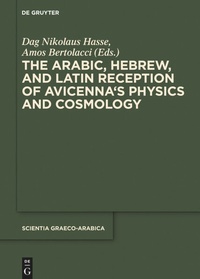
The Arabic, Hebrew and Latin Reception of Avicenna's Physics and Cosmology
Description

Avicenna (Ibn Sina) greatly influenced later medieval thinking about the earth and the cosmos, not only in his own civilization, but also in Hebrew and Latin cultures. The studies presented in this volume discuss the reception of prominent theories by Avicenna from the early 11th century onwards by thinkers like Averroes, Fahraddin ar-Razi, Samuel ibn Tibbon or Albertus Magnus. Among the topics which receive particular attention are the definition and existence of motion and time. Other important topics are covered too, such as Avicenna's theories of vacuum, causality, elements, substantial change, minerals, floods and mountains. It emerges, among other things, that Avicenna inherited to the discussion an acute sense for the epistemological status of natural science and for the mental and concrete existence of its objects. The volume also addresses the philological and historical circumstances of the textual tradition and sheds light on the translators Dominicus Gundisalvi, Avendauth and Alfred of Sareshel in particular.
The articles of this volume are presented by scholars who convened in 2013 to discuss their research on the influence of Avicenna's physics and cosmology in the Villa Vigoni, Italy.
Reviews / Votes
"I highly recommend this fantastic work, especially for those interested in history ofphilosophy (Arabic, Hebrew or Latin) or history of science." Mustafa Yavuz in: Revista Española de Filosofía Medieval, 27/2 (2020), 192-197
More details
Other editions
Additional editions
Persons
Dag Nikolaus Hasse
, Julius-Maximilians-Universität Würzburg;
Amos Bertolacci
, Scuola Normale Superiore, Pisa, Italy.
Content
- Intro
- Preface
- Contents
- Introduction
- Changing Motion: The Place (and Misplace) of Avicenna's Theory of Motion in the Post-Classical Islamic World
- Avicenna's al-?ikma al-muta?aliya. Meaning and Early Reception
- Avicennian Elements in Fa?r al-Din al-Razi's Discussion of Place, Void and Directions in the al-Maba?i? al-masriqiyya
- The Existence of Time in Fa?r al-Din al-Razi's al-Ma?alib al-?aliya
- Time and Mind-Dependence in Sayf al-Din al-Amidi's Abkar al-afkar
- A Map of Averroes' Criticism against Avicenna: Physics, De caelo, De generatione et corruptione and Meteorology
- Avicennian Sources in Abraham Ibn Daud's Natural Philosophy?
- The Medieval Hebrew Reception of Avicenna's Account of the Formation and Perseverance of Dry Land: Between Bold Naturalism and Fideist Literalism
- Notes on Anonymous Twelfth-Century Translations of Philosophical Texts from Arabic into Latin on the Iberian Peninsula
- Avicenna's Influence on William of Auvergne's Theory of Efficient Causes
- 'Averroes ubique Avicennam persequitur': Albert the Great's Approach to the Physics of the Sifa? in the Light of Averroes' Criticisms
- Avicenna's Physics in Roger Bacon's Communia naturalium
- Follower or Opponent of Aristotle? The Critical Reception of Avicenna's Meteorology in the Latin World and the Legacy of Alfred the Englishman
- Index of Avicenna's Works with Passages Cited
- Index of Names
