

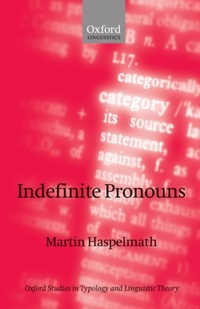
Indefinite Pronouns
1st Edition
Published on 8. February 2001
385 pages
978-0-19-159291-1 (ISBN)
Description

This is an open access title available under the terms of a CC BY-NC-ND 4.0 International licence. It is free to read at Oxford Scholarship Online and offered as a free PDF download from OUP and selected open access locations. Most of the world's languages have indefinite pronouns, that is, expressions such as 'someone', 'anything', and 'nowhere'. Martin Haspelmath presents the first comprehensive and encyclopaedic investigation of indefinite pronouns in the languages of the world, mapping out the range of variation in their functional and formal properties. He shows that cross-linguistic diversity is severely constrained by a set of implicational universals and by a number of unrestricted universals. The author treats his subject matter broadly within the Humboldt-Greenberg tradition of language typology, but also considers the contribution of other theoretical approaches to an understanding of the functional and formal properties of indefinite pronouns. The book is organized into four logically ordered steps: selection of a part of grammar-indefinite pronouns-that can be identified across languages by formal and functional criteria, investigation of the properties of indefinite pronounsin a world-wide sample of forty languages, formulation of generalizations that emerge from the data, summarized in the form of an implicational map, and theoretically-informed explanations of the generalizations, which go beyond system-internal statements, appealing to cognitive semantics, functionalpressures, and universals of language change (especially grammaticalization).
More details
Other editions
Additional editions
Martin Haspelmath
Indefinite Pronouns
Book
02/2001
Oxford University Press
€91.00
Shipment within 15-20 days
Content
- Cover
- Half-Title Page
- Title Page
- Copyright Page
- Dedication Page
- Acknowledgements
- Contents
- Abbreviations
- Notation
- 1. Overview
- 2. A Typological Perspective on Indefinite Pronouns
- 2.1. Language Typology
- 2.2. Indefinite Pronouns: Definition and Delimitation of the Domain of Inquiry
- 2.2.1. Mixed functional-formal definitions
- 2.2.2. The formal criterion: 'pronoun'
- 2.2.3. The functional criterion: 'indefinite'
- 2.3. Earlier Work
- 2.4. The Language Samples
- 2.4.1. General problems of typological sampling
- 2.4.2. Selection of the samples for this study
- 2.4.3. The two samples
- 3. Formal and Functional Types of Indefinite Pronoun
- 3.1. The Main Formal Types of Indefinite Pronoun
- 3.1.1. Types of indefiniteness marker
- 3.1.2. The derivational bases of indefinite pronouns
- 3.1.3. The ontological categories
- 3.2. The Main Functional Types of Indefinite Pronoun
- 3.2.1. Negation: negative indefinite pronouns
- 3.2.2. Negative polarity (or scale reversal)
- 3.2.3. Specificity and non-specificity
- 3.2.4. Knowledge of the speaker
- 3.2.5. Free-choice indefinite pronouns
- 3.2.6. Summary: the main functional distinctions
- 3.3. Alternatives to Indefinite Pronouns
- 3.3.1. Generic nouns
- 3.3.2. Existential sentences
- 3.3.3. Non-specific free relative clauses
- 3.3.4. Universal quantifiers
- 3.3.5. Languages without indefinite pronouns
- 4. An Implicational Map for Indefinite Pronoun Functions
- 4.1. Multifunctionality
- 4.2. The Semantic Map Methodology
- 4.2.1. Indefiniteness markers as grammatical categories
- 4.2.2. The use/function-based approach
- 4.2.3. A geometric representation of implicational universals
- 4.3. The Implicational Map
- 4.3.1. English
- 4.3.2. Russian
- 4.3.3. Nanay
- 4.4. The Distributional Schemas of 40 Languages
- 4.5. Further Restrictions on Combinations of Functions
- 4.6. Earlier Formulations of Typological Implications
- 4.7. Some Finer Distinctions
- 4.7.1. Comparatives
- 4.7.2. Indirect negation
- 4.7.3. Questions
- 4.7.4. Expectations of the speaker
- 4.8. Towards an Explanation of the Implicational Map
- 5. Theoretical Approaches to the Functions of Indefinite Pronouns
- 5.1. Structuralist Semantics
- 5.2. Logical Semantics
- 5.2.1. Free-choice indefinites and universal or existential quantifiers
- 5.2.2. (Non-)specific indefinites and referential opacity
- 5.2.3. Conclusion
- 5.3. Syntactic Approaches
- 5.3.1. Transformational approaches
- 5.3.2. A binding approach
- 5.4. Mental Spaces
- 5.4.1. Introduction to the mental-space approach
- 5.4.2. A definition of (non-)specificity
- 5.4.3. Advantages of the mental-space approach
- 5.5. Pragmatic Scales and Scale Reversal
- 5.5.1. Pragmatic scales
- 5.5.2. Scalar implicatures
- 5.5.3. Scale reversal
- 5.5.4. Negative polarity items express the low point on a scale
- 5.5.5. Free-choice indefinites express the low point on a scale
- 5.5.6. Widening and strengthening
- 5.6. Explaining the Implicational Map
- 5.7. Focusing and Sentence Accent
- 5.7.1. Sentence accent
- 5.7.2. Emphatic vs. non-emphatic indefinites
- 5.7.3. Further meaning differences associated with sentence accent
- 6. The Grammaticalization of Indefinite Pronouns
- 6.1. Diachronic Typology
- 6.2. Source Constructions for Indefiniteness Markers
- 6.2.1. The 'dunno' type
- 6.2.2. The 'want/pleases' type
- 6.2.3. The 'it may be' type
- 6.2.4. The 'no matter' type
- 6.3. Grammaticalization
- 6.3.1. Grammaticalization theory
- 6.3.2. Integrity
- 6.3.3. Scope
- 6.3.4. Paradigmaticity
- 6.3.5. Bondedness
- 6.3.6. Paradigmatic and syntagmatic variability
- 6.3.7. The explanatory power of grammaticalization
- 6.4. Desemanticization: The Semantic Side of Grammaticalization
- 6.4.1. Three competing theories of semantic grammaticalization
- 6.4.2. Extension from 'free choice'
- 6.4.3. Semantic change as weakening
- 6.4.4. Extension from 'dunno'
- 6.5. From Free-Choice Indefinite to Universal Quantifier
- 7. Further Sources of Indefinite Pronouns
- 7.1. Indefinite Pronouns Marked by Scalar Focus Particles
- 7.1.1. The facts
- 7.1.2. Two possible pathways
- 7.1.3. Towards an explanation
- 7.2. Indefinite Pronouns from 'Or'?
- 7.3. Bare Interrogatives as Indefinites
- 7.3.1. Bare interrogatives and strategies for disambiguation
- 7.3.2. Bare interrogatives in Indo-European
- 7.3.3. Why are indefinites often identical to interrogatives?
- 7.3.4. The multiple partitive use of bare interrogatives
- 7.4. Indefinite Pronouns Derived by Reduplication
- 7.5. Some Further Diachronic Issues
- 7.5.1. Generic nouns turned pronouns
- 7.5.2. Indefinite pronouns from 'one'
- 7.5.3. Borrowing of indefiniteness markers
- 7.5.4. Semantic enrichment by implicature: appreciative and depreciative meanings
- 8. Negative Indefinite Pronouns
- 8.1. The Main Syntactic Types of Negative Indefinite
- 8.1.1. The consensus: four types
- 8.1.2. Negative indefinites and elliptical contexts
- 8.1.3. 'Special indefinites'
- 8.2. Negative Indefinites and Verbal Negation
- 8.2.1. What counts as verbal negation
- 8.2.2. Main subtypes with respect to verbal negation
- 8.2.3. Type V-NI: No co-occurrence with verbal negation
- 8.2.4. Type (N)V-NI: Variation in co-occurrence with verbal negation
- 8.2.5. Type NV-NI: Obligatory co-occurrence with verbal negation
- 8.2.6. Co-occurrence of several negative indefinites in one clause
- 8.3. Diachronic Sources of Negative Indefinites
- 8.3.1. Negative scalar focus particles
- 8.3.2. Minimal-unit and maximal-unit expressions
- 8.3.3. Summary of diachronic sources
- 8.3.4. From negative to non-negative indefinite?
- 8.4. Concluding Remarks
- 9. Conclusions
- 9.1. Summary of the Results of This Work
- 9.1.1. Typological generalizations about indefinite pronouns
- 9.1.2. Explanations of the generalizations
- 9.1.3. Remaining puzzles
- 9.2. Wider Typological and Areal Connections
- 9.2.1. Looking for typological correlations
- 9.2.2. Indefinite pronoun type and word order in the 100-language sample
- 9.2.3. Continent-sized areas of indefinite pronoun type
- Appendices
- Appendix A. The Data of the 40-Language Sample
- A.1. German
- A.2. Dutch
- A.3. English
- A.4. Swedish
- A.5. Icelandic
- A.6. Latin
- A.7. Portuguese
- A.8. Catalan
- A.9. French
- A.10. Italian
- A.11. Romanian
- A.12. Modem Greek
- A.13. Bulgarian
- A.14. Serbian/Croatian
- A.15. Polish
- A.16. Russian
- A.17. Lithuanian
- A.18. Latvian
- A.19. Irish
- A.20. Ossetic
- A.21. Persian
- A.22. Hindi/Urdu
- A.23. Turkish
- A.24. Kazakh
- A.25. Yakut
- A.26. Hungarian
- A.27. Finnish
- A.28. Nanay
- A.29. Lezgian
- A.30. Maltese
- A.31. Hebrew
- A.32. Hausa
- A.33. Swahili
- A.34. Georgian
- A.35. Kannada
- A.36. Chinese
- A.37. Ancash Quechua
- A.38. Japanese
- A.39. Korean
- A.40. Basque
- Appendix B. The Data of the 100-Language Sample
- References
- Index of Languages
- Index of Authors
- Index of Subjects
