

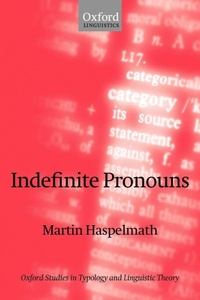
Indefinite Pronouns
Published on 8. February 2001
Book
Paperback/Softback
380 pages
978-0-19-829963-9 (ISBN)
Description
This is an open access title available under the terms of a CC BY-NC-ND 4.0 International licence. It is free to read at Oxford Scholarship Online and offered as a free PDF download from OUP and selected open access locations.
Most of the world's languages have indefinite pronouns, that is, expressions such as 'someone', 'anything', and 'nowhere'. Martin Haspelmath presents the first comprehensive and encyclopaedic investigation of indefinite pronouns in the languages of the world, mapping out the range of variation in their functional and formal properties. He shows that cross-linguistic diversity is severely constrained by a set of implicational universals and by a number of unrestricted universals.
The author treats his subject matter broadly within the Humboldt-Greenberg tradition of language typology, but also considers the contribution of other theoretical approaches to an understanding of the functional and formal properties of indefinite pronouns. The book is organized into four logically ordered steps: selection of a part of grammar-indefinite pronouns-that can be identified across languages by formal and functional criteria; investigation of the properties of indefinite pronouns in a world-wide sample of forty languages; formulation of generalizations that emerge from the data, summarized in the form of an implicational map; and theoretically-informed explanations of the generalizations, which go beyond system-internal statements, appealing to cognitive semantics, functional pressures, and universals of language change (especially grammaticalization).
Most of the world's languages have indefinite pronouns, that is, expressions such as 'someone', 'anything', and 'nowhere'. Martin Haspelmath presents the first comprehensive and encyclopaedic investigation of indefinite pronouns in the languages of the world, mapping out the range of variation in their functional and formal properties. He shows that cross-linguistic diversity is severely constrained by a set of implicational universals and by a number of unrestricted universals.
The author treats his subject matter broadly within the Humboldt-Greenberg tradition of language typology, but also considers the contribution of other theoretical approaches to an understanding of the functional and formal properties of indefinite pronouns. The book is organized into four logically ordered steps: selection of a part of grammar-indefinite pronouns-that can be identified across languages by formal and functional criteria; investigation of the properties of indefinite pronouns in a world-wide sample of forty languages; formulation of generalizations that emerge from the data, summarized in the form of an implicational map; and theoretically-informed explanations of the generalizations, which go beyond system-internal statements, appealing to cognitive semantics, functional pressures, and universals of language change (especially grammaticalization).
Reviews / Votes
of interest to all linguists with an interest in cross-linguistic variation and typology ... the book is clearly written and well edited ... the facts provided offer a great deal of food for thought to anyone with an interest in cross-linguistic work. * Molly Diesing, American Journal of Germanic Linguistics and Literatures 10.2 1998 * This volume is well presented and edited and contains an extensive bibliography on the topic of indefinite pronouns in what Haspelmath regards the mainstream of linguistics. It will appeal to specialists rather than to people with an only generalist interest in linguistics. * Peter Muhlhausler * A welcome addition to the typological literature, this book is the most comprehensive work to date devoted exclusively to the description of indefinite pronous ... in the world's languages. Haspelmath's presentation offers generally interesting reading, giving us many facts, testable universal claims, and tantalizing attempts at explanation. With its many examples, the book can serve not only as a springboard for further scholarship but also as a useful reference work for teaching. ... well-organized book... The writing style is accessible; thus the book has a potentially wide readership among both linguists and nonlinguists interested in language universals and their explanation. Haspelmath is to be applauded for attempting explanations of so many of his findings. The explanatory ideas he appeals to are seductive ones that crop up repeatedly in linguistics. * Jessica Wirth, University of Wisconsin-Milwaukee, Anthropological Linguistics, Vol 41, no.1 * The first book in a new series which aims to provide a functional-typological perspective to linguistic problems that are of both typological and formal importance. One couldn't wish for a better first book to inaugurate the series... highly recommended, not only to field workers... but also to any linguist who wants to see a textbook example of a linguistic analysis... adds significantly to our understanding of negative indefinites. Anyone working on two or more closely related languages should be required to read this book. * Ferdinand de Haan, Notes on Linguistics 2.2 *More details
Series
Language
English
Place of publication
Oxford
United Kingdom
Target group
Professional and scholarly
Illustrations
numerous line figures
Dimensions
Height: 234 mm
Width: 156 mm
Thickness: 21 mm
Weight
582 gr
ISBN-13
978-0-19-829963-9 (9780198299639)
Copyright in bibliographic data and cover images is held by Nielsen Book Services Limited or by the publishers or by their respective licensors: all rights reserved.
Schweitzer Classification
Other editions
Additional editions
Martin Haspelmath
Indefinite Pronouns
E-Book
02/2001
1st Edition
OUP Oxford
€88.99
Available for download
Person
Martin Haspelmath is a member of the scientific staff at the Max Planck Institute for Evolutionary Anthropology in Liepzig. Previous positions have included Wissenschaftlicher Assistent in the Department of English at the Free University of Berlin, and Programme Assistant to the ESF-sponsored Programme in Language Typology (EUROTYP). He is the author of 'A Grammar of Lezgian' (1993), and co-editor (with Ekkehard Konig) of 'Converbs in Cross-Linguistic Perspective' (1995).
Content
1. Overview ; 2. A Typological Perspective on Indefinite Pronouns ; 3. Formal and Functional Types of Indefinite Pronoun ; 4. An Implicational Map for Indefinite Pronoun Functions ; 5. Theoretical Approaches to the Functions of Indefinite Pronouns ; 6. The Grammaticalization of Indefinite Pronouns ; 7. Further Sources of Indefinite Pronouns ; 8. Negative Indefinite Pronouns ; 9. Conclusions ; Appendix A The Data of the 40-Language Sample ; Appendix B The Data of the 100-Language Sample