
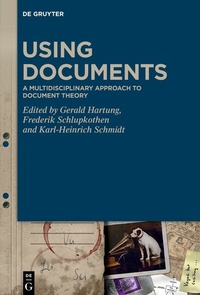
Using Documents
Description
Alles über E-Books | Antworten auf Fragen rund um E-Books, Kopierschutz und Dateiformate finden Sie in unserem Info- & Hilfebereich.
Using Documents presents an interdisciplinary discussion of human communication by means of documents, e.g., letters. Cultural scientists, together with researchers from media science and media engineering, analyze questions of document modeling, including a document's contexts of use, on the basis of cultural theory. The research also concerns the debate on the material turn in the fields of cultural studies and media studies.
Looking back on existing work, texts on written communication by the philosopher and sociologist Georg Simmel and by an interdisciplinary French group of authors under the pseudonym Roger T. Pédauque are taken as a starting point and presented afresh.
A look ahead to the future is also attempted. Whereas the modeling (including technical modeling) of documents has to date largely been limited to the description of output forms and specific content, the foundations are laid here for including documents' contexts of use in models that are grounded in cultural theory.
More details
Other editions
Additional editions

Persons
System requirements
File format: ePUB
Copy protection: Watermark-DRM (Digital Rights Management)
System requirements:
- Computer (Windows; MacOS X; Linux): Use a reading software that can process the file format ePUB: e.g., Adobe Digital Editions or FBReader – both free (see eBook Help).
- Tablet/Smartphone (Android; iOS): Before downloading, install the free app Adobe Digital Editions (see eBook Help).
- E-reader: Bookeen, Kobo, Pocketbook, Sony, Tolino and many more (not Kindle).
The file format ePUB works well for novels and non-fiction books – i.e., „flowing” text without complex layout. On an e-reader or smartphone, line and page breaks automatically adjust to fit the small displays.
This eBook uses Watermark-DRM, a „soft” copy protection. This means that there are no technical restrictions to prevent illegal distribution. However, there is a personalised watermark embedded in the eBook that can be used to identify the purchaser of the eBook in the event of misuse and to provide evidence for legal purposes.
For more information, see our eBook Help page.