

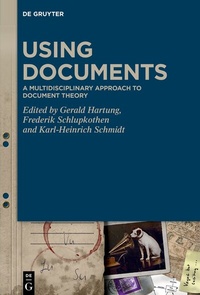
Using Documents
Description

Using Documents presents an interdisciplinary discussion of human communication by means of documents, e.g., letters. Cultural scientists, together with researchers from media science and media engineering, analyze questions of document modeling, including a document's contexts of use, on the basis of cultural theory. The research also concerns the debate on the material turn in the fields of cultural studies and media studies.
Looking back on existing work, texts on written communication by the philosopher and sociologist Georg Simmel and by an interdisciplinary French group of authors under the pseudonym Roger T. Pédauque are taken as a starting point and presented afresh.
A look ahead to the future is also attempted. Whereas the modeling (including technical modeling) of documents has to date largely been limited to the description of output forms and specific content, the foundations are laid here for including documents' contexts of use in models that are grounded in cultural theory.
More details
Other editions
Additional editions
Persons
Content
- Intro
- Acknowledgments
- Contents
- Part I: Introduction
- Preface
- Document Theory
- Part II: Using Documents
- The Document as Cultural Form
- From Manuscript to Printed Book
- Documenting as a Communicative Form
- Legibility and Viewability
- A Semiotic Perspective on the Ontology of Documents and Multimodal Textuality
- Part III: Background
- Simmel's Excursus on Written Communication
- Document: Form, Sign, and Medium, as Reformulated by Digitization
- List of Contributors
