

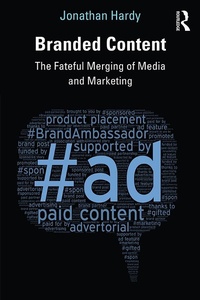
Branded Content
The Fateful Merging of Media and Marketing
1st Edition
Published on 26. August 2021
292 pages
978-1-317-27889-4 (ISBN)
Description

This is a critical study of the changing relationship between media and marketing communications in the digital age. It examines the growth of content funded by brands, including brands' own media, native advertising, and the integration of branded content across film, television, journalism and publishing, online, mobile, and social media.
This ambitious historical, empirical, and theoretical study examines industry practices, policies, and 'problems', advancing a framework for analysis of communications governance. Featuring examples from the UK, US, EU, Asia, and other regions, it illustrates and explains industry practices, forms, and formats and their relationship with changing market conditions, policies, and regulation. The book provides a wide-ranging and incisive guide to contemporary advertising and media practices, to different arguments and perspectives on these practices arising in industry, policy, and academic contexts, and to the contribution made by critical scholarship, past and present. It also offers a critical review of industry, regulatory, societal, and academic literatures.
Jonathan Hardy examines the erosion of the principle of separating advertising and media and calls for a new framework for distinguishing marketing communications across 21st-century communications. With a focus on key issues in industry, policy, and academic contexts, this is essential reading for students of media industries, advertising, marketing, and digital media.
This ambitious historical, empirical, and theoretical study examines industry practices, policies, and 'problems', advancing a framework for analysis of communications governance. Featuring examples from the UK, US, EU, Asia, and other regions, it illustrates and explains industry practices, forms, and formats and their relationship with changing market conditions, policies, and regulation. The book provides a wide-ranging and incisive guide to contemporary advertising and media practices, to different arguments and perspectives on these practices arising in industry, policy, and academic contexts, and to the contribution made by critical scholarship, past and present. It also offers a critical review of industry, regulatory, societal, and academic literatures.
Jonathan Hardy examines the erosion of the principle of separating advertising and media and calls for a new framework for distinguishing marketing communications across 21st-century communications. With a focus on key issues in industry, policy, and academic contexts, this is essential reading for students of media industries, advertising, marketing, and digital media.
Reviews / Votes
"Advertising has 'gone native'. From sponsorship and product placement to advergames and YouTube influencers brand promotion is now stitched seamlessly into media flows of news, fiction, entertainment, conversation and interaction. Jonathan Hardy's carefully researched forays have produced the best map so far of this expanding territory and prompted thoughtful reflections on how we should respond. Filled with informative examples and provocative insights it is indispensable reading for anyone concerned with the accelerating corporate enclosure of public expression" - Graham Murdock, Professor of Media and Communication at Loughborough University London"Branded Content zeros in on the signal social challenge of financing the media in the 21st century. With this book, Jonathan Hardy provides an expert, accessible guide to major developments coursing through the advertising-and-media system. Adamant about the importance of historical understanding, he links the past to the present and possible future. He carefully lays out the political economic and social factors guiding and resisting branded content developments. While his focus is branded content, Hardy ranges across several forms of advertising-media relationships, interrogating their often-problematic implications for audiences and suggesting possible policy responses." - Joseph Turow, Professor of Media Systems & Industries, The Annenberg School for Communication.
"Branded Content is a timely intervention into conversations about the fate of media in the twenty-first century, arguing that the convergence of media and marketing organizations is both inevitable and fraught with consequence. With a measured, taxonomic approach to the messy world of branded content, native advertising, and content marketing, Hardy details the gradual encroachment of advertising into other kinds of communicative spaces, as well as efforts to regulate such encroachments. Drawing on and updating critical political economy, Hardy convincingly demonstrates that research approaches to the converged world of branded content require a rethinking not only of theories of media and capital, but of the disciplinary structures of communications research itself." - Lisa Lynch, Associate Professor and Program Director of Media and Communications, Drew University
More details
Edition
1. Auflage
Language
English
Place of publication
London
United Kingdom
Publishing group
Taylor & Francis Ltd
Target group
College/higher education
Illustrations
2 Tables, black and white
ISBN-13
978-1-317-27889-4 (9781317278894)
Copyright in bibliographic data and cover images is held by Nielsen Book Services Limited or by the publishers or by their respective licensors: all rights reserved.
Schweitzer Classification
Other editions
Additional editions
Book
08/2021
1st Edition
Routledge
€208.00
Shipment within 10-20 days
Book
08/2021
1st Edition
Routledge
€60.60
Shipment within 10-20 days
Book
08/2021
Routledge
Unfortunately, price unknown
Available (delivery time upon request)
Person
Jonathan Hardy is Professor of Communications and Media at the University of the Arts London. He writes and comments on media industries, media and advertising, communications regulation, and international media systems. His books include Critical Political Economy of the Media (2014), Cross-Media Promotion (2010), and Western Media Systems (2008). He is co-editor of The Advertising Handbook (2018) and is series editor of Routledge Critical Advertising Studies. He is a member of the editorial boards of Digital Journalism, Political Economy of Communication, Mediterranean Journal of Communication, and TripleC: Communication, Capitalism & Critique.
Content
Part One: Practices 1 Advertising and media: separation and integration 2. News Media and Marketing 3. Branded entertainment and product integration 4. Brand content direct to you: marketers' 'owned' media 5. Going native in digital media 6. Media as Marketers Part Two: Policies and Problems 7. Regulating convergent media and marketing communications 8. Lobbying, liberalisation, normalisation, and contestation 9. Communication gains and losses: economic, cultural, and societal 10. Media and marketing critiques: renewing the radical tradition 11. Advertising and Media (reprise): contesting normalisation
