

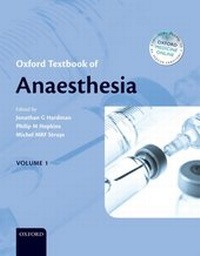
Oxford Textbook of Anaesthesia
1st Edition
Published on 28. April 2017
1680 pages
978-0-19-250825-6 (ISBN)
Description

This definitive resource from the eminent Oxford Textbooks series, the Oxford Textbook of Anaesthesia addresses the fundamental principles, underpinning sciences and the full spectrum of clinical practice. It brings together the most pertinent research from on-going scientific endeavours with practical guidance and a passion to provide the very best clinical care to patients. This comprehensive work covers all aspects of anaesthesia, volume one addresses the fundamental principles and the basic sciences whose understanding is required for a logical, effective and evidence-based approach to practice. Volume two focuses on the clinical aspects of anaesthesia, including those aspects of intensive care and pain medicine that are required by all general anaesthetists as well as sections dedicated to procedures, surgical specialities, paediatrics, the conduct ofanaesthesia outside the theatre, and concurrent disease. In 91 finely crafted and highly illustrated chapters, experts in anaesthesia review the supporting evidence and key techniques for the clinical management of specific conditions and patient groups. International contributors share their research and extensive experience to provide a wealth of practical advice for use in clinical situations in a global context. The Oxford Textbook of Anaesthesia will publish both in print and online on Oxford Medicine Online where it can be accessed via smartphone or similar devices and will be updated annually to reflect major changes in clinical practice. The print edition of the Oxford Textbook of Anaesthesia comes with a year's access to the online version. This essential reference tool supports all anaesthetists seeking an up-to-date and trustworthy account of all aspects of anaesthesia. It will be an indispensable guide to anaesthetists of all grades and subspecialty interest.
More details
Other editions
Additional editions
Jonathan G. Hardman | Philip M. Hopkins | Michel M.R.F Struys
Oxford Textbook of Anaesthesia
Other
04/2017
Oxford University Press
€448.21
Article exhausted; check different version
Content
- Cover
- Series
- Volume 1
- Copyright
- Dedication
- Brief contents
- Contents
- Abbreviations
- Part editors
- Contributors
- Part 1 Applied physiology in anaesthesia
- 1 Cardiac and vascular physiology in anaesthetic practice
- 2 Respiratory physiology in anaesthetic practice
- 3 Fluid and electrolyte physiology in anaesthetic practice
- 4 Gastrointestinal physiology in anaesthetic practice
- 5 Kidney and acid-?base physiology in anaesthetic practice
- 6 Central nervous system physiology in anaesthetic practice
- 7 Neuromuscular physiology in anaesthetic practice
- 8 Neuroendocrine physiology in anaesthetic practice
- 9 Pain physiology in anaesthetic practice
- 10 Immune system physiology in anaesthetic practice
- 11 The physiology of blood in anaesthetic practice
- Part 2 Applied pharmacology in anaesthesia
- 12 Drug distribution and elimination in anaesthetic practice
- 13 Mechanisms and determinants of anaesthetic drug action
- 14 Inhaled anaesthetics
- 15 Intravenous anaesthetics
- 16 Neuromuscular blockade and reversal
- 17 Local anaesthetic agents
- 18 Analgesics in anaesthetic practice
- 19 Cardiovascular drugs in anaesthetic practice
- 20 Intravenous fluids in anaesthetic practice
- 21 Drug interactions in anaesthetic practice
- 22 Adverse drug reactions in anaesthesia
- Part 3 Physics, equipment, measurement, and hazards
- 23 Physics in anaesthesia
- 24 Equipment in anaesthesia
- 25 Measurement and monitoring in anaesthesia
- 26 Assessment of the components of anaesthesia
- Part 4 Mathematics, statistics, and evidence-based medicine
- 27 Mathematical models and anaesthesia
- 28 Presentation and handling of data, descriptive and inferential statistics
- 29 Evidence-?based medicine in anaesthesia
- 30 Clinical trial designs in anaesthesia
- Part 5 The practice of anaesthesia
- 31 The history of anaesthesia
- 32 The roles and responsibilities of the anaesthesiologist
- 33 Ethics, consent, benefit, and risk in anaesthetic practice
- 34 Informatics and technology for anaesthesia
- 35 Human factors and simulation in anaesthetic practice
- 36 Safety and quality assurance in anaesthesia
- 37 Teaching in anaesthesia
- 38 Research in anaesthesia
- 39 Outcomes of anaesthesia
- Part 6 Management of anaesthesia
- 40 Preoperative assessment and optimization
- 41 Choice and interpretation of preoperative investigations
- 42 Management of anaesthesia
- 43 Intraoperative monitoring
- 44 Hazards in anaesthetic practice: general considerations, injury, and drugs
- 45 Hazards in anaesthetic practice: body systems and occupational hazards
- 46 Post-?surgical analgesia and acute pain management
- 47 Post-?surgery, post-?anaesthesia complications
- Index
- Cover
- Series
- Volume 2
- Part 7 Procedures, techniques, and therapies
- 48 The airway in anaesthetic practice
- 49 Vascular access during anaesthesia
- 50 Conscious sedation
- 51 Blood conservation and transfusion in anaesthesia
- Part 8 Regional anaesthesia
- 52 General principles of regional anaesthesia
- 53 Regional anaesthesia of the trunk
- 54 Regional anaesthesia of the upper limb
- 55 Regional anaesthesia of the lower limb
- Part 9 The conduct of anaesthesia by surgical specialty
- 56 Anaesthesia for cardiac surgery
- 57 Anaesthesia for thoracic surgery
- 58 Anaesthesia for vascular surgery
- 59 Anaesthesia for neurosurgery and electroconvulsive therapy
- 60 Anaesthesia for ophthalmic surgery
- 61 Anaesthesia for abdominal surgery
- 62 Anaesthesia for urological surgery and for robotic surgery in urology and gynaecology
- 63 Anaesthesia for orthopaedic and trauma surgery
- 64 Anaesthesia for plastic surgery and burns
- 65 Anaesthesia for ENT, dental, and maxillofacial surgery
- 66 Obstetric anaesthesia and analgesia
- 67 Anaesthesia for transplant surgery
- 68 Anaesthesia for day-stay surgery
- Part 10 Paediatric anaesthesia
- 69 Anatomy, physiology, and pharmacology in paediatric anaesthesia
- 70 Neonatal anaesthesia
- 71 Anaesthesia for the infant and older child
- 72 Procedural sedation in children
- 73 Acute paediatric pain management
- 74 Resuscitation, stabilization, and transfer of sick and injured children
- 75 Ethics, consent, and safeguarding in paediatric anaesthesia
- Part 11 The conduct of anaesthesia outside the operating theatre
- 76 Pre-hospital care for the anaesthetist
- 77 Anaesthesia for medical imaging and bronchoscopic procedures
- 78 Military anaesthesia
- Part 12 Anaesthesia and concurrent disease
- 79 Endocrine disease and anaesthesia
- 80 Musculoskeletal disorders and anaesthesia
- 81 Central nervous system pathologies and anaesthesia
- 82 Pulmonary disease and anaesthesia
- 83 Heart disease and anaesthesia
- 84 Haematological and coagulation disorders and anaesthesia
- 85 Hepatic and renal disease and anaesthesia
- 86 Anaesthesia in the elderly
- 87 Anaesthesia for the obese patient
- Paet 13 Critical care and the anaesthetist
- 88 Pre-surgical optimization of the high- risk patient
- 89 Acute illness in the postoperative period
- 90 Transport of the critically ill patient
- 91 Advanced life support
