

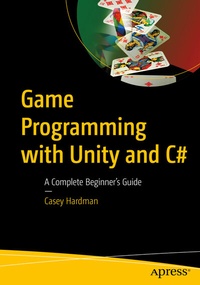
Game Programming with Unity and C#
A Complete Beginner's Guide
Published on 13. June 2020
XX, 577 pages
978-1-4842-5656-5 (ISBN)
Description

Designed for beginners with no knowledge or experience in game development or programming, this book teaches the essentials of the Unity game engine, the C# programming language, and the art of object-oriented programming. New concepts are not only explained, but thoroughly demonstrated.
Starting with an introduction to Unity, you'll learn about scenes, GameObjects, prefabs, components, and how to use the various windows to interact with the engine. You'll then dive into the fundamentals of programming by reviewing syntax rules, formatting, methods, variables, objects and types, classes, and inheritance, all while getting your hands dirty writing and testing code yourself. Later, the book explains how to expose script data in the Inspector and the basics of Unity's serialization system.
This carefully crafted work guides you through the planning and development of bare bones, simple game projects designed to exercise programming concepts while keeping less relevant interruptions out of the way, allowing you to focus on the implementation of game mechanics first and foremost. Through these example projects, the book teaches input handling, rigidbodies, colliders, cameras, prefab instantiation, scene loading, user interface design and coding, and more.
By the end, you'll have built a solid foundation in programming that will pave your way forward in understanding core C# syntax and fundamentals of object-oriented programming-not just what to type but why it's typed and what it's really doing. Game Programming with Unity and C# will send you on your way to becoming comfortable with the Unity game engine and its documentation and how to independently seek further information on yet-untouched concepts and challenges.
What You'll Learn
Beginners who have no prior experience in programming or game development who would like to learn with a solid foundation that prepares them to further develop their skills.
Starting with an introduction to Unity, you'll learn about scenes, GameObjects, prefabs, components, and how to use the various windows to interact with the engine. You'll then dive into the fundamentals of programming by reviewing syntax rules, formatting, methods, variables, objects and types, classes, and inheritance, all while getting your hands dirty writing and testing code yourself. Later, the book explains how to expose script data in the Inspector and the basics of Unity's serialization system.
This carefully crafted work guides you through the planning and development of bare bones, simple game projects designed to exercise programming concepts while keeping less relevant interruptions out of the way, allowing you to focus on the implementation of game mechanics first and foremost. Through these example projects, the book teaches input handling, rigidbodies, colliders, cameras, prefab instantiation, scene loading, user interface design and coding, and more.
By the end, you'll have built a solid foundation in programming that will pave your way forward in understanding core C# syntax and fundamentals of object-oriented programming-not just what to type but why it's typed and what it's really doing. Game Programming with Unity and C# will send you on your way to becoming comfortable with the Unity game engine and its documentation and how to independently seek further information on yet-untouched concepts and challenges.
What You'll Learn
- Understand the fundamentals of object-oriented computer programming, including topics specifically relevant for games.
-
Leverage beginner-to-intermediate-level skills of the C# programming language and its syntax.
- Review all major component types of the Unity game engine: colliders and rigidbodies, lights, cameras, scripts, etc.
- Use essential knowledge of the Unity game engine and its features to balance gameplay mechanics for making interesting experiences.
Beginners who have no prior experience in programming or game development who would like to learn with a solid foundation that prepares them to further develop their skills.
More details
Series
Edition
First Edition
Language
English
Place of publication
Berkeley
United States
Publishing group
APRESS
Target group
Professional and scholarly
Product notice
Reflowable
Illustrations
XX, 577 p. 121 illus.
File size
8,74 MB
ISBN-13
978-1-4842-5656-5 (9781484256565)
DOI
10.1007/978-1-4842-5656-5
Schweitzer Classification
Other editions
New editions
E-Book
12/2023
2nd Edition
APress
€62.99
Available for download
Additional editions
Book
06/2020
1st Edition
APress
€48.14
Article exhausted; check for reprint
Person
Casey Hardman is a hobbyist game developer, who found inspiration in the capacity for immersion and interactivity provided by games. His area of focus is the Unity game engine. He has nurtured a passion for video games since he was a child. In his early teens, this interest led him on a journey into the world of game design and programming. He is self-taught through a variety of personal projects, some small and some lofty. He has been regular contributor on various online game development platforms and spends far too much time in front of a keyboard.
Content
Chapter 1: Installation and Setup.- Chapter 2: Unity Basics.- Chapter 3: Manipulating the Scene.- Chapter 4: Parents and their Children.- Chapter 5: Prefabs.- Chapter 6: Programming Primer.- Chapter 7: Code Blocks and Methods.- Chapter 8: Conditions.- Chapter 9: Working with Objects.- Chapter 10: Working with Scripts.- Chapter 11: Inheritance.- Chapter 12:Debugging.- Game Project 1: Obstacle Course.- Chapter 13.- Obstacle Course Design and Outline.- Chapter 14: Player Movement.- Chapter 15: Death and Respawning.- Chapter 16: Basic Hazards.- Chapter 17: Walls and Goals.- Chapter 18:Patrolling Hazards.- Chapter 19: Wandering Hazards.- Chapter 20:Dashing.- chapter 21:Designing Levels- Chapter 22: Menus and UI.- Chapter 23: In-Game Pause Menu.- Chapter 24: Spike Traps.- Chapter 25: Obstacle Course Conclusion.- Game Project 2: Tower Defense.- Chapter 26: Tower Defense Design and Outline.- Chapter 27: Camera Movement.- Chapter 28: Enemies, Towers, and Projectiles.- Chapter 29: Build Mode.- Chapter 30 Play Mode.- Chapter 31: More Tower Types.- Chapter 32: Tower Defense Conclusion.- Game Project 3: Physics Playground.- Chapter 33: Physics Playground Design and Outline.- Chapter 34: Mouse-Aimed Camera.- Chapter 35: Advanced 3D Movement.- Chapter 36: Wall Jumping.- Chapter 37: Pulling and Pushing.- Chapter 38: Moving Platforms.- Chapter 389 Joints and Swings.- Chapter 40: Force Fields and Jump Pads.- Chapter 41: Physics Playground Conclusion and More
