

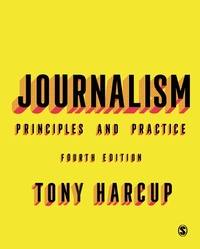
Journalism
Principles and Practice
4th Edition
Published on 6. October 2021
328 pages
978-1-5297-6524-3 (ISBN)
Description

"A classic text of journalism education that goes beyond the basics to ask the questions that anyone thinking of becoming a journalist really needs to consider. An ethical, entertaining and enduring read - highly recommended."
- Michelle Stanistreet, General Secretary, National Union of Journalists
This is the one book you need to guide you through university and into your career in journalism.
It features stories and tips from a diverse range of journalists, including Ayshah Tull and Cathy Newman of Channel 4 News; Emma Youle of HuffPost; Andrew Norfolk of the Times; and the Mirror's Nada Farhoud.
Covering everything from print to podcasting, it will equip you with the skills and understanding you need to become a successful and ethical journalist.
Tony Harcup's Journalism: Principles and Practice is simply the best guide there is to studying and practising journalism today.
"A holistic assessment of what journalism is all about, with plenty of enterprising interpretations of our trade - a word I prefer to 'profession'. I never met a more 'unprofessional' breed than that of my fellow hacks. This book will, I hope, lead our successors both to question and rebel more than we have."
- Jon Snow, Channel 4 News
- Michelle Stanistreet, General Secretary, National Union of Journalists
This is the one book you need to guide you through university and into your career in journalism.
It features stories and tips from a diverse range of journalists, including Ayshah Tull and Cathy Newman of Channel 4 News; Emma Youle of HuffPost; Andrew Norfolk of the Times; and the Mirror's Nada Farhoud.
Covering everything from print to podcasting, it will equip you with the skills and understanding you need to become a successful and ethical journalist.
Tony Harcup's Journalism: Principles and Practice is simply the best guide there is to studying and practising journalism today.
"A holistic assessment of what journalism is all about, with plenty of enterprising interpretations of our trade - a word I prefer to 'profession'. I never met a more 'unprofessional' breed than that of my fellow hacks. This book will, I hope, lead our successors both to question and rebel more than we have."
- Jon Snow, Channel 4 News
Reviews / Votes
"Journalism still matters. How it's done, why it's done, by whom and for whom remain at the heart of this updated edition. Harcup draws on a rich diversity of voices to cast a critical, yet practical eye on journalism now, providing an indispensable resource for all who are interested in news." -- Dr Margaret Hughes "A classic text of journalism education that goes beyond the basics to ask the questions that anyone thinking of becoming a journalist really needs to consider. An ethical, entertaining and enduring read - highly recommended." -- Michelle Stanistreet "A holistic assessment of what journalism is all about, with plenty of enterprising interpretations of our trade - a word I prefer to 'profession'. I never met a more 'unprofessional' breed than that of my fellow hacks. This book will, I hope, lead our successors both to question and rebel more than we have." -- Jon SnowMore details
Edition
Fourth Edition
Language
English
Place of publication
London
United Kingdom
Publishing group
Sage Publications Ltd (Digital)
Target group
College/higher education
Product notice
Reflowable
ISBN-13
978-1-5297-6524-3 (9781529765243)
Copyright in bibliographic data and cover images is held by Nielsen Book Services Limited or by the publishers or by their respective licensors: all rights reserved.
Schweitzer Classification
Other editions
Additional editions
Book
11/2021
4th Edition
SAGE Publications Ltd
€176.40
Shipment within 15-20 days
Book
10/2021
4th Edition
SAGE Publications Ltd
€110.80
Shipment within 15-20 days
Person
Tony Harcup is an Emeritus Fellow of the University of Sheffield whose writing about journalism can be found on reading lists around the world and has been translated into Chinese, Korean and Polish, among other languages.
Before moving into journalism education, Tony spent many years working as a staff and freelance journalist on alternative and mainstream media ranging from small local weekly publications to national newspapers, magazines and websites.
He has researched extensively in the fields of news values, journalistic ethics, alternative journalism and journalism education. His best-selling book Journalism: Principles and Practice (Sage, 2021) is now in its fourth edition, and his other titles include The Ethical Journalist (Sage, 2007) and What's the Point of News? (Palgrave, 2020).
Before moving into journalism education, Tony spent many years working as a staff and freelance journalist on alternative and mainstream media ranging from small local weekly publications to national newspapers, magazines and websites.
He has researched extensively in the fields of news values, journalistic ethics, alternative journalism and journalism education. His best-selling book Journalism: Principles and Practice (Sage, 2021) is now in its fourth edition, and his other titles include The Ethical Journalist (Sage, 2007) and What's the Point of News? (Palgrave, 2020).
Content
Part 1: What is Journalism?
Chapter 1: The Who, What, Where, When, Why and How of Journalism
Chapter 2: Constraints and Influences on Journalists
Chapter 3: What is News?
Chapter 4: Where Does News Come From?
Chapter 5: "The Best Obtainable Version of the Truth": Journalists as Objective Reporters?
Chapter 6: "Be Curious and Sceptical": Journalists as Investigators
Chapter 7: "We Are in the Entertainment Business": Journalists as Entertainers
Part 2: How To Do Journalism
Chapter 8: Interviewing for Journalism
Chapter 9: Writing News
Chapter 10: Writing Features
Chapter 11: Telling Stories in Sound and Vision
Chapter 12: Doing It in Style: The Language of Journalism
Part 3: What Now for Journalism?
Chapter 13: An Ethical Approach to Journalism
Chapter 14: "Our History Will Be What We Make It": Journalism Today, Tomorrow and the Day After
Appendix: Style Guide for Journalists
Chapter 1: The Who, What, Where, When, Why and How of Journalism
Chapter 2: Constraints and Influences on Journalists
Chapter 3: What is News?
Chapter 4: Where Does News Come From?
Chapter 5: "The Best Obtainable Version of the Truth": Journalists as Objective Reporters?
Chapter 6: "Be Curious and Sceptical": Journalists as Investigators
Chapter 7: "We Are in the Entertainment Business": Journalists as Entertainers
Part 2: How To Do Journalism
Chapter 8: Interviewing for Journalism
Chapter 9: Writing News
Chapter 10: Writing Features
Chapter 11: Telling Stories in Sound and Vision
Chapter 12: Doing It in Style: The Language of Journalism
Part 3: What Now for Journalism?
Chapter 13: An Ethical Approach to Journalism
Chapter 14: "Our History Will Be What We Make It": Journalism Today, Tomorrow and the Day After
Appendix: Style Guide for Journalists
