

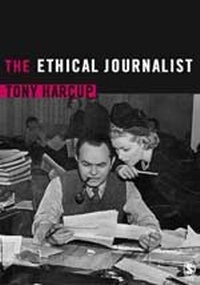
The Ethical Journalist
1st Edition
Published on 30. November 2006
224 pages
978-1-84860-497-1 (ISBN)
Description

"As one of the main scriptwriters of the two internal BBC training sessions which were produced following the Hutton inquiry, I can heartily recommend this book."
- Peter Stewart, BBC Training Department
"Packed with illustrations of journalistic heroism and skulduggery... This is an engaging and useful reference book and should become essential reading for serious students of journalism and for those who practise it."
- Times Higher Education Supplement
"A must-read for all journalists - be they reporters, editors or bloggers. It is both a straightforward explanation of ethical dilemmas using real-life examples and a subtle commentary on the state of British journalism."
- British Journalism Review
"This engaging nd accessible book cannot fail to inspire those who want to be good journalists in every sense of the word."
- Journalism Practice
Everything that journalists do has ethical implications, and in this book Tony Harcup explores the range of issues likely to confront those studying journalism or training to become journalists. The starting point for this engaging and innovative book is that ethical journalism is good journalism.
Building on the reflective and questioning approach of the author's acclaimed Journalism: Principles and Practice, this book discusses journalists' personal anecdotes alongside relevant critical studies by academics. Original interviews include Andrew Gilligan on his meeting with weapons expert Dr David Kelly and Ryan Parry on being an undercover reporter in Buckingham Palace.
Informed by new research and the author's own experience within mainstream and alternative journalism, The Ethical Journalist addresses topics such as trust, the public interest, deception, news values, source relationships, crime reporting, regulation and the Hutton inquiry.
This exciting new title discusses ethics as fundamental rather than as a set of problems or an added extra, and it should become essential reading for everyone interested in journalism.
- Peter Stewart, BBC Training Department
"Packed with illustrations of journalistic heroism and skulduggery... This is an engaging and useful reference book and should become essential reading for serious students of journalism and for those who practise it."
- Times Higher Education Supplement
"A must-read for all journalists - be they reporters, editors or bloggers. It is both a straightforward explanation of ethical dilemmas using real-life examples and a subtle commentary on the state of British journalism."
- British Journalism Review
"This engaging nd accessible book cannot fail to inspire those who want to be good journalists in every sense of the word."
- Journalism Practice
Everything that journalists do has ethical implications, and in this book Tony Harcup explores the range of issues likely to confront those studying journalism or training to become journalists. The starting point for this engaging and innovative book is that ethical journalism is good journalism.
Building on the reflective and questioning approach of the author's acclaimed Journalism: Principles and Practice, this book discusses journalists' personal anecdotes alongside relevant critical studies by academics. Original interviews include Andrew Gilligan on his meeting with weapons expert Dr David Kelly and Ryan Parry on being an undercover reporter in Buckingham Palace.
Informed by new research and the author's own experience within mainstream and alternative journalism, The Ethical Journalist addresses topics such as trust, the public interest, deception, news values, source relationships, crime reporting, regulation and the Hutton inquiry.
This exciting new title discusses ethics as fundamental rather than as a set of problems or an added extra, and it should become essential reading for everyone interested in journalism.
Reviews / Votes
'He offers dozens of stories, interviews with reporters, and historical references to bolster his idea that from reflective practitioners comes ethical journalism, and ethical journalism is good journalism... As a guide to applied ethics in international journalism, this collection of recent and historical cases provides grist for solid debate... Altogether The Ethical Journalist presents a glimpse at how British and other journalists grapple with the ethical demands of their employers, their audiences, and even their governments' -Jan Leach
Journal of Mass Media Ethics.
All prices
More details
Language
English
Place of publication
London
United Kingdom
Target group
College/higher education
ISBN-13
978-1-84860-497-1 (9781848604971)
Copyright in bibliographic data and cover images is held by Nielsen Book Services Limited or by the publishers or by their respective licensors: all rights reserved.
Schweitzer Classification
Other editions
Additional editions
Tony Harcup
The Ethical Journalist
Book
11/2006
1st Edition
SAGE Publications Inc
€220.24
Shipment within 10-20 days
Tony Harcup
The Ethical Journalist
Book
11/2006
1st Edition
SAGE Publications Inc
€97.40
Shipment within 10-20 days
Person
Tony Harcup is an Emeritus Fellow of the University of Sheffield whose writing about journalism can be found on reading lists around the world and has been translated into Chinese, Korean and Polish, among other languages.
Before moving into journalism education, Tony spent many years working as a staff and freelance journalist on alternative and mainstream media ranging from small local weekly publications to national newspapers, magazines and websites.
He has researched extensively in the fields of news values, journalistic ethics, alternative journalism and journalism education. His best-selling book Journalism: Principles and Practice (Sage, 2021) is now in its fourth edition, and his other titles include The Ethical Journalist (Sage, 2007) and What's the Point of News? (Palgrave, 2020).
Before moving into journalism education, Tony spent many years working as a staff and freelance journalist on alternative and mainstream media ranging from small local weekly publications to national newspapers, magazines and websites.
He has researched extensively in the fields of news values, journalistic ethics, alternative journalism and journalism education. His best-selling book Journalism: Principles and Practice (Sage, 2021) is now in its fourth edition, and his other titles include The Ethical Journalist (Sage, 2007) and What's the Point of News? (Palgrave, 2020).
Content
Introduction to ethical journalism
Why journalism matters
Knowledge is power
In the public interest
Danger: news values at work
Can I quote you on that? Journalists and their sources
Round up the usual suspects: how crime is reported in the media
The regulation of journalism
Standing up for standards
Ethical journalism is good journalism
Why journalism matters
Knowledge is power
In the public interest
Danger: news values at work
Can I quote you on that? Journalists and their sources
Round up the usual suspects: how crime is reported in the media
The regulation of journalism
Standing up for standards
Ethical journalism is good journalism
