

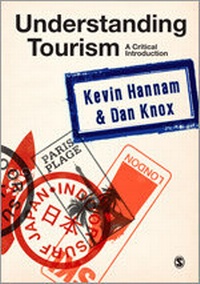
Understanding Tourism
A Critical Introduction
1st Edition
Published on 15. March 2010
240 pages
978-1-4462-0429-0 (ISBN)
Description

This text introduces tourism students to concepts drawn from critical theory, cultural studies and the social sciences. It does so with a light and readable touch, highlighting the ideas that underlie contemporary critical tourism studies in a practical and engaging way.
Specifically, the authors examine how post-structuralist thought has led to a re-imagining of power relationships and the ways in which they are central to the production and consumption of tourism experiences.
Eleven clear, relevant chapters provide an accessible introduction to tourism defining, explaining and developing the key issues and methods in this exciting field.
These topics include:
* Regulating Tourism
* Commodifying Tourism
* Embodying Tourism
* Performing Tourism
* Tourism and the Everyday
* Tourism and the Other
* Tourism and the Environment
* Tourism and the Past
* Tourism Mobilities
* Researching Tourism
A strong teaching text, this will be well received by lecturers seeking an authoritative, multi-disciplinary book on contemporary tourism and by students who want a practical, grounded introduction which understands their learning and research needs.
Specifically, the authors examine how post-structuralist thought has led to a re-imagining of power relationships and the ways in which they are central to the production and consumption of tourism experiences.
Eleven clear, relevant chapters provide an accessible introduction to tourism defining, explaining and developing the key issues and methods in this exciting field.
These topics include:
* Regulating Tourism
* Commodifying Tourism
* Embodying Tourism
* Performing Tourism
* Tourism and the Everyday
* Tourism and the Other
* Tourism and the Environment
* Tourism and the Past
* Tourism Mobilities
* Researching Tourism
A strong teaching text, this will be well received by lecturers seeking an authoritative, multi-disciplinary book on contemporary tourism and by students who want a practical, grounded introduction which understands their learning and research needs.
Reviews / Votes
An insightful and original approach to different aspects of tourism...The book is admirable for the interesting, vivid and shrewd style of writing which makes it really enjoyable for reading. Fun and humour are deliberately and successfully interwoven into the elevated academic analysis, thus making this text equally valuable for professionals, academics, students and anyone else who is passionate about tourismEuropean Journal of Tourism Research
At last! A refreshingly lucid text for students that substantially enriches the analysis of tourism and tourists. Hannam and Knox explore the recent theoretical insights that have helped tourist studies to escape from a self-imposed academic ghetto and have multiplied approaches to making sense of tourism. Clear, concise and stimulating
Tim Edensor
Manchester Metropolitan University
With this book Hannam and Knox have gone a long way towards elevating the study of tourism from the obscure margins of social science into a bona fide research area. They encourage us to think critically about the subject and successfully interweave dominant contemporary concepts to present tourism as a social, cultural, economic, and spatial phenomenon. Students will be sure to enjoy this innovative contribution which takes a 'user-friendly' approach and provides a useful pedagogic tool for those at all levels of study
Dimitri Ioannides
Professor of Human Geography; Mid-Sweden University and ETOUR
Understanding Tourism provides an in-depth and critical analysis of tourism studies that is conceptually rich, empirically strong and extremely accessible to scholars and students of tourism. It is a refreshing analysis of an extremely complex and multidimensional global phenomenon, and raises our understanding of tourism to new heights
Dallen Timothy
Professor of Tourism Development and Management, Arizona State University
A very interesting mobilities view of tourism with useful student-friendly text and exercises
John Urry
Distinguished Professor, Lancaster University
This is a useful and accessible introduction to critical approaches to tourism that will be a value for lecturers and students alike. The provision of many thought-provoking exercises will be of benefit for both teaching and learning
Greg Richards
Annals of Tourism Research
All prices
More details
Language
English
Place of publication
London
United Kingdom
Target group
College/higher education
ISBN-13
978-1-4462-0429-0 (9781446204290)
Copyright in bibliographic data and cover images is held by Nielsen Book Services Limited or by the publishers or by their respective licensors: all rights reserved.
Schweitzer Classification
Other editions
Additional editions
Book
03/2010
1st Edition
SAGE Publications Inc
€220.24
Shipment within 10-20 days
Book
03/2010
1st Edition
SAGE Publications Inc
€66.00
Shipment within 10-20 days
Persons
Professor Kevin Hannam recently joined the Carnegie Faculty at Leeds Beckett University as Professor of Tourism Mobilities from the University of Sunderland where he was Associate Dean (Research) and Head of the Department of Tourism, Hospitality & Events. Dr Dan Knox is Senior Lecturer in Tourism and Events Management at the University of West England, Bristol.
Content
Understanding Tourism
Regulating Tourism
Commodifying Tourism
Embodying Tourism
Performing Tourism
Tourism and the Everyday
Tourism and the Other
Tourism and the Environment
Tourism and the Past
Tourism Mobilities
Researching Tourism
Regulating Tourism
Commodifying Tourism
Embodying Tourism
Performing Tourism
Tourism and the Everyday
Tourism and the Other
Tourism and the Environment
Tourism and the Past
Tourism Mobilities
Researching Tourism
