

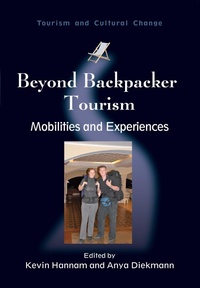
Beyond Backpacker Tourism
Mobilities and Experiences
Published on 2. February 2010
248 pages
978-1-84541-190-9 (ISBN)
Description

Building on previous work on backpacking, this book takes the analysis of backpacker tourism further by engaging both with new theoretical debates into tourism experiences and mobilities as well as with new empirical phenomena such as the rise of the 'flashpacker' and alternative destinations. Chapters include material on flashpacking, the virtualization of backpacker culture, the re-conceptualisation of lifestyle travellers, backpackers as volunteer tourists, as well as backpackers' experiences of hostels, mobilities and their policy implications. It sets a new benchmark for the study of independent travel in the contemporary world.
Reviews / Votes
This excellent edited collection by international scholars clearly demonstrates the ongoing research agenda of backpacking. It offers a critical contribution by engaging with the changing dynamics of backpacking and examines a range of complex issues. A delightful find in this book is that, not only are the mainstream destinations discussed but lesser known areas (such as: Mongolia, Tanzania and Norway) are evident and add to the book's richness. -- Angela Benson, University of Brighton, UK Beyond Backpacker Tourism provides a useful overview of the current state of backpacking and of the kind of research being undertaken on the subject. -- Frances Brown, Seabank, Maidens, Scotland, UK * Tourism Recreation Research Vol. 36, No. 1, 2011 * Beyond Backpacker Tourism is the newest edited volume to be produced by the Backpacker Research Group (BRG) of the Association for Tourism and Leisure Education. It follows Backpacker Tourism (Hannam & Ateljevic, 2008) and The Global Nomad (Richards & Wilson, 2004). While the editors stress they did not attempt to provide an ''exhaustive account of backpacker tourism research'' (p. 1), they nevertheless succeed in presenting a thorough picture of developments within backpacker research that is as enlightening as the two previous offerings. -- Benjamin Lucca Iaquinto, Monash University, Australia * Annals of Tourism Research 38 (2011) 723-743, 2011 *More details
Series
Language
English
Place of publication
Bristol
United Kingdom
Publishing group
Channel View Publications Ltd
Target group
College/higher education
Professional and scholarly
ISBN-13
978-1-84541-190-9 (9781845411909)
Copyright in bibliographic data and cover images is held by Nielsen Book Services Limited or by the publishers or by their respective licensors: all rights reserved.
Schweitzer Classification
Other editions
Additional editions
Book
02/2010
Channel View Publications
€48.00
Shipment within 10-20 days
Persons
Kevin Hannam is Chair of the ATLAS Backpacker Research Group (BRG). He is currently Professor of Tourism Development at the University of Sunderland, UK. He has published widely on tourism theory and is co-author of the text Understanding Tourism and co-editor of the journal Mobilities.
Anya Diekmann is coordinator of ATLAS Europe. She is Assistant Professor at the IGEAT and co-director of LIToTeS (Laboratoire interdisciplinaire Tourisme, Territoire et Societes), Universite Libre de Bruxelles, Belgium. Her publications include work on social tourism and aspects of cultural tourism with a particular focus on heritage and ethnic tourism.
Anya Diekmann is coordinator of ATLAS Europe. She is Assistant Professor at the IGEAT and co-director of LIToTeS (Laboratoire interdisciplinaire Tourisme, Territoire et Societes), Universite Libre de Bruxelles, Belgium. Her publications include work on social tourism and aspects of cultural tourism with a particular focus on heritage and ethnic tourism.
Content
1. From Backpacking to Flashpacking: Developments in Backpacker Tourism Research - Kevin Hannam and Anya Diekmann
2. Not such a Rough or Lonely planet? Backpacker Tourism: An Academic Journey - Mark P. Hampton
3. Flashpacking in Fiji: Reframing the 'Global Nomad' in a Developing Destination - Jeff Jarvis and Victoria Peel
4. The Virtualization of Backpacker Culture: Virtual Mooring, Sustained Interactions, and Enhanced Mobilities - Cody Paris
5. Re-Conceptualising Lifestyle Travellers: Contemporary 'Drifters' - Scott Cohen
6. Backpacker Hostels: Place and Performance - Michael O'Regan
7. Euro-railing: A Mobile-Ethnography of Backpacker Train Travel - James Johnson
8. Budget Backpackers Testing Comfort Zones in Mongolia - Claudia Bell
9. Lesbian Identities Backpacker Travel Experiences in New Zealand - Linda Myers
10. Backpackers as Volunteer Tourists: Evidence from Tanzania - Kath Laythorpe
11. Backpackers in Norway: Landscapes, Ties and Platforms - Gareth Butler
12. Town of 1770, Australia: The Creation of a New Backpacker Brand - Peter Welk
13. A Clash of Cultures or Definitions? Complexity and Backpacker Tourism in Residential Communities - Robyn Bushell and Kay Anderson
14. Towards Strategic Planning for an Emerging Backpacker Tourism Destination: The South African Experience - Christian Rogerson
2. Not such a Rough or Lonely planet? Backpacker Tourism: An Academic Journey - Mark P. Hampton
3. Flashpacking in Fiji: Reframing the 'Global Nomad' in a Developing Destination - Jeff Jarvis and Victoria Peel
4. The Virtualization of Backpacker Culture: Virtual Mooring, Sustained Interactions, and Enhanced Mobilities - Cody Paris
5. Re-Conceptualising Lifestyle Travellers: Contemporary 'Drifters' - Scott Cohen
6. Backpacker Hostels: Place and Performance - Michael O'Regan
7. Euro-railing: A Mobile-Ethnography of Backpacker Train Travel - James Johnson
8. Budget Backpackers Testing Comfort Zones in Mongolia - Claudia Bell
9. Lesbian Identities Backpacker Travel Experiences in New Zealand - Linda Myers
10. Backpackers as Volunteer Tourists: Evidence from Tanzania - Kath Laythorpe
11. Backpackers in Norway: Landscapes, Ties and Platforms - Gareth Butler
12. Town of 1770, Australia: The Creation of a New Backpacker Brand - Peter Welk
13. A Clash of Cultures or Definitions? Complexity and Backpacker Tourism in Residential Communities - Robyn Bushell and Kay Anderson
14. Towards Strategic Planning for an Emerging Backpacker Tourism Destination: The South African Experience - Christian Rogerson
