

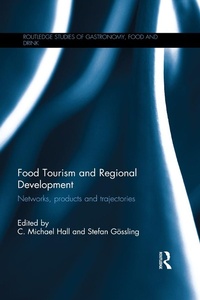
Food Tourism and Regional Development
Networks, products and trajectories
Published on 26. May 2016
314 pages
978-1-317-43089-6 (ISBN)
Description

Food tourism is a topic of increasing importance for many destinations. Seen as a means to potentially attract tourists and differentiate destinations and attractions by means of the association with particular products and cuisines, food is also regarded as an opportunity to generate added value from tourism through local agricultural systems and supply chains and the local food system.
From a regional development perspective this book goes beyond culinary tourism to also look at some of the ways in which the interrelationships between food and tourism contribute to the economic, environmental and social wellbeing of destinations, communities and producers. It examines the way in which tourism and food can mutually add value for each other from the fork to the plate and beyond. Looking at products, e.g. cheese, craft beer, noodles, wine; attractions, restaurants and events; and diverse regional examples, e.g. Champagne, Hong Kong, Jamaica, Margaret River, southern Sweden, and Tuscany; the title highlights how clustering, networking and the cultural economy of food and tourism and foodscapes adds value for regions. Despite the attention given to food, wine and culinary tourism no book has previously directly focused on the contribution of food and tourism in regional development. This international collection has contributors and examples from almost every continent and provides a comprehensive account of the various intersections between food tourism and regional development.
This timely and significant volume will inform future food and tourism development as well as regional development more widely and will be valuable reading for a range of disciplines including tourism, development studies, food and culinary studies, regional studies, geography and environmental studies.
From a regional development perspective this book goes beyond culinary tourism to also look at some of the ways in which the interrelationships between food and tourism contribute to the economic, environmental and social wellbeing of destinations, communities and producers. It examines the way in which tourism and food can mutually add value for each other from the fork to the plate and beyond. Looking at products, e.g. cheese, craft beer, noodles, wine; attractions, restaurants and events; and diverse regional examples, e.g. Champagne, Hong Kong, Jamaica, Margaret River, southern Sweden, and Tuscany; the title highlights how clustering, networking and the cultural economy of food and tourism and foodscapes adds value for regions. Despite the attention given to food, wine and culinary tourism no book has previously directly focused on the contribution of food and tourism in regional development. This international collection has contributors and examples from almost every continent and provides a comprehensive account of the various intersections between food tourism and regional development.
This timely and significant volume will inform future food and tourism development as well as regional development more widely and will be valuable reading for a range of disciplines including tourism, development studies, food and culinary studies, regional studies, geography and environmental studies.
More details
Series
Language
English
Place of publication
London
United Kingdom
Publishing group
Taylor & Francis Ltd
Target group
College/higher education
Illustrations
18 s/w Abbildungen, 17 s/w Tabellen, 18 s/w Zeichnungen
17 Tables, black and white; 18 Line drawings, black and white; 18 Illustrations, black and white
File size
3,56 MB
ISBN-13
978-1-317-43089-6 (9781317430896)
Copyright in bibliographic data and cover images is held by Nielsen Book Services Limited or by the publishers or by their respective licensors: all rights reserved.
Schweitzer Classification
Other editions
Additional editions
C. Michael Hall | Stefan Goessling
Food Tourism and Regional Development
Networks, products and trajectories
Book
04/2018
1st Edition
Routledge
€71.90
Shipment within 10-20 days
C. Michael Hall | Stefan Goessling
Food Tourism and Regional Development
Networks, products and trajectories
Book
05/2016
1st Edition
Routledge
€242.30
Shipment within 10-20 days
Persons
C. Michael Hall is a Professor at the University of Canterbury, New Zealand; Docent, University of Oulu, Finland; and Visiting Professor, Linnaeus University, Kalmar, Sweden. Co-editor of Current Issues in Tourism, he has wide-ranging research interests in tourism, policy, food and environmental history.
Stefan Goessling is a Professor at the Department of Service Management, Lund University, and the School of Business and Economics, Linnaeus University, Kalmar, Sweden, and research coordinator at the Western Norway Research Institute's Research Centre for Sustainable Tourism. His research interests include tourism and climate change, tourism and development, mobility studies, renewable energy and low-carbon tourism, as well as climate policy and carbon trading.
Stefan Goessling is a Professor at the Department of Service Management, Lund University, and the School of Business and Economics, Linnaeus University, Kalmar, Sweden, and research coordinator at the Western Norway Research Institute's Research Centre for Sustainable Tourism. His research interests include tourism and climate change, tourism and development, mobility studies, renewable energy and low-carbon tourism, as well as climate policy and carbon trading.
Content
Lists of illustrations
List of Contributors
Acknowledgements
Part 1: Introduction
1. Food Tourism and Regional Development: An Introduction
C. Michael Hall & Stefan Goessling
Part 2: Local Food Systems, Tourism and Trajectories of Regional Development
2. Value creation in sustainable food networks: The role of tourism
(Jan-Henrik Nilsson)
3. Developing regional food systems: A case study of restaurant-customer relationships in Sweden
(Stefan Goessling & C. Michael Hall)
4. Growing tourism from the ground up: Drivers of tourism development in agricultural regions
(Michelle Thompson & Bruce Prideaux)
5. The role of regional foods and food events in rural destination development: The case of Bario, Sarawak
(Samuel Adeyinka-Ojo & Catheryn Khoo-Lattimore)
6. Local foods, rural networks, and tourism development: A comparative study between Michigan, USA and the North Midlands, Ireland
(Cecilia Hegarty & Deborah Che)
Part 3: The Cultural Economy of Food and Tourism
7. Japanese obsession to noodles and regional development: The Udon Noodle tourism phenomenon in Japan
(Sangkyun Kim)
8. "Modernology", food heritage and neighbourhood tourism: The example of Sheung Wan, Hong Kong
(Sidney C. H. Cheung & Jiting Luo)
9. Regional economic development through food tourism: The case of AsiO Gusto in Namyangju City, South Korea
(Timothy Lee & Jang-Hyun Nam)
10. Consuming the rural and regional: The evolving relationship between food and tourism
(Paul Cleave)
11. Food tourism and place identity in the development of Jamaica's rural culture economy
(Ernest Taylor & Moya Kneafsey)
12. Gastronomy does not recognize political borders
(Marisa Ramos Abascal)
Part 4: Products, Regions and Regionality
13. Differences in wine tourism development: Description and illustrations from two Old World cases
(Elsa Gatelier)
14. Does regionality matter? The experience in Ireland
(John Mulcahy)
15. Craft beer, tourism and local development in South Africa
(Christian M. Rogerson)
16.Cheese Tourism: local produce with protected designation of origin in the region of Galicia, Spain
(Francesc Fuste Forne)
Part 5: Barriers and Constraints
17. Barriers and constraints in the use of local foods in the hospitality sector
(Hiran Roy, C. Michael Hall & Paul Ballantine)
18. Culinary collisions: The vision of local food use collides with daily restaurant practice
(Lotte Wellton, Inger M. Jonsson & Ute Walter)
Part 6: Conclusions
19 Conclusions: Food tourism and regional development - new localism or globalism?
(Stefan Goessling & C. Michael Hall)
List of Contributors
Acknowledgements
Part 1: Introduction
1. Food Tourism and Regional Development: An Introduction
C. Michael Hall & Stefan Goessling
Part 2: Local Food Systems, Tourism and Trajectories of Regional Development
2. Value creation in sustainable food networks: The role of tourism
(Jan-Henrik Nilsson)
3. Developing regional food systems: A case study of restaurant-customer relationships in Sweden
(Stefan Goessling & C. Michael Hall)
4. Growing tourism from the ground up: Drivers of tourism development in agricultural regions
(Michelle Thompson & Bruce Prideaux)
5. The role of regional foods and food events in rural destination development: The case of Bario, Sarawak
(Samuel Adeyinka-Ojo & Catheryn Khoo-Lattimore)
6. Local foods, rural networks, and tourism development: A comparative study between Michigan, USA and the North Midlands, Ireland
(Cecilia Hegarty & Deborah Che)
Part 3: The Cultural Economy of Food and Tourism
7. Japanese obsession to noodles and regional development: The Udon Noodle tourism phenomenon in Japan
(Sangkyun Kim)
8. "Modernology", food heritage and neighbourhood tourism: The example of Sheung Wan, Hong Kong
(Sidney C. H. Cheung & Jiting Luo)
9. Regional economic development through food tourism: The case of AsiO Gusto in Namyangju City, South Korea
(Timothy Lee & Jang-Hyun Nam)
10. Consuming the rural and regional: The evolving relationship between food and tourism
(Paul Cleave)
11. Food tourism and place identity in the development of Jamaica's rural culture economy
(Ernest Taylor & Moya Kneafsey)
12. Gastronomy does not recognize political borders
(Marisa Ramos Abascal)
Part 4: Products, Regions and Regionality
13. Differences in wine tourism development: Description and illustrations from two Old World cases
(Elsa Gatelier)
14. Does regionality matter? The experience in Ireland
(John Mulcahy)
15. Craft beer, tourism and local development in South Africa
(Christian M. Rogerson)
16.Cheese Tourism: local produce with protected designation of origin in the region of Galicia, Spain
(Francesc Fuste Forne)
Part 5: Barriers and Constraints
17. Barriers and constraints in the use of local foods in the hospitality sector
(Hiran Roy, C. Michael Hall & Paul Ballantine)
18. Culinary collisions: The vision of local food use collides with daily restaurant practice
(Lotte Wellton, Inger M. Jonsson & Ute Walter)
Part 6: Conclusions
19 Conclusions: Food tourism and regional development - new localism or globalism?
(Stefan Goessling & C. Michael Hall)
