

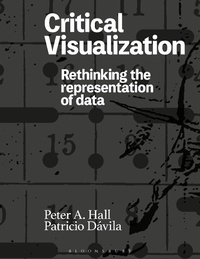
Critical Visualization
Rethinking the Representation of Data
1st Edition
Published on 1. December 2022
256 pages
978-1-350-07726-3 (ISBN)
Description

Information may be beautiful, but our decisions about the data we choose to represent and how we represent it are never neutral. This insightful history traces how data visualization accompanied modern technologies of war, colonialism and the management of social issues of poverty, health and crime. The discussion is based around examples of visualization, from the ancient Andean information technology of the quipu to contemporary projects that show the fate of our rubbish and take a participatory approach to visualizing cities. This analysis places visualization in its theoretical and cultural contexts, and provides a critical framework for understanding the history of information design with new directions for contemporary practice.
More details
Edition
1. Auflage
Language
English
Place of publication
London
United Kingdom
Publishing group
Bloomsbury Publishing PLC
Illustrations
100 colour illus
ISBN-13
978-1-350-07726-3 (9781350077263)
Copyright in bibliographic data and cover images is held by Nielsen Book Services Limited or by the publishers or by their respective licensors: all rights reserved.
Schweitzer Classification
Other editions
Additional editions
Book
12/2022
Bloomsbury Visual Arts
€101.50
Article exhausted; check different version
Book
12/2022
Bloomsbury Visual Arts
€32.50
Shipment within 15-20 days
Persons
Peter A. Hall is Reader in Graphic Design at CCW, University of the Arts London, UK. His publications include Critical Visualization: Rethinking the Representation of Data, co-authored with Patricio Dávila (Bloomsbury, 2022), Sagmeister: Made You Look (2009), Else/Where: Mapping - New Cartographies of Networks and Territories, co-edited with Janet Abrams (2005) and Tibor Kalman: Perverse Optimist (2002).
Patricio Dávila is a designer, artist, researcher and educator. He is Associate Professor in the Department of Cinema and Media Arts in the School of the Arts, Media, Performance and Design at York University, Canada. He is the editor of Diagrams of Power (2019) based on the international exhibition he curated on critical practice in mapping, and co-author, with Peter A. Hall, of Critical Visualization: Rethinking the Representation of Data (Bloomsbury, 2022).
Patricio Dávila is a designer, artist, researcher and educator. He is Associate Professor in the Department of Cinema and Media Arts in the School of the Arts, Media, Performance and Design at York University, Canada. He is the editor of Diagrams of Power (2019) based on the international exhibition he curated on critical practice in mapping, and co-author, with Peter A. Hall, of Critical Visualization: Rethinking the Representation of Data (Bloomsbury, 2022).
Content
1. An Introduction to Critical Visualization
Defining the field
Looking at Visualization beyond Western Paradigms
Alternative Western perspectives: Distributed Cognition and Humanistic Approaches
2. Disruptive Histories
Positivism and Objectivity
A History of Progress
Critical Cartography: a 'Defining Moment'
A Few Examples: Not a Canon
- Haptic Visualization: the Quipu (1200-1532)
- Plan and Sections of a Slave Ship (1789)
- Polar Area Diagram (1859)
- Great Trigonometrical Survey of India (1802-1875)
- Data Visualization at the Paris Exposition, W.E.B. Du Bois (1900)
- Community-building with Isotype: Otto and Marie Neurath
Conclusion
Focus: Anna Ridler, Myriad (Tulips) 2018
3. Making Data
Qualitative and Quantitative Data
The Role of Categorization
Focus: Data4Change
- Keepiton
- Hear the Blind Spot
- Perceiving Yemen
4. Data and the Self
Taylorism Within?
Comic Critique
What is Normal?
Biometrics and Risk-Profiling
Challenging Norms
The Examined Life
Focus: Margaret Pearce and Michael Hermann, They Would Not Take Me There: People, Places, and Stories from Champlain's Travels in Canada, 1603-1616
5. Data and the City
Participatory planning: HECTOR
Focus: Heath Bunting: Status Project
6. Aesthetics and Representation
Aesthetics and Representation
Representation as Translation
7. Beyond Critical Visualization Practice
Defining the field
Looking at Visualization beyond Western Paradigms
Alternative Western perspectives: Distributed Cognition and Humanistic Approaches
2. Disruptive Histories
Positivism and Objectivity
A History of Progress
Critical Cartography: a 'Defining Moment'
A Few Examples: Not a Canon
- Haptic Visualization: the Quipu (1200-1532)
- Plan and Sections of a Slave Ship (1789)
- Polar Area Diagram (1859)
- Great Trigonometrical Survey of India (1802-1875)
- Data Visualization at the Paris Exposition, W.E.B. Du Bois (1900)
- Community-building with Isotype: Otto and Marie Neurath
Conclusion
Focus: Anna Ridler, Myriad (Tulips) 2018
3. Making Data
Qualitative and Quantitative Data
The Role of Categorization
Focus: Data4Change
- Keepiton
- Hear the Blind Spot
- Perceiving Yemen
4. Data and the Self
Taylorism Within?
Comic Critique
What is Normal?
Biometrics and Risk-Profiling
Challenging Norms
The Examined Life
Focus: Margaret Pearce and Michael Hermann, They Would Not Take Me There: People, Places, and Stories from Champlain's Travels in Canada, 1603-1616
5. Data and the City
Participatory planning: HECTOR
Focus: Heath Bunting: Status Project
6. Aesthetics and Representation
Aesthetics and Representation
Representation as Translation
7. Beyond Critical Visualization Practice
