

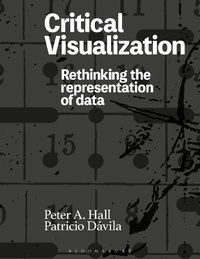
Critical Visualization
Rethinking the Representation of Data
Published on 29. December 2022
Book
Hardback
256 pages
978-1-350-07723-2 (ISBN)
Description
Information may be beautiful, but our decisions about the data we choose to represent and how we represent it are never neutral. This insightful history traces how data visualization accompanied modern technologies of war, colonialism and the management of social issues of poverty, health and crime. The discussion is based around examples of visualization, from the ancient Andean information technology of the quipu to contemporary projects that show the fate of our rubbish and take a participatory approach to visualizing cities. This analysis places visualization in its theoretical and cultural contexts, and provides a critical framework for understanding the history of information design with new directions for contemporary practice.
Reviews / Votes
Debunking the idea that data is ever 'raw' or unbiased, this book brings information anxiety to a new level as it goes deep into the underlying power structures at play in the assemblage of data and the motivations of those who amass it. Hall and Davila explain how design's focus on clarity and statistical accuracy can serve to enhance dominant narratives inherent in the data and challenge designers to activate their agency to visualize the kind of world in which we want to live. This should be required reading in any data visualization or information design curriculum. -- Thomas Starr, Professor of Graphic and Information Design, Northeastern University, USA Hall and Davila make a compelling argument for a critical approach to data visualization. Through a comprehensive survey of extant literature, a rereading of canonical images through decolonizing frameworks, and discussion of highly topical debates, they arrive at a rich examination of current projects drawn from a wide array of activities. They address self-quantification, smart cities, emotional cartography, and a whole host of specific and activist interventions in conventional data practices. Ultimately, they argue for visualizations that might create alternatives to dominant conventions and the oppressive power asymmetries of the status quo. -- Johanna Drucker, Distinguished Professor of Information Studies, UCLA, USA With acuity and depth, Hall and Davila demonstrate just how much history, culture and context matter for the design and interpretation of data visualization. Their book is timely and important, and will usher in a new era of critical data practice. -- Lauren Klein, Winship Distinguished Research Professor, Departments of English and Quantitative Theory and Methods, Emory University, USAMore details
Language
English
Place of publication
London
United Kingdom
Publishing group
Bloomsbury Publishing PLC
Target group
College/higher education
Product notice
sewn/stitched
Cloth over boards
With dust jacket
Illustrations
100 colour illus
Dimensions
Height: 253 mm
Width: 197 mm
Thickness: 20 mm
Weight
889 gr
ISBN-13
978-1-350-07723-2 (9781350077232)
Copyright in bibliographic data and cover images is held by Nielsen Book Services Limited or by the publishers or by their respective licensors: all rights reserved.
Schweitzer Classification
Other editions
Additional editions
E-Book
12/2022
1st Edition
Bloomsbury Visual Arts
€28.49
Available for download
Persons
Peter A. Hall is Reader in Graphic Design at CCW, University of the Arts London, UK. His publications include Critical Visualization: Rethinking the Representation of Data, co-authored with Patricio Davila (Bloomsbury, 2022), Sagmeister: Made You Look (2009), Else/Where: Mapping - New Cartographies of Networks and Territories, co-edited with Janet Abrams (2005) and Tibor Kalman: Perverse Optimist (2002).
Patricio Davila is a designer, artist, researcher and educator. He is Associate Professor in the Department of Cinema and Media Arts in the School of the Arts, Media, Performance and Design at York University, Canada. He is the editor of Diagrams of Power (2019) based on the international exhibition he curated on critical practice in mapping, and co-author, with Peter A. Hall, of Critical Visualization: Rethinking the Representation of Data (Bloomsbury, 2022).
Patricio Davila is a designer, artist, researcher and educator. He is Associate Professor in the Department of Cinema and Media Arts in the School of the Arts, Media, Performance and Design at York University, Canada. He is the editor of Diagrams of Power (2019) based on the international exhibition he curated on critical practice in mapping, and co-author, with Peter A. Hall, of Critical Visualization: Rethinking the Representation of Data (Bloomsbury, 2022).
Content
1. An Introduction to Critical Visualization
Defining the field
Looking at Visualization beyond Western Paradigms
Alternative Western perspectives: Distributed Cognition and Humanistic Approaches
2. Disruptive Histories
Positivism and Objectivity
A History of Progress
Critical Cartography: a 'Defining Moment'
A Few Examples: Not a Canon
- Haptic Visualization: the Quipu (1200-1532)
- Plan and Sections of a Slave Ship (1789)
- Polar Area Diagram (1859)
- Great Trigonometrical Survey of India (1802-1875)
- Data Visualization at the Paris Exposition, W.E.B. Du Bois (1900)
- Community-building with Isotype: Otto and Marie Neurath
Conclusion
Focus: Anna Ridler, Myriad (Tulips) 2018
3. Making Data
Qualitative and Quantitative Data
The Role of Categorization
Focus: Data4Change
- Keepiton
- Hear the Blind Spot
- Perceiving Yemen
4. Data and the Self
Taylorism Within?
Comic Critique
What is Normal?
Biometrics and Risk-Profiling
Challenging Norms
The Examined Life
Focus: Margaret Pearce and Michael Hermann, They Would Not Take Me There: People, Places, and Stories from Champlain's Travels in Canada, 1603-1616
5. Data and the City
Participatory planning: HECTOR
Focus: Heath Bunting: Status Project
6. Aesthetics and Representation
Aesthetics and Representation
Representation as Translation
7. Beyond Critical Visualization Practice
Defining the field
Looking at Visualization beyond Western Paradigms
Alternative Western perspectives: Distributed Cognition and Humanistic Approaches
2. Disruptive Histories
Positivism and Objectivity
A History of Progress
Critical Cartography: a 'Defining Moment'
A Few Examples: Not a Canon
- Haptic Visualization: the Quipu (1200-1532)
- Plan and Sections of a Slave Ship (1789)
- Polar Area Diagram (1859)
- Great Trigonometrical Survey of India (1802-1875)
- Data Visualization at the Paris Exposition, W.E.B. Du Bois (1900)
- Community-building with Isotype: Otto and Marie Neurath
Conclusion
Focus: Anna Ridler, Myriad (Tulips) 2018
3. Making Data
Qualitative and Quantitative Data
The Role of Categorization
Focus: Data4Change
- Keepiton
- Hear the Blind Spot
- Perceiving Yemen
4. Data and the Self
Taylorism Within?
Comic Critique
What is Normal?
Biometrics and Risk-Profiling
Challenging Norms
The Examined Life
Focus: Margaret Pearce and Michael Hermann, They Would Not Take Me There: People, Places, and Stories from Champlain's Travels in Canada, 1603-1616
5. Data and the City
Participatory planning: HECTOR
Focus: Heath Bunting: Status Project
6. Aesthetics and Representation
Aesthetics and Representation
Representation as Translation
7. Beyond Critical Visualization Practice