

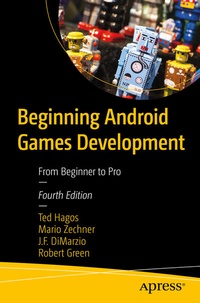
Beginning Android Games Development
Description

Do you have an awesome idea for the next break-through mobile gaming title? This updated edition will help you kick-start your project as it guides you through the process of creating several example game apps using APIs available in Android.
You will learn the basics needed to join the ranks of successful Android game app developers. the book starts with game design fundamentals using Canvas and Android SDK 10 or earlier programming basics. You then will progress toward creating your own basic game engine and playable game apps that work on Android 10 or earlier smartphones and tablets. You take your game through the chapters and topics in the book to learn different tools such as OpenGL ES.
And you will learn about publishing and marketing your games to monetize your creation.
What You Will Learn
- Gain knowledge on the fundamentals of game programming in the context of Android
- Use Android's APIsfor graphics, audio, and user input to reflect those fundamentals
- Develop two 2D games from scratch, based on Canvas API and OpenGL ES
- Create a full-featured 3D game
- Publish your games, get crash reports, and support your users
- Complete your own playable 2D OpenGL games
Who This Book Is For
Those with basic knowledge of Java who want to write games on the Android platform, and experienced game developers who want to know about the pitfalls and peculiarities of the platform
More details
Other editions
Additional editions
Persons
Mario Zechner runs Badlogic Games, a game development shop focused on Android.
JF DiMarzio is a seasoned Android developer and author. He began developing games in Basic on the TRS-80 Color Computer II in 1984. Since then, he has worked in the technology departments of companies such as the US Department of Defense and the Walt Disney Company. He has been developing on the Android platform since the beta release of version .03. He is also an accomplished author. Over the last 20 years, he has released fifteen books, including Android: A Programmer's Guide . His books have been translated into four languages and published worldwide. His writing style is very easy to read and understand, which makes the information on the topics that he presents more retainable.
Robert Green is a mobile video game developer from Portland, Oregon who develops and publishes mobile games under the brand Battery Powered Games. He has developed over a dozen mobile games and graphically interactive apps for himself and clients in the last two years, which include 2D and 3D action, puzzle, racing, and casual games. Before diving full time into video game development, he worked for software companies in Minneapolis, Minnesota and Chicago, Illinois, including IBM Interactive. His current focus is on cross-platform game development and high-performance mobile gaming.
Content
Chapter 1: Setup.- Chapter 2: Project Basics.- Chapter 3: Android Studio.- Chapter 4: What's in an Android Application?.- Chapter 5: Introduction to Game Development.- Chapter 6: Building the Crazy 8 Game.- Chapter 7: Building the Balloon Popper Game.- Chapter 8: Testing and Debugging.- Chapter 9: .- Chapter 10: Monetization.- Chapter 11: Publishing the Game.- Chapter 12: Where Do We Go From Here?.
