

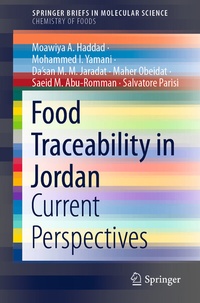
Food Traceability in Jordan
Description

This book outlines the evolution of food traceability matters in the current traditional foods market and particularly with regard to selected historical foods based in Jordan.
At present, traceability is just one of the many requirements the food industry is forced to meet. The topic can be approached from various angles: regulation, technological perspectives, food business operators, packaging manufacturers, software producers, and consumer views. In addition, traceable food products provide an interesting legacy for many geographical and ethnic cultures. Consequently, the examination of certain recipes or food products linked with history and traditions can make a unique and valuable contribution to future developments in this area.
More details
Other editions
Additional editions
Persons
Moawiya A. Haddad
Holds a Ph.D. , MSC. and BSC. in Nutrition and Food Technology. Chiefly focusing on product development, functional foods, food safety and shelf life extension for fermented dairy products, he is Associate Professor and currently Head of the Department of Nutrition and Food Processing, Al-Balqa Applied University. He is also interested in olive oil and recognized by IOC as team leader (panelists) for sensory evaluation of olive oil and member in olive international standard.
Mohammed I. Yamani
is a Professor of Food Microbiology, Hygiene, and Quality Management at the University of Jordan, Amman, and former Dean of the Faculty of Agriculture at this university. He holds a Ph.D. in Food Microbiology and Hygiene from the Berlin Free University, Germany, and before joining the Faculty of Agriculture at the University of Jordan, Amman, he has worked as Assistant to the head of the microbiological unit of Amman Municipality Food Control Laboratories, head of the unit, and head of the laboratories (1973-1985). Professor Yamani has directed five research projects about the microbiology and hygiene of some traditional foods in Jordan, funded by the Scientific Research Council of the University of Jordan, and the Higher Council of Science and Technology in Jordan.
Da'san M. M. Jaradat holds a Ph.D. in Bioorganic Chemistry and M.Sc. in Chemistry and Crystallography from the Freie Universität Berlin, Germany. He held several posts at the Royal Scientific Society of Jordan (RSS) beginning in 2001. In 2015, he was Visiting Research Scholar at the Department of Chemistry, University of California, Berkeley, and Lawrence Berkeley National Laboratory (LBNL), Berkeley, CA, USA. Dr. Jaradat is currently Assistant Professor at the Department of Chemistry, Al-Balqa Applied University, Jordan.
Maher Obeidat is Associate Professor of Microbiology and Vice Dean of the Faculty of Science, at Al-Balqa Applied University. He is specialized in microbiology, immunology, and cancer therapy.
Saeid Abu-Romman
is currently Professor of Crop Physiology and Biotechnology at Al-Balqa Applied University, where he has been since 2009. He received his B.S. degree from Mutah University and his M.S. from the University of Jordan. He subsequently completed his Ph.D. in Plant Physiology and Biotechnology at the University of Hohenheim, Germany, in 2008, working with Prof. Andreas Schaller. Prof. Abu-Romman is the former director of the Office of Cooperation and International Relations and is currently a council member of the Deanship of Scientific Research, as well as Assistant to President for International Agreement.
Salvatore Parisi
obtained his M.Sc. from the University of Palermo and his Ph.D. from the University of Messina, Italy. Prof. Parisi serves as Series Editor for the SpringerBriefs in Molecular Science: Chemistry of Foods; he is also Associate of AOAC International, USA, Southern California Section, serving on various AOAC expert review panels and working groups.
