

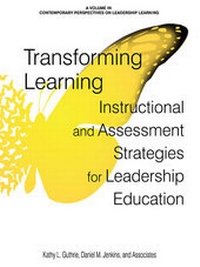
Transforming Learning
Instructional and Assessment Strategies for Leadership Education
1st Edition
Published on 6. January 2020
143 pages
978-1-64802-047-6 (ISBN)
Description

In this companion manual to The Role of Leadership Educators: Transforming Learning, this text was developed to fill a significant resource gap in leadership education. In response to this gap, as well as leadership educators' call for professional development related to teaching and learning, this text is grounded in the college teaching and leadership education literature. Filled with 60 learning activities for diverse contributors, this book offers a hands-on resource for leadership educators to use when facilitating leadership learning opportunities.
Each learning activity includes learning outcomes, activity instructions, facilitation notes, and additional resources offered by the author. The text is organized by the pedagogical methods covered in The Role of Leadership Educators: Transforming Learning. Pedagogical methods covered include Discussion, Case Studies, Reflection, Team-Based Learning, Service Learning, Self- and Peer-Assessments, Role-Play, Simulation, Games, and Art. Each chapter contains six learning activities for each pedagogical method, four focused in instructional strategies (curricular, co-curricular, technology-enhanced, followership-focused) and two in learning assessment strategies (curricular and co-curricular).
Each learning activity includes learning outcomes, activity instructions, facilitation notes, and additional resources offered by the author. The text is organized by the pedagogical methods covered in The Role of Leadership Educators: Transforming Learning. Pedagogical methods covered include Discussion, Case Studies, Reflection, Team-Based Learning, Service Learning, Self- and Peer-Assessments, Role-Play, Simulation, Games, and Art. Each chapter contains six learning activities for each pedagogical method, four focused in instructional strategies (curricular, co-curricular, technology-enhanced, followership-focused) and two in learning assessment strategies (curricular and co-curricular).
All prices
More details
Other editions
Additional editions
Kathy L. Guthrie | Daniel M. Jenkins
Transforming Learning
Instructional and Assessment Strategies for Leadership Education
Book
06/2020
Information Age Publishing
€105.50
Shipment within 3-4 weeks
Kathy L. Guthrie | Daniel M. Jenkins
Transforming Learning
Instructional and Assessment Strategies for Leadership Education
Book
06/2020
Information Age Publishing
€54.60
Shipment within 3-4 weeks
Content
- Front Cover
- Tranforming Learning: Instructional and Assessment Strategies for Leadership Education
- A Volume in Contemporary Perspectives on Leadership Learning
- Kathy L. Guthrie, Series Editor
- Transforming Learning
- Instructional and Assessment Strategies for Leadership Education
- By
- Kathy L. Guthrie, Daniel M. Jenkins, and Associates
- Information Age Publishing, Inc. Charlotte, North Carolina www.infoagepub.com
- Transforming Learning
- Instructional and Assessment Strategies for Leadership Education
- Contents
- Acknowledgments ix
- 1. Setting the Stage 1
- 2. Discussion 13
- 3. Case Study Methods 25
- 4. Reflection 37
- 5. Team-Based Learning 47
- 6. Service-Learning 59
- 7. Self- and Peer-Assessments 69
- 8. Role-Play 83
- 9. Simulation 97
- 10. Games 107
- 11. Arts-Based Learning 117
- Editor and Contributor Bios 127
- Acknowledgments
- Chapter 1
- Setting the Stage
- Facilitating Leadership Learning Opportunities
- Organization of Text
- 1. Curricular: These learning activities were designed with academic credit-bearing leadership education courses in mind.
- 2. Cocurricular: These learning activities were designed with nonacademic leadership education programs-often situated in higher education within student affairs and/or academic affairs-in mind.
- 3. Technology Enhanced: These learning activities were designed with asynchronous and synchronous online learning in mind.
- 4. Followership Focused: These learning activities were designed with the role of the leader and follower in mind and provide opportunities to explore both leadership and followership dynamics and experiences.
- 5. Learning Assessment-Curricular: These learning activities were designed with a focus on the assessment of learning in academic credit-bearing leadership education courses.
- 6. Learning Assessment-Cocurricular: These learning activities were designed with a focus on the assessment of learning in nonacademic leadership education programs.
- Why Curricular?
- Why Cocurricular?
- Why Technology Enhanced?
- Why Followership Focused?
- Why Assessment?
- How to Use This Text
- Beginning With the End in Mind: Developing Learning Outcomes for Your Leadership Program
- Types of leadership learning outcomes
- 1. Foundational Knowledge: Understand and remember key assumptions and components of various leadership models
- 2. Application: Know how to apply leadership models to real-life situations
- 3. Integration: Be able to relate leadership theory to other academic subjects and current events
- 4. Human Dimension: Understand the personal and social implications of knowing about leadership
- 5. Caring: Care about leadership and learning more about it
- and
- 6. Learning How to Learn: Know how to keep on learning about leadership.
- THE LEADERSHIP LEARNING FRAMEWORK
- The Leadership Learning Framework as a Vehicle for Learning Outcomes
- Why the Leadership Learning Framework Works: Leader and Follower Experiences as a Source of Transformational Learning
- TABLE OF ACTIVITIES
- Table of Activities
- X
- X
- X
- X
- X
- X
- X
- X
- X
- X
- X
- X
- X
- X
- X
- X
- X
- X
- X
- X
- X
- X
- X
- X
- X
- X
- X
- X
- X
- X
- X
- X
- X
- X
- X
- X
- X
- X
- X
- X
- X
- X
- Table of Activities (Continued)
- X
- X
- X
- X
- X
- X
- X
- X
- X
- X
- X
- X
- X
- X
- X
- X
- X
- X
- X
- X
- X
- X
- X
- X
- X
- X
- X
- X
- X
- X
- X
- X
- X
- X
- X
- X
- X
- X
- X
- X
- X
- X
- X
- X
- X
- X
- X
- Table of Activities (Continued)
- X
- X
- X
- X
- X
- X
- X
- X
- X
- X
- X
- X
- X
- X
- X
- X
- X
- X
- X
- X
- X
- X
- X
- X
- X
- X
- X
- X
- X
- X
- X
- X
- X
- X
- X
- X
- X
- X
- X
- X
- X
- X
- X
- X
- X
- X
- X
- X
- X
- X
- X
- X
- X
- X
- X
- Table of Activities (Continued)
- X
- X
- X
- X
- X
- X
- X
- X
- X
- X
- X
- X
- X
- X
- X
- X
- Chapter 2
- Discussion
- DISCUSSION IN LEADERSHIP EDUCATION
- Braving the Fishbowl: Using Concentric Circles to Facilitate Dialogue
- Darren Pierre, Shelby Hearn, and Cristian Noriega
- Discussion, Curricular Instructional
- 1. In a class setting, as part of the assignments outlined on the syllabus, participants will be asked to facilitate an in-class dialogue.
- 2. One week prior to class, participants assigned to facilitate discussion will meet with the instructor (outside of class) to clarify the key points of the readings, share the discussion questions developed for class, and ask any remaining questions...
- 3. The activity begins with the class being randomly split into two groups. The 2-3 participant facilitators will split up, each with a group.
- 4. The timer starts and the facilitator assigned to Group #1 facilitating a discussion on the readings. (15-20 minutes)
- 5. The facilitators should engage in a discussion that elicits from participants an understanding of their personal impressions of the readings, challenges to the texts, and connections to lived experiences. Suggested debriefing questions may be:
- 6. While Group #1 is participating in the discussion, Group #2 will observe the interactions within Group #1. Group #2 will be asked to pay attention to body language and major themes that emerged from the conversation had by Group #1. (15-20 minutes)
- 7. The same process will occur with the inner circle now becoming the outer circle, and the facilitator assigned to Group #2 will lead the discussion. This time, the discussion should focus on the second half of readings assigned for that session, wh...
- 8. Group #2 participant facilitator will close the discussion and the two circles will then organize into a large group. The facilitators will engage their peers in a discussion on how the readings covered in both rounds speak to one another (15-20...
- Talking Popsicle Sticks
- Trisha Teig
- Discussion, Cocurricular Instructional
- 1. Set up (5-10 min)
- 2. Discussion (30 minutes)
- 3. Debriefing (30-40 minutes)
- Live Twitter Chats
- Kathy L. Guthrie and Josie Ahlquist
- Discussion, Technology Enhanced
- 1. Introduce the concept of a live Twitter chat to participants, which are scheduled gatherings to discuss a topic with a moderator. Explain that this chat will cover at least six questions over a period of one hour that must be responded to within t...
- 2. Instruct participants to prepare for the live Twitter chat by understanding the expectations and viewing tutorial videos. (5 minutes)
- 3. During the determined hour in which the live Twitter chat will take place, the facilitator will want to pose questions every 8 minutes. Potential questions may include:
- 4. With 5 minutes left in the allotted hour for the live Twitter chat, pose a survey to get feedback from the experience. Figure 2.1 is a visual from feedback Dr. Josie Ahlquist received from a live twitter chat in LDR 2116 at Florida State Universit...
- Exploring Preconceived Understandings of Followership Through Group Discussion
- Cameron C. Beatty
- Discussion, Followership Focused
- 1. Have the participants write out: (5 minutes)
- 2. Have participants share in pairs their definition of followership and a story of a time when they felt they were a good follower. (7-10 minutes)
- 3. Large-Class Discussion (10 minutes)
- 4. Discussion Follow-Up (Large Group) (7-10 minutes)
- Let's Discuss Learning: Assessing Learning of Discussion Activities
- Trisha Teig
- Discussion, Curricular Learning Assessment
- 1. Following the discussion, the instructor should pass out the discussion feedback and reflection handout to each participant.
- 2. Instructor should explain the purpose/directions for the handout:
- 3. Participants complete the handout. (10-15 minutes)
- 4. In the following class, the instructor should discuss the overall information from the handouts to inform the learning from the discussion with the class. (30-45 minutes)
- 5. Instructors should take time to read through the handouts and aggregate the feedback. Debriefing of the handout should take place in the next class period with the facilitator sharing overall comments on learning, clarifying concepts that were mis...
- Untangling the Destructive Leadership Web: The Case of Team Foxcatcher
- Jasmine D. Collins
- Discussion, Cocurricular Learning Assessment
- 1. Set up (5 minutes)
- 2. Watch the film (90 minutes)
- 3. Break (5 minutes)
- 4. Set up for discussion (5 minutes)
- 5. Facilitate discussion (30 minutes)
- Chapter 3
- Case Study Methods
- CASE STUDY METHODS IN LEADERSHIP EDUCATION
- Making a Case for Leading Critically
- Daniel M. Jenkins and Amanda Cutchens
- Case Study Methods, Curricular Instructional
- 1. The instructor provides groups with a case, preferably one in the participants' context. The case should have a few general, open-ended discussion questions.
- 2. Each group of 4-5 participants should be given time to discuss and answer the questions related to the case. (10 minutes)
- 3. The instructor should allow each group time to present the case and answers to discussion questions to the class. During this time, the instructor should allow participants from the larger group to give respectful, constructive feedback to partici...
- 4. Debrief.
- 1. Be aware of the context of your situation and evaluate the implications of your decisions.
- 2. Ask questions and listen appropriately.
- 3. Take the time to understand the diversity of others' decisions, values, and opinions.
- 4. Be flexible and open-minded in your decision-making.
- 5. Accept, internalize, and apply constructive criticism.
- 6. Evaluate assumptions before you try to challenge them.
- 7. Understand processes before you try to change them.
- 8. Know the strengths and weaknesses of your followers and direct or empower accordingly.
- 9. Be purposeful and take into account your organization's mission and values when making decisions.
- 10. Engage others where they are, not where you want them to be.
- 11. Encourage critical followership.
- 12. Take informed action.
- Protests and Student Activism on Your Campus: Are You Ready?
- Brian T. Magee and Anne-Marie Algier
- Case Study Methods, Courricular Instructional
- 1. All constituents above meet for one hour to review current policies/guidelines. If no policies/guidelines exist, conversations should be had to begin to develop policies/guidelines. (30 minutes)
- 2. Please consider: Who is covered by the policy? Who is administrating and enforcing the policy? What are the guiding principles? Are there restrictions on when a protest or student activism can happen on campus? (30 minutes)
- 1. Constituents meet for two hours and review the campus policies/guidelines that exist or were developed. (30 minutes)
- 2. Read and discuss the case study. Discuss in detail the universal response by drafting a step by step process of how each constituent is involved. (1 hour 30 minutes)
- Cracking the Case: Learning Through Student-Written Teaching Case Studies
- Eric Kaufman
- Case Study Methods, Technology Enhanced
- 1. Begin by facilitating exploration and discussion of a short case study, such as one available through Stanford's "Leadership in Focus" website: http:// leadershipinfocus.net/. Experience with a variety of different case studies will enhance ...
- 2. Assign participants to groups that will be conducive for collaborative development of a teaching case during the time frame available and encourage them to brainstorm topics and options for a case that would easily feature concepts that are the fo...
- 3. Direct participants to prepare a case narrative and teaching notes following guidance from Writing Case Studies: A Manual, available at https:// www.slideshare.net/hudda2020/writing-case-studies-a-manual.
- 4. Arrange time for student groups to facilitate a case study discussion using the teaching case study they have developed. Although the participants should consider plausible solutions to the case, encourage them to be open to alternate views and ex...
- 5. Facilitate reflection on the experience, including appropriate peer evaluation (e.g., participants provide both qualitative and quantitative feedback to those with whom they collaborated to develop and deliver the teaching case).
- Peer Consultation
- Justin Greenleaf, Thomas Stanley, and Kerry L. Priest
- Case Study Methods, Followership Focused
- 1. Identify roles in advance: facilitator, case presenter, timekeeper, and notetaker. The case presenter should come prepared to share details specific leadership challenge they are facing. Some guiding questions may include: What is the background o...
- 2. Upon completion of the peer consultation process, there are several questions that may be useful in determining what went well and what could be done better for next time. These questions include, but are not limited to, the following:
- Practice Case Study: Preparing Students to Become Leadership Consultants
- Lindsay J. Hastings
- Case Study Methods, Curricular Learning Assessment
- 1. Individually participants read the case and answer the following questions in small groups: (30 minutes)
- 2. Small groups are to act as if they have been hired by the case study organization as leadership consultants. The objective for each small group is to critically evaluate the case using the assigned leadership theory that applies and formulate a th...
- 3. Each group will be allowed 5 minutes to present their analysis. (30 minutes)
- 4. Facilitators should offer overall oral evaluative feedback to the small groups or written individual feedback to each group. The key in debriefing the learning outcomes associated with the practice case study is to ensure that the chosen theory is...
- "Living Leadership" Case Studies
- Melissa L. Rocco
- Case Study Methods, Cocurricular Learning Assessment
- 1. Activity Introduction: Share with participants that they will be working together in small groups as organization consultants with the goal of helping a fellow organization improve their leadership capacity and practice. Each team will choose an o...
- 2. Determine Consulting Teams and Organizations: Divide participants into teams of 2-4 people each, taking care to promote diversity of background, identity, and thought within each team. Team members should take time to get to get familiar with on...
- 3. Organizational Analysis Instructions: Share advice for engaging in organizational observation and analysis, including but not limited to the below suggestions. (5 minutes)
- 4. Recommendations Instructions: Share that the consulting team should use their analysis to determine what the organization could do to improve and/or develop their leadership capacity and organizational culture. Recommendations may include, but are...
- 5. Questions and Team Planning: Solicit and respond to any questions from the participants regarding the project instructions. Provide time for the consulting teams to plan their work together. Explain how many days/weeks they will have to work as co...
- 6. Consulting Team Work: During this time, consulting teams should work on their own to observe and interact with their organization as they deem appropriate. In addition to the suggestions in #3 "Organizational Analysis Instructions", consulting...
- 7. Final Meeting and Debriefing: Provide time for each consulting team to present their analysis and recommendations to the other consulting teams. Participants' presentations should indicate clear connections to leadership knowledge, as well as de...
- 8. Peer Feedback and Team Self-Assessment: Following final presentations and debrief (can be done at a separate time, if necessary), ask consulting teams to group together to provide one another with feedback on the group's process throughout the e...
- Chapter 4
- Reflection
- REFLECTION-BASED PEDAGOGY IN LEADERSHIP EDUCATION
- Reflection Through Mind Mapping Leadership and Change Concepts
- Cameron C. Beatty
- Reflection, Curricular Instructional
- 1. From the main idea, deep change, create branches (as many as needed), that each represent a single word that relates to the main topic. It is helpful to use different colors and images to differentiate the branches and subtopics (feel free to use ...
- 2. Then, create subbranches that stem from the main branches to further expand on ideas and concepts around deep change. These subbranches will also contain words that elaborate on the topic of the branch it stems from. This helps develop and elabora...
- 3. Next, include examples of where you have seen examples of the concepts included on your mind map. These could be personal examples or examples from society. (3-5 minutes to add on to mind map).
- 4. Next, pair up and share your mind maps and reflect on the concepts from Deep Change (Quinn, 1996) and make connections to your own lives. (10 minutes for pairs to share).
- 5. Finally, we will come back to together as a community to process.
- 6. By listening to their peers' reflection, this might spark further personal reflection. Discussion questions could include:
- Mirror Your Experience: Peer-Teaching Through Reflection
- Aaron D. Clevenger
- Reflection, Cocurricular Instructional
- 1. Begin by explaining the activity and prompting reflection by providing a list of leadership topics, for example conflict management, active listening, empowering others, or leadership styles such as transformational leadership, servant leadership,...
- 2. Set aside time for participants to choose one of the leadership topics and to write a short reflection of their experience with the chosen topic. (15 minutes)
- 3. Participants will design a lesson answering the following questions: (45 minutes)
- 4. At the 15-minute point of the lesson planning time, have participants meet in small groups of five to six people to reflect for 15 minutes on how they are thinking about the activity and the leadership topic. Reflecting on their thought process an...
- 5. Set aside 10 minutes per presentation to allow the participants to provide their peer lesson, which will include the specific leadership topic and learning outcome along with any personal experience and reflection that the participants have on the...
- 6. Debrief: Utilize the following reflective questions for a debrief: (15 minutes)
- Photographing Leadership: Making Meaning of Our World
- Jackie Bruce and Daniel Collins
- Reflection, Technology-Enhanced
- 1. Read the textbook chapter to review the theory(ies) under study and attend the lecture or review the PowerPoint/lecture notes. (2-4 hours)
- 2. Go out into your worlds and take a picture/s you believe demonstrates the enactment or application of the theory under study. (1-3 hours)
- 3. Post the photo to the learning manage system. Once the photo is posted, reflect on and respond to the guided reflection questions provided. (1-2 hours).
- 4. After your original post is completed, take a few days to review, read and reflect on the posts of your classmates. Take the time to respond to two of your classmates' original posts
- paying special attention to the guided reflection response qu...
- 5. The guided reflection questions for the original posts are:
- Follow the Leader or Leading the Follower? Asking Critical Questions About Followers and Followership
- Julie E. Owen
- Reflection, Followership Focused
- 1. Introduce the concept of followership and ask participants to brainstorm ways followers might be different from leaders using reflection Prompt #1 (Parts a-c) below. Encourage them to draw on their own past experiences with leadership. (10 minutes)
- 2. Present three different taxonomies of followers presented in Prompt #2 (parts a-c) below (and expounded upon in Northouse, 2019, Chapter 12: Followership) and ask corresponding reflection questions. (15 minutes)
- 3. Invite participants to interrogate the underlying concepts of followership using the prompts presented in Prompt #3 below. Explore how a focus on followership might detract from the creation of leader-full environments. (15 minutes)
- 1. Uhl-Bien, Riggio, Lowe, and Carsten (2014) define followership as involving "characteristics (a), behaviors (b), and processes (c) of individuals acting in relation to leaders" (p. 96). Have participants brainstorm responses to the following:
- 2. There are many taxonomies where scholars try to name diverse approaches to followership. Three are summarized below (see Northouse, 2019, Chapter 12, for more detailed descriptions).
- 3. Now that we have established commonly held views of followers and followership, let's apply a critical lens:
- Beyond "Dear Diary": Feedback Driven Journaling
- Jillian M. Volpe White
- Reflection, Curricular Learning Assessment
- 1. Explain the goal of this reflective learning assessment is for participants to process experiences and obtain feedback. Introduce participants to reflective journaling (Stevens & Cooper, 2009). This provides participants with shared language and c...
- 2. Introduce the "What? So what? Now what?" reflection format (adapted from Kolb, 1984, by Campus Opportunity Outreach League in 1995
- Ash & Clayton, 2009).
- 3. Set expectations. You might include a minimum length (250-500 words), depending upon where journaling fits in the context of other assignments. Journal writing should go beyond a log of tasks to include thoughtful reflections on experience.
- 4. Provide a handout which includes dates for reflective journals and prompts.
- 5. Set aside time to provide feedback. If you are using paper journals, use a page to ask questions or share reactions. If you are using an online format, such as discussion boards or a blog, write comments for participants asking questions or sharin...
- 6. Allow time in class for participants to exchange materials and share thoughts. Invite participants to react to the content of what they are writing and/or the process of journaling.
- 7. During the final few weeks of the semester/experience, ask participants to read back through their journal entries and the feedback they were provided throughout the semester.
- 8. Ask them to write a meta-analysis of their journals including insights they gleaned from reading back over the content of the semester.
- 1. What are you most excited or nervous about as you begin this experience?
- 2. What do you hope to learn as a result of this experience?
- 3. What assumptions or expectations do you bring to this experience?
- 4. Describe your experience. What does it look like, sound like, and feel like?
- 5. What is the culture of the organization, including the underlying values and assumptions? What has been the most challenging aspect of adapting to a new place or learning a new organizational culture?
- 6. Describe something specific you have done or seen that has revealed something new to you personally or intellectually.
- 7. How do you think you are perceived with the people with whom you are working? How are interactions with people causing you to reevaluate stereotypes?
- 8. What differences in communication have you faced in a new place (language, customs, gender roles, etc.)? How have you adapted to these differences and been an effective member of your organization?
- 9. How can you use your knowledge, skills, and abilities to create positive change?
- 10. Addressing complex issues is rarely simple, and there is not a magic bullet for creating change. How do you identify multiple perspectives on and facets of complex issues?
- 11. What are your values? How do you know these are your values?
- You Think What?: Utilizing Reflection to Enhance Understanding of Self and Comfort With Differing Perspectives
- Eric Grospitch and Michael Gleason
- Reflection, Cocurricular Learning Assessment
- 1. Encourage participants to complete a self-assessment tool such as the Student Leadership Practices Inventory (Kouzes & Posner, 2003). Facilitators might also consider Northouse (2019) inventories as initial assessment tools as well. (10 minutes)
- 2. After completing and evaluating the self-assessment, ask participants to individually reflect on their results by writing responses to the following questions: (5 minutes)
- 3. Participants are asked to share their responses to the above questions with other members of the group. Members of the group are encouraged to share candid feedback with one another and present tough interpretations about the participant's curre...
- 4. Participants are then asked to complete the following verbal reflection with their group members. (10 minutes)
- 5. As a final step in the process, participants individually write responses based on Ash and Clayton's (2009) articulated learning guiding questions: (10 minutes)
- Chapter 5
- Team-Based Learning
- TEAM-BASED LEARNING IN LEADERSHIP EDUCATION
- Organizational Change Case Study Project
- Corey Seemiller
- Team-Based Learning, Curricular Instructional
- 1. Week 1: Setting expectations/forming groups
- 2. Week 2: Provide opportunities for group development early and often
- 3. Week 3: Team building
- 4. Week 4: Offer feedback and support
- 5. Weeks 5 and 6: Course experience/ending
- Post-it Note Introductions
- Brittany Brewster
- Team-Based Learning, Cocurricular Instructional
- 1. Provide each participant with a sheet of flip chart paper and give the group a minute to create the layout found under the facilitator notes section. (2 minutes)
- 2. Guide participants through filling each box with the following prompts/questions. The subsequent information can be utilized to frame statements: (3 minutes)
- 3. Ask participants to answer the prompts/questions provided above on their flip chart paper. (10 minutes)
- 4. Ask participants to place their flip chart paper on the walls when finished and grab a stack of Post-It notes and a pen/pencil.
- 5. Participants should read responses posted around the room in silence. During this time, participants should use the post it notes to write questions and comments and place them directly on the flip chart papers. (15-20 minutes)
- 6. Request participants to spend five minutes reading and reflecting on their responses using the following prompt: (5 minutes)
- 7. Gather participant's attention for a large group reflection on the activity. (20 minutes)
- Globally Networked Learning: An International Lens on Leadership
- Lisa Endersby
- Team-Based Learning, Technology-Enhanced
- 1. Determining an assignment or lesson that would benefit from the real-time integration and exploration of cultural differences.
- 2. Finding a partner facilitator in another country who teaches a topic either similar or complimentary to what you are teaching. This step can take the most time if you have not yet or often engaged with colleagues in this way.
- 3. With your partner facilitator, determine how both groups of participants may benefit from interacting with each other.
- 4. Consider the technology you will need to connect participants. You may also wish to consider asynchronous technologies (e.g., discussion forums) alongside or in place of synchronous tools as a means to mitigate challenges related to time zones, ac...
- 5. Prepare participants to engage with their partner class. This is often where an initial lesson on intercultural/global competencies is helpful, alongside a discussion of what skills may be developed in and/ or most useful for completing this activity
- 6. Facilitate an opportunity for engagement with the partner class. At the first attempt, it is often helpful for facilitators to be on hand to guide participants through the initial encounter. Typically, this initial engagement happens within a sing...
- Escape Games as a Learning Assessment
- John Banter and John Egan
- Team-Based Learning, Followership Focused
- 1. Provide basic rules for the escape game before participants begin that may include: (a) no breaking or tearing items within the game
- (b) how much time they have to accomplish their task
- (c) when and if any hints will be given (i.e., with 10 minu...
- 2. For this specific learning assessment surrounding followership, it is important to assign one person in each game as the positional leader of the group. This will lead to a richer debrief.
- 3. Provide the teams with the team goal that has been designed into the game, start a visual timer, and announce you have __ (time) ____ minutes to ________ (goal) _________.
- 4. Once game has been complete, engage in a debrief of the process. Possible debriefing questions include:
- Examining Identity and Expanding One's Self-Awareness as a Leader
- Sara E. Thompson
- Team-Based Learning, Curricular Learning Assessment
- 1. Facilitator may share a story about how the term "leader" is overused in society and for many people their definition (prior to taking a leadership course or engaging in a leadership program) is built from our life experiences. (5 minutes)
- 2. Ask participants to engage in an individual reflection exercise thinking about what they have seen and been taught about leading and leadership throughout their lives. (10 minutes)
- 3. Sort participants into small groups ranging from 3- 5 participants. Then, ask participants to draw a leader. Encourage participants to be creative, share their individual reflections with one another. Consider the qualities and attributes that a...
- 4. Report out. Ask each group to show and describe their drawing. (20 minutes depending on group size)
- 5. Facilitate discussion about the activity. (10-15 minutes)
- 6. After debrief, share the definition of implicit leadership theories:
- Ready-Set-Action: Multimedia Teach-Back Group Activity
- Bobby Kunstman
- Team-Based Learning, Cocurricular Learning Assessment
- 1. This activity is designed to provide opportunities for participants to relearn material, work as a team, present learning with tangible examples related to the community, and reflect on their learning process.
- 2. Identify lesson (or learning material) to be used for teach-back that can be divided amongst a larger group into equal smaller groups (e.g., Bordas, 2012, developed eight principles that inform leadership from a multicultural lens. Those eight pri...
- 3. Prior to start of the activity, encourage the use of handheld mobile devices to include videos of places, people, and things (Free video editing applications can be downloaded from smartphone application stores).
- 4. Explain the following to participants:
- 5. After 90 minutes, participants should be prepared to teach-back their lesson. Each group will have approximately time for their teach-back. (5 minutes per group)
- 6. After all teach-back presentations, engage in a debrief about the lessons and its connection to the environment. (20 minutes)
- Chapter 6
- Service-Learning
- SERVICE-LEARNING IN LEADERSHIP EDUCATION
- Are You Sure We Can Do This? Tackling Concerns Around Service-Learning
- Marianne Lorensen
- Service-Learning, Curricular Instructional
- 1. Invite participants, as a large group, to generate a list of the concerns they have and challenges they perceive to be part of service-learning. (Variation: If time is a consideration in this activity, the instructor can start with a prepared list...
- 2. Poll participants or have them "vote" to determine which challenges and concerns are most prevalent in the group. Record results on the list at the front of the room. (With a show of hands, the instructor can record results. If desired, the in...
- 3. Once the list is generated, have participants pair off or create small groups (3-4 people). (TIP: If participants are already organized into groups for class or around service-learning sites, those groups can be used. Mixing them up may have som...
- 4. Assign each group one of the top five concerns expressed by the class. Allow them ten minutes to discuss the concern and identify ways to address it. (Example: If transportation is a concern, the group addressing it may start looking into options ...
- 5. Have each group share their assigned concern and corresponding strategies with the class. Encourage the class to share other strategies that might come to mind about a particular concern. (10-15 minutes)
- 6. Debrief, either in a group discussion or individual written reflection. (5-10 minutes)
- Iterative Concept Mapping in Service-Learning
- Rian Satterwhite
- Service-Learning, Cocurricular Instructional
- 1. Before class/program starts
- 2. First class/meeting
- 3. Later class/meeting (prior to the start of service- learning experience)
- 4. Throughout semester or service-learning time frame
- 5. Final class/meeting
- Reflecting 1 Second Each Day
- Kathy L. Guthrie
- Service-Learning, Technology Enhanced
- 1. Before the service-learning project begins, discuss the importance of critical reflection (Owen, 2016). Introduce activity. (5 minutes)
- 2. Participants will dedicate time each day they are engaged in their service project to personally reflect on their learning that day. They are encouraged to reflect in a preferred method, such as journaling, discussing with a friend, or just thinki...
- 3. Next, participants need to write their chosen word for the day on their small white board. (1 minute/ day)
- 4. Using a video diary app or software, participants are to record themselves holding the white board with their word printed on it and saying the word. (30 second/day).
- 5. Depending on context of the service-learning project, participants can share their video with the facilitator, service site volunteer coordinator, or advisor.
- 6. If for a curricular based course, participants may be required to make a presentation to their class on their video, including any themes in the words they chose or how their words evolved over the semester.
- Appreciative Service-Learning
- Tamara Bauer and Kerry L. Priest
- Service-Learning, Followership Focused
- 1. Discover (Weeks 1-2): Orientation to the service- learning purpose and process. Discover and appreciate personal, organizational, and societal stories/ experiences related to the social issue of food security and hunger through watching a docume...
- 2. Dream and Design (Weeks 2-3): Cocreate a desired future/vision, and develop action steps and organizational structure to bring dream to life. Emphasis on addressing root causes and collaboration.
- 3. Deliver (Weeks 4-5): Implementation of action steps, including a communitywide food collection. Emphasis on team project management and team performance.
- 4. Debrief (Weeks 5-6): This addition to the appreciative inquiry process integrates experiential learning. Participants critically reflect on their experience and make meaning of socially responsible leadership through structured writing prompts a...
- 5. Define (Week 7): In this final stage, participants consider how to apply learning into their different spheres of influence to impact change. Learning is evaluated through a final group presentation titled "Synthesis of Learning."
- The Service and Leadership Integration
- Eric Buschlen
- Service-Learning, Curricular Learning Assessment
- 1. Embed this assignment/activity into a course syllabus or leadership development program. (several weeks before semester or program)
- 2. Outline the requirements to participants. (10-15 minutes)
- 3. Make sure participants follow university policies related to service or service learning (early in semester, invite member from appropriate university volunteer center to address participants and discuss policies related to off-campus service, sit...
- 4. Facilitate a group-based debriefing discussion. (10- 15 minutes)
- Table Leadership Service Critique Form
- Root Causes, Connections, and Systems
- Julie LeBlanc
- Service-Learning, Cocurricular Learning Assessment
- 1. The facilitator should introduce the learning assessment as a means for participants to reflect upon the array of social issues they witnessed, experienced, or came to understand during their service-learning experience. (5 minutes)
- 2. Divide the group into pairs. The facilitator is encouraged to determine the pairs so that participants meet new people within the group and learn from diverse perspectives.
- 3. The facilitator will have participants write the primary social issue in a circle in the middle of their paper. Then, they should give the pairs five minutes to brainstorm the social issues connected to the primary social issue, which they will wr...
- 4. Next, the facilitator will reassign participants with a new partner. They will have 5 minutes to add six to eight sublevel topics to their webs. For example, from criminalization of those living in homelessness, pairs might mention city ordinances...
- 5. The facilitator should reassemble the entire group and collectively create a social issue web representing the perspectives of all participants. As the facilitator draws the social issue web on the chart paper, participants can shout out answers. ...
- 6. The facilitator will then lead a debrief about the creation of the social issue web as it relates to the service-learning experience. (10 minutes)
- Chapter 7
- Self- and Peer-Assessments
- SELF- AND PEER-ASSESSMENTS IN LEADERSHIP EDUCATION
- Strengths-Spotting
- Rachel Pridgen and Abigaile VanHorn
- Self- and Peer-Assessments, Curricular Instructional
- 1. Strengths-Spotting: In-class Conversations
- 2. Strengths-Spotting: Out of Class Conversations
- 3. Following "Strengths-Spotting-Out of Classroom Conversations" Assignment:
- Leadership You Admire
- Jennifer Batchelder
- Self- and Peer-Assessments, Cocurricular Instructional
- 1. Ask participants to reflect on the people they admire. This can include mentors, friends, faculty/ staff, family members, and others. In particular, encourage them think about those who they feel demonstrate leadership. (1 minute)
- 2. Have participants write the header "Leadership I Admire in Others." Underneath header, instruct them to make a list of about 10 things they admire in others' leadership. These may include skills, behaviors, abilities, accomplishments, and ot...
- 3. Next, invite participants to take one more view of their lists. Ask them to cross out the word "Others" in the title of their header and write above this the word "Myself" to give the list a new perspective on "Leadership I admire in Mys...
- 4. Bring the group back and discuss aspirations and accomplishments from their lists. As the participants review their lists, they may see reflections of themselves. Participants may identify things they have not accomplished yet, and they may see th...
- 5. Facilitate a group discussion using following debriefing questions. (5-10 minutes)
- Virtual Values Sort
- Vivechkanand S. Chunoo
- Self- and Peer-Assessments, Technology Enhanced
- 1. Introduce the values card sort as an activity of values clarification which may help participants understand who they are as people, as leaders, and why they approach leadership in a particular way. (approximately 5 minutes when done synchronously...
- 2. Provide participants with a link to the virtual value sort (http://thegoodproject.org/toolkits-curricula/ the-goodwork-toolkit/value-sort-activity/) and allow them to complete the activity. Instructions are found on the website, but they can also ...
- 3. Once participants have completed the activity, divide them evenly into groups of 3-5 people. Have them discuss some of the following questions: (15 minutes)
- 4. Once participants have completed their small group discussions, reorganize everyone into a large discussion group. You may choose to ask a few volunteers to describe their small group conversation. The facilitator may also ask of the larger group:...
- Humility Exercise: Self- and Peer-Assessment
- Matthew Sowcik and Austin Council
- Self- and Peer-Assessments, Followership Focused
- 1. Prior to activity, print out copies for participants. Each participant will need one self-assessment handout, one peer-assessment handout, and each pair will need one maze handout.
- 2. To begin activity, ask each participant to complete the self-assessment handout. (5 minutes)
- 3. Ask participants to get into pairs (if there is an odd number have one group of three). Once in pairs, ask participants to self-select which member will be Team Member "A" and who will be Team Member "B" (this will help giving the rest of ...
- 4. Ask Team Member "A" to place the maze handout in front of them, take out a pen/pencil and close their eyes.
- 5. "Team Member "A" will need to get through the maze and Team Member "B" will need to help them through the maze being their eyes. Team Member "B" can communicate however they would like to Team Member "A" but cannot touch Team Mem...
- 6. Teams should engage in the maze activity. (10 minutes)
- 7. After maze activity is completed, ask both team members to fill out the peer-assessment handout. Remind participants to be as honest in providing feedback. (5 minutes)
- 8. Ask both participants in the pair to share their ratings of the other person. (5 minutes)
- 9. Debriefing has three areas: (10 minutes)
- Self-Assessment Handout
- 1. Innovative: The ability to produce new ideas and insights into a situation.
- 2. Optimistic: Have a positive attitude and advancing a positive outlook on goals.
- 3. Resilient: Continuing to move forward despite setbacks or obstacles on the task.
- 4. Empathetic: Being able to understand another person's feelings and perspectives.
- 5. Communication: Being able to send clear messages that are easily understood by others.
- 6. Listening: Actively seeks out others feedback and takes time to hear others' perspectives.
- 7. Adaptable: Easily takes suggestions and is willing to change strategy to accomplish a goal.
- 8. Decision Making: Analyzes different problems, evaluates information, and makes well- informed, effective, recommendations to advance toward the goal.
- 9. Emotional Self-Awareness: Has an awareness of one's emotions and the impact they are having on others.
- 10. Planning: Proving a clear and coherent plan, including different strategies, prior to jumping into the goal.
- Peer Assessment Handout
- 1. Innovative: The ability to produce new ideas and insights into a situation.
- 2. Optimistic: Have a positive attitude and advancing a positive outlook on goals.
- 3. Resilient: Continuing to move forward despite setbacks or obstacles on the task.
- 4. Empathetic: Being able to understand another person's feelings and perspectives.
- 5. Communication: Being able to send clear messages that are easily understood by others.
- 6. Listening: Actively seeks out others feedback and takes time to hear others' perspectives.
- 7. Adaptable: Easily takes suggestions and is willing to change strategy to accomplish a goal.
- 8. Decision Making: Analyzes different problems, evaluates information, and makes well-informed, effective, recommendations to advance toward the goal.
- 9. Emotional Self-Awareness: Has an awareness of one's emotions and the impact they are having on others.
- 10. Planning: Proving a clear and coherent plan, including different strategies, prior to jumping into the goal.
- Luck of the Draw Discussion Groups: Using Self-Assessment to Promote Lifelong Leadership Learning
- Beth Hoag
- Self- and Peer-Assessments, Curricular Learning Assessment
- 1. Prior to the Activity: In order to maximize the use of time and participant learning for this activity, instruct participants to complete the Illinois Leadership Inventory (ILI): Personal/Self Level prior to coming to class. For a link, instructio...
- 2. Set-Up: Prior to class ensure that you have enough playing cards for each participant. If you have a small class size, limit the number of the card options so participants will be able to find a partner for each discussion group. As participants e...
- 3. Introduction: Discuss how leadership development is an ongoing process that involves self- reflection and a commitment to continued learning. Leadership development is never finished and it is important to develop foundations and skills for lifelo...
- 4. Self-Reflection: Handout the ILI worksheet and ask participants to review their results from the ILI for each competency. Have them choose one recommendation that interests them the most from each competency and respond to the questions on their w...
- 5. Discussion Groups: Transition participants from the individual reflection activity to a reflective discussion. State that learning is a relational process and by telling our stories and listening to others, we often gain greater clarity of our own...
- 6. Debrief: Ask participants to return to their seats and spend time debriefing the discussion group experience. (5-10 minutes)
- In My Feelings: Individual and Collective Capacities for Emotional Intelligence
- Erica Wiborg
- Self- and Peer- Assessments, Cocurricular Learning Assessment
- 1. Emotions Warm-Up (15 minutes)
- 2. Overview of Emotionally Intelligent Leadership (5 minutes)
- 3. Individual: Concentric Circle Meaning Making (20 minutes)
- 4. Collective: Action Planning (20 minutes)
- 5. At the end of the Individual: Concentric Circle Meaning Making debrief on building connection and gauge what surprises came up or what might have been unfamiliar.
- Chapter 8
- Role-Play
- ROLE-PLAY IN LEADERSHIP EDUCATION
- Leadership Behaviors and Fast Food
- Daniel M. Jenkins and Amanda Cutchens
- Role-Play, Curricular Instructional
- 1. Pass out a Leadership Behavior Questionnaire for all participants to complete.
- 2. Give the participants time to complete the questionnaire. (15 minutes) While they are doing so, ask for or select three strong participants with improvisational acting experience. Explain to the three participants that one of them will play the ro...
- 3. While your participant actors are preparing for the role play, explain to the remaining participants that they are about to observe two scenarios. Ask them to jot down observations as to the effectiveness or ineffectiveness of the leadership behav...
- 4. Run Scenario 1 (5 minutes) and then allow time (10 minutes) for participants to respond on the handout. Then, run Scenario 2 (5 minutes).
- 5. Debrief:
- (Handout) Participant Observation
- (Handout) Scenario
- A "Starring Role" in Processing Diversity and Inclusion
- Jason Headrick
- Role-Play, Cocurricular Instructional
- 1. Begin the activity by scaffolding class discussion/ readings and setting the scene for the activity. Assign three participants as casting agents and inform the participants that the agents will be in class casting for an upcoming movie about leade...
- 2. Instruct participants that they will be given directions on a unique card so they know how to "act" in the audition. You may assign an activity observer to get an outside perspective through taking notes and documenting what occurs. (5 minutes)
- 3. Distribute the color-coded identity cards to participants and instruct them to turn these over at the same time, but not share the information with others. They are to read the character description on the card and be "in character" for the au...
- 4. Spread the casting agents out across the room. Each casting agent has also been assigned a color- coded identity card. You may want to provide them with a ribbon or color-coded designation as long as it is visible to everyone in the activity.
- 5. Restate the objectives of networking with all casting agents and fellow actors and announce the beginning of the audition process. Observe and initiate as needed. Announce to participants when there are five minutes remaining. (10-20 minutes)
- 6. You have two options (or can be combined): (a) Allow participants to freeze where they are in the role play and engage in a debrief session
- or (b) Allow participants to gather in color-coded groups and discuss their experiences from the activity ...
- 7. Debrief. Depending on your direction from #6 above, the debrief can help arrive at the "heart and soul" of your activity (Qudrat-Ullah, 2004). Using a discussion frame (Davis, 2009
- Rao & Stupans, 2012), participants are asked the following qu...
- Uncovering Challenges Working through Technology
- Kirstin C. Phelps
- Role-Play, Technology Enhanced
- 1. Prepare the group task/scenario, such as creating a plan for an organizational event, writing a 1-2- page document to promote the university, finding materials (journal articles, multimedia, or popular press publications) relevant to a specific ...
- 2. Prepare group envelopes (1 per group), containing slips of paper for each role.
- 3. Create an editable Google Docs with a sharable link for each group, copying the chosen task/scenario to the top of the GDoc, along with the group number. For more information, visit the user guide at https:/ /gsuite.google.com/learning-center/prod...
- 4. Remind participants to bring their internet-enabled device to class for the session.
- 5. Introduction (15 minutes)
- 6. Provide directions:
- 7. Answer any questions. Remind participants they have 30 minutes to work and there will be reporting out time afterwards on their progress.
- 8. Have participants arrange themselves throughout the room and begin the timer.
- 9. Display the group numbers and their associated Google Docs URLs on the PowerPoint.
- 10. Group Work Time (30 minutes)
- 11. Debrief Activity (30 minutes)
- 12. Activity Debriefing Questions:
- Architects, Inventors, Creators: Exploring Follower Behavior in Groups
- Maritza Torres
- Role Play, Followership Focused
- 1. Divide the class into groups of five and in each group provide an index card with the one of the five levels of follower engagement behaviors to four members of the group. (5 minutes)
- 2. Provide the following instructions: "You are a group of architects and have been tasked with creating a new university. Each group is responsible for creating their ideal university. You will have 15 minutes to come up with the name, course offe...
- 3. Have each group "pitch" their university. (5 minutes)
- 4. Make sure to address the following debrief questions. (dependent on group size, 20-25 minutes)
- Conscious Selection and Review of Role-Playing Activities
- Michaela Shenberger
- Role-Play, Curricular Learning Assessment
- 1. Instructors should consider the following questions in relation to the potential role-playing activity:
- 2. If upon reflection of these questions, the instructor decides the role-playing activity no longer fits their needs or the learning outcomes for participants, they may decide not to go further with the assessment. However, if the activity does seem...
- 3. During Role-Playing Activity Facilitation: This aspect of the assessment will take place during an actual facilitation of the role-playing activity.
- 4. Prior to the facilitation activity the instructor should inform participants this activity is up for review and their input will be considered.
- 5. Instructor should conduct the role-playing activity as instructed by the activity instructions, including the debrief portion of the activity.
- 6. During the facilitation of the activity, the instructor should consider the following:
- 7. Postfacilitation: Following the facilitation of the activity space will be created for feedback from participants, prior to the final decision being made in relation to the continuation of using this activity. (40 minutes)
- 8. Provide participants with a copy of the Role-Playing Activity Feedback Worksheet, ask them to complete it, they can do so anonymously. (10 minutes)
- 9. Once completed, open the space for feedback on the activity. This could take the form of open discussion or a question/response. Potential prompting questions include:
- 10. Following the debriefing conversation with participants, the instructor should review all of their notes in conjunction with participants' feedback to make a decision on the continued use of this role- play activity. (30 minutes)
- (Handout) Role-Playing Activity Feedback
- Empathic Listening Triads
- Gayle Spencer
- Role-Play, Cocurricular Learning Assessment
- 1. Give a brief lecture about the five different levels of listening as well as skills you can use to be an empathic listener. Might be helpful to share on PowerPoint or board:
- 2. Ask participants to get into groups of three. In each group, participants will each play one of the following roles:
- 3. One participant needs to be the talker, who thinks about a story they would like to tell.
- 4. After each person has been in each role, individually, participants answer these questions. (5-7 minutes) If time allows, have them discuss the answers with their triad. (5-7 minutes)
- 5. Debrief as a large group using the following questions:
- (Handout) Empathic Listening Triads
- 1. You got a new job. Tell details of the job and how you feel about it, the boss, coworkers.
- (Handout) Evaluation of the Listener
- 1. What difficulties did you experience in each of the roles-speaker, listener, and observer?
- 2. What barriers to effective listening emerged during this exercise?
- 3. What did you learn about the effectiveness of your empathic listening?
- 4. What applications can you used to more empathically listen in the future?
- 5. Why is it important to listening empathically?
- Chapter 9
- Simulation
- SIMULATION IN LEADERSHIP EDUCATION
- What if There Is No "Right" Answer? Preparing for the "Grey Areas" of Ethical Decision Making
- Sonja Ardoin
- Simulation, Curricular Instructional
- 1. Introduction of Simulation (5 minutes)
- 2. Review leadership theory or theories (Dugan, 2017) (10 minutes)
- 3. Discuss the concept of consensus (5 minutes)
- 4. Share the purpose of the simulations, instructions, and timeline (5 minutes)
- 5. Facilitate the simulations (60 minutes-1 hour 30 minutes)
- 6. Debrief with questions:
- 7. Large group discussion (20 minutes)/Q&A (5 minutes)
- 8. Allot time for questions at the end. (5 minutes)
- Diversifying the Vision of Leadership
- Jesse Ford
- Simulation, Cocurricular Instructional
- 1. With the construction paper and markers provided, instruct participants to draw their personal thoughts and understanding of leadership in picture form only. (5-10 minutes)
- 2. On the reverse side of the construction paper, inform participants to write their description of the picture. (5-10 minutes)
- 3. Each participant should post one side of the paper (of their choosing) on the poster board. (5 - 10 minutes)
- 4. Invite participants to observe their peer's artwork on the poster board. (5-10 minutes)
- 5. Conclude the activity by facilitating the debriefing and allow participants to ask questions that may have come up during the activity. (15-25 minutes)
- 6. Debrief with questions (3-5 minutes):
- Gamified Test
- Elizabeth Goryunova
- Simulation, Technology Enhanced
- 1. Setting up the user accounts (5 minutes)
- 2. Setting up content for the game (25 minutes, one- time set up for the lifetime of test)
- 3. Administer the test (30 minutes)
- 4. Debrief with questions for each scenario:
- Finding the Path: Leadership and Followership as a Relationship
- Jillian M. Volpe White
- Simulation, Followership Focused
- 1. Before participants arrive, section off a space using the boundary marker. The space should be able to accommodate half the group at one time with room to walk around objects which will be placed in the boundary. Scatter the items within the bound...
- 2. Have participants get into pairs. To begin, one person should put on the blindfold. The person who is not blindfolded should guide the blindfolded person to the edge of the boundary. Have pairs spread out around the edge of the boundary.
- 3. Explain that the boundary represents a situation the group may face. For example, their organization is planning a major event, and to successfully execute the event, they must guide their partner from one side of the boundary to the other. There ...
- 4. The person who is blindfolded must cross the boundary without touching any of the objects. The person who is not blindfolded cannot enter the circle. They can only provide directions to their partner from outside the boundary. After making sure th...
- 5. As the people outside the boundary provide directions, make sure they do not cross into the space. If you see someone moving easily from one side of the space to the other, you can move some objects into their path. Once all participants have made...
- 6. Shuffle the items in the space. Once the partners have switched roles, invite them to guide their pair across the space. Once all partners have been guided across the space, invite everyone to remove their blindfolds, and facilitate a debrief disc...
- 7. The debrief has two areas of emphasis. First, was it like to trust someone to give you directions? Second, what was it like to give directions to someone? Some people may react strongly to not having control whereas other people may have been comf...
- Game On! Using Barnga to Facilitate Cultural Awareness in Leadership Education
- Amber Manning-Ouellette
- Simulation, Curricular Learning Assessment
- 1. Play Barnga: A Simulation Game on Cultural Clashes following game instructions. (35-40 minutes)
- 2. Facilitators should conceptualize debriefing through a two-stage process. (20-25 minutes) The initial stage's purpose is to initiate reflection on individual- and group-level dynamics and the second stage's purpose to process the connection ...
- On Campus Simulations as Leadership Development
- Kathleen Callahan
- Simulation, Cocurricular Learning Assessment
- 1. Each leadership program will have different topic areas of interest, but below are two examples that leaders might encounter or observe. With each example below, tailor the wording to align with the participants you are working with-for the exam...
- 2. Debrief (15-20 minutes for each scenario)
- Chapter 10
- Games
- GAMES IN LEADERSHIP EDUCATION
- Green Apple Group Scramble Game
- Natalie Coers
- Games, Curricular Instructional
- 1. Review instructions for the game (1-3 minutes)
- 2. Active game play (7-12 minutes)
- 3. Debrief (5-10 minutes)
- The Power of Thoughtful Directions
- Brittany Devies
- Games, Cocurricular Instructional
- 1. Before the participants begin to assemble, ensure there are no physical barriers to the success of the activity. If indoors, make sure all barriers (like chairs, tables, desks, etc.) are out of the way of the facilitation space. If outdoors, check...
- 2. Place the circular rope on the ground and instruct participants to gather around the circle. If you are running multiple groups, each group of 5-10 participants should have one circular rope in the center of their circle.
- 3. As the participants find their spot around the circle, instruct the participants to comfortably secure their blindfolds themselves. Should participants not want to be blindfolded, they are welcome to simply close their eyes.
- 4. The participants can then reach down and grab the rope with one or both of their hands.
- 5. Once every participant has secured a spot on the circular piece of rope, the facilitator can begin with the first instruction.
- 6. To begin the activity, one participant can remove the blindfold and open their eyes to see the rest of the group. The facilitator is welcome to pick the participant that gets to open their eyes.
- 7. The facilitator will then say a shape (examples listed in facilitator's notes) and tell the group to begin. Only the participant(s) without their blindfold/with their eyes open can speak and offer directions. Encourage the person offering direct...
- 8. Once the group achieves the first shape, ask the participant offering directions to close their eyes/ secure their blindfold and ask another participant to open their eyes/take off the blindfold. Once the participants switch roles, offer another s...
- 9. Repeat for as many shapes and rotations as time permits.
- 10. As the facilitator, take note of moments of frustration by both the participant offering directions and their peers following the directions. Also take note of moments of success and other actions/words/ nonverbal communications to process in the...
- 11. Ask the participants to set the rope back down and take off the blindfold. Thank the participants for their willingness to engage in this activity.
- 12. Debrief:
- Using a Video Game for Learning Ethical Decision Making
- Virginia L. Byrne
- Games, Technology Enhanced
- 1. Prereading on ethical decision making and integrity, for example:
- 2. Participants discuss readings in pairs with questions (5-10 minutes)
- 3. As a whole class, discuss the small-group questions (5 - 10 minutes)
- 4. Game Set-up (5 minutes)
- 5. Learners play Attentat 1942 (15 minutes)
- 6. Discussion (5 minutes)
- 7. Play (1 hour 15 minutes)
- 8. Facilitator leaders a whole-class discussion with pair & shares (15 minutes)
- 9. Provide a writing assignment that encourages them to use the content to make meaning of the ethical dilemma in the game. For example, "Reflect on if Operation Arthropoid-Heydrich's assassination-was worth the outcomes. Support your argumen...
- 10. After participants have completed their assignment, debrief the game with the following questions:
- Five Types of Followers and You
- Ali Raza
- Games, Followership Focused
- 1. Divide participants into five separate groups of 3-4 people.
- 2. Once the groups have formed, facilitator will spend time to explain the learning activity offers an opportunity for each group to identify, discuss, and synthesize one of the five types of followers as outlined in the Kellerman (2008) reading. Eac...
- 3. Describe parameters for the activity, including: ground rules, random assignment of follower type, prompt of questions to consider, usage of flip chart paper in group, length of time, expectation of each group member's participation in the activ...
- 4. Request that each group picks up one flip chart paper and one set of markers.
- 5. If space allows, encourage groups to spread out and utilize the environment accordingly.
- 6. Each group will be given time to identify, discuss, and synthesize their follower type verbally with their thoughts written on the flip chart paper. (15 minutes)
- 7. Once 15 minutes is up, each group will then have time to present their findings. (3-5 minutes)
- 8. After each group presentation, the large class will have an opportunity to ask questions.
- 9. Following all presentations, the facilitator will move into the debrief phase of the activity. Questions may include and are not limited to:
- Perfect Storm
- Cara Lucia
- Games, Curricular Learning Assessment
- 1. Select four players to be storm leaders. One leader will rub their hands together (quiet wind or mist), the next will snap (raindrops) their fingers, the third will clap (heavy rain) their hands loudly and the fourth will stomp (thunder) their fee...
- 2. Inform each leader that they will begin their motion when you tap their shoulder, they will continue this motion until you tap their shoulder for them to stop. (2 minutes)
- 3. After giving the directions to the storm leaders, you, the facilitator will have the remaining players count off by fours. All of the "ones" will go to the leader rubbing their hands, all of the "twos" will go to the leader snapping their ...
- 4. Before starting the activity, encourage the players to keep quiet during the activity. Any noises not part of the activity will take away from the ability to create the sound of a storm. (2 minutes)
- 5. You, the facilitator, will remind all of the players to follow the actions of the leader. Inform the players that they will only move and do the activity of their leader when their leader is completing the movement. (2 minutes)
- 6. Begin the activity by first tapping the shoulder of the leader who is responsible for rubbing their hands together. Count 5 seconds and tap the shoulder of the leader who is responsible for snapping their fingers. Count another 5 seconds and tap t...
- 7. When you get through tapping each leader, start doing the whole process backwards again to make the room quieter and have the thunder turn into a slight drizzle-the storm is slowly ending. You, the facilitator, will count 5 seconds and tap on th...
- 8. Debrief with questions:
- Game Change Management
- Michael Miller
- Games, Cocurricular Learning Assessment
- 1. Explain that participants will play a series of tic-tac- toe-games using scratch paper. Briefly remind them of the rules of tic tac toe: in pairs, choosing who will go first, and using a "hash tag" as the playing board, one player marks with a...
- 2. Ask participants to create a score sheet by numbering 1 to 5 on their scratch paper. (30 seconds)
- 3. Inform them that they will be playing in timed rounds and that they must change players after each game, writing their total number of wins for each round on the score sheet next to that round's number. Allow for any questions to make sure parti...
- 4. Instruct participants that on facilitator's count of three, participants will begin playing Round 1. Remind participants to note the number games they won on their score sheets. (3 minutes with final warning at 30 seconds)
- 5. Round 2, instruct participants they will play silently. Round begins on the facilitator's count to three. (3 minutes with final warning at 30 seconds) Remind participants to note the number of games they won for Round Two on their score sheet.
- 6. Ask participants to prepare for Round 3, telling them they will play with no use of pens, but may speak. (4 minutes with final warning at 30 seconds) Remind participants to note the number of games they won for Round Three on the score sheet.
- 7. Ask participants to prepare for Round 4, telling them that they will play with no use of paper/pens. Round begins on facilitator's count to three. (5 minutes with final warning at 30 seconds) Remind participants to note the number of games they ...
- 8. Ask participants to prepare for Round 5 telling them that they will play with pairs playing back to back. Round will begin on facilitator's count to three. (5 minutes with final warning at 30 seconds) Remind participants to note the number of ga...
- 9. Ask participants to multiply scores for each round by that round's number. Round 1 is multiplied by two, Round 2 by two, et cetera. Participants add multiplied scores to gain a Final Score. (1 minute)
- 10. Determine the winner by deducing from who has the highest final score. This may be accomplished by asking participants to raise their hand if they score 10 or more, then 15 or more, until the highest score is determined. If desired, award the hig...
- Chapter 11
- Arts-Based Learning
- ARTS-BASED LEARNING IN LEADERSHIP EDUCATION
- The Mirror Exercise: "Follow The Follower"
- Chris Esparza
- Art, Curricular Instructional
- 1. Ask participants to form in pairs. Ask each pair to identify a "leader" and a "follower." Ensure pairs are facing each other, unobstructed by other people or objects. (1 minute)
- 2. Inform participants that this exercise will be played silently. Explain that any movement the leader makes, the follower will imitate as if they are a mirror image. For example, if the leader moves their right hand, the follower will move their le...
- 3. Announce "go" for participants to begin. The leader starts by creating their own unique movements. The follower's aim is to fully mirror these movements-anything and everything the leader does. (2 minutes)
- 4. Instruct followers to "just follow what the leader is doing. Reflect as strongly as possible every movement by your partner." Additional coaching might include: "Be as simultaneous as you can." "Focus on your partner 100%. Head to toe. W...
- 5. After a minute or two, instruct the pairs to switch roles (switch the lead). Call out "switch" and explain that pairs should switch the leader role without resetting the movement. The new leader continues from wherever the previous leader left...
- 6. Repeat the process 3-5 times-calling "switch" each time to cue the pairs to switch leader and follower roles again and again.
- 7. After several switches, instruct pairs to pass the lead back and forth at their own discretion (i.e., without the facilitator or pair calling switch). Partners are to mirror each other's movements without explicitly declaring a leader or a follo...
- 8. Ultimately, the goal is for pairs to reach a point where they themselves are unsure who is leading and who is following-a point where they are spontaneously creating movements collaboratively and with no preconceived agenda.
- 9. Debrief with questions:
- Theater of Bad Leadership
- Sally R. Watkins
- Art, Cocurricular Instructional
- 1. Divide participants into groups of three to five individuals.
- 2. Explain "Theater of Bad Leadership" (often said in an overly dramatic voice) as an opportunity to be writers, actors, and directors in a one-act play.
- 3. Prior to assigning each group a type of bad leadership, address any ground rules such as length of scene, use of props, and other parameters you as facilitator would like to include. Optional: To add some complexity, the facilitator may assign rol...
- 4. Assign each group one of the seven types of bad leadership and ask the groups to withhold their specific type of bad leadership from the larger group.
- 5. If your physical space allows, offer the opportunity for groups to move into different spaces to plan, write, and practice their scene. (10 minutes)
- 6. Bring the individual groups back together and set the scene for the opening night of Theater of Bad Leadership. Invite the first group to the stage and once they are set call, "Action!"
- 7. Following each play, allow the audience to guess the type of bad leadership portrayed and let the actors reveal if the audience is correct.
- 8. Repeat this cycle until all groups have taken the stage.
- 9. Debrief with questions:
- Leadership: Changing the Narrative
- Natasha H. Chapman and Naliyah Kaya
- Art, Technology Enhanced
- 1. Word association (20 minutes)
- 2. Google search (30 minutes)
- 3. Counternarrative Examples (40 minutes)
- 4. Discussion prompts
- Encouraging Creative Reflection through Journaling
- Jessica Chung
- Art, Followership Focused
- 1. Introduce activity by discussing how there will be reflection on a course topic through visual elements. Remind participants that the journaling process is private, is not graded on artistic ability, and is meant to encourage experimentation and p...
- 2. Start with a header or focus of discussion (for example: "My identities"). Encourage participants to draw this header in an artistic way using bubble letters, fake calligraphy, or colorful cursive. Demonstrate on the pad of paper or white boar...
- 3. As you reflect on a given topic or answer different course questions, encourage participants to continue using a variety of structures to process the material. Select activities that encourage participants to practice higher order thinking skills ...
- 4. Debrief with questions:
- Oozing Leadership Slime
- Sally R. Watkins
- Art, Curricular Learning Assessment
- 1. Set up slime production work station with the required materials (10 participants):
- 2. Set up leadership baubles and bits station. Suggested items to use in this activity are:
- 1. Making the clear slime base. Printed instructions for the participants will help to facilitate slime making. When set up for individual work stations with premeasured ingredients the mixing phase is accomplished (5 minutes). Setting the activity u...
- 2. During the slime making process and during the gelling stage (10 minutes), ask participants to reflect on their leadership journey. This can be an individual experience or participants can engage in dialogue around the questions. Guide the process...
- 3. When each participant is finished making the slime, have them sit down and capture the thoughts and ideas that emerged during the guided reflection and dialogue. (Make sure to take the 10 minutes needed for the slime to gel.)
- 4. Have participants "shop" the bits and baubles station and include items that represent the ideas, thoughts, and concepts that emerged in their reflection. Now, add the items producing unique slime for each participant.
- 5. Bring the group together and have participants share their personal slime.
- 6. Debrief with questions:
- The Eyes Have It: Using Images as a Leadership Assessment Tool
- J. Preston Yarborough and S. Todd Deal
- Art, Cocurricular Learning Assessment
- 1. Set-up for each method is basically the same.
- 2. Arrange Visual Explorer cards face up on a large table, or other space. For more than 10 people, position cards so they may be approached from several directions. For example, if you place your cards on a 6' table, position the table away from a...
- 3. If possible, write the activity directions and prompt so participants can clearly see this information before and during their selection process. The directions and prompt will vary somewhat based on your intent for the exercise. Below, we will pr...
- 4. Participants can be instructed to choose a card and take it back to their seat. But if you have a large group and want to give participants the option to select from any image in the deck, rather than having them choose a card and take it back to ...
- 5. The methods below demonstrate how to use Visual Explorer for assessing/enhancing participant learning as well as generating performance appraisals within participant teams. The instructions below provide a structure for the basic facilitation of a...
- Editor and Contributor Bios
- Editor and Contributor Bios
- Back Cover

