

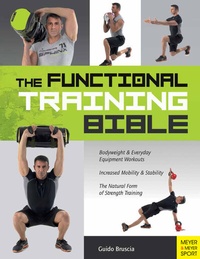
The Functional Training Bible
1st Edition
Published on 29. January 2015
512 pages
978-1-78255-707-4 (ISBN)
Description

Discover functional training like you've never seen or experienced!
This training is easy, fast and fun and it will revolutionize your health and athletic performance. It will become a new way of life! Functional training is a scientific method for personal training, workouts at the gym, at home or outdoors.
The book is divided into three parts: The first, theoretical part explains the 'why' at the foundation of functional training; the second, practical part contains bodyweight exercises and exercises with various tools (sandbags, medicine ball, kettlebells). The final section proposes several specific training programs for strength, hypertrophy and weight loss.
Welcome to the revolution in functional training! Get your focus and follow it!
More details
Other editions
Additional editions
Guido Bruscia
The Functional Training Bible
Book
12/2014
1st Edition
Meyer & Meyer Sport (UK) Ltd
€24.95
Article exhausted; check different version
Person
Guido Bruscia is a Master Trainer, popular in Italy and abroad, for functional and kettlebell training. He is technical director of the Functional Training School, teacher at institutions of education for fitness and body building, personal trainer and fitness coach. He has written several bestselling books.
He lives in Rimini, where he invented Personal Care, an innovative method of personal training with the goal of revolutionizing the lives of its students.
Content
- Intro
- Acknowledgements and thanks
- Foreword
- Introduction
- PART I - THEORY
- Chapter 1 - The Locomotor Apparatus
- 1.1 Presentation
- 1.1.1 The Active Part of the Locomotor Apparatus: Muscles, Tendons, and Ligaments
- 1.1.2 The Passive Part of the Locomotor Apparatus: Bones and Joints
- 1.2 Muscle Action
- 1.3 Role of the Individual Muscles
- 1.4 Articular Features of Muscles
- 1.5 Muscular Tissue Features
- 1.6 Elements of Biomechanics: Levers
- 1.6.1 Thoughts on Organic Levers
- Chapter 2 - Energy Systems
- 2.1 Presentation
- 2.2 Anaerobic Alactacid System
- 2.3 Anaerobic Lactacid System
- 2.4 Aerobic System
- 2.5 Energy System Interactions
- 2.6 VO2 max and the Anaerobic Threshold
- 2.7 Oxygen Debt and EPOC
- Chapter 3 - Muscular Contraction
- 3.1 Presentation
- 3.2 Muscular Contraction
- 3.3 Types of Muscle Fibers
- 3.4 Types of Muscular Contraction
- Chapter 4 - Training Theory
- 4.1 Organic Systems
- 4.2 Training: Presentation
- 4.3 Training Program
- 4.4 Training Theory
- 4.5 Training Parameters
- 4.6 Exercises
- 4.6.1 Complex exercises
- 4.6.2 Competition exercises
- Chapter 5 - Functional Training
- 5.1 Kinetic and Kinematic Chains
- 5.2 The Meaning of Functional
- 5.3 The Action-Function Principle
- 5.4 Pebbles Into a Pond
- 5.5 Objectives
- 5.5.1 What are the Benefits of Functional Training?
- 5.6 Motivations
- 5.7 Functional Training and Pre-athleticism
- 5.8 Functional Training: Other Factors to Develop
- 5.8.1 Training Recruitment
- 5.8.1.1 Training Recruitment in Adults
- 5.8.2 Stregthening Pivot Muscles
- 5.8.3 Reinforcing the Weak Links in the Kinematic Chains
- 5.8.4 Breaking the Pattern
- Chapter 6 - Hip Extensor Chain
- 6.1 Presentation
- 6.2 Action and Function of the Lower Body
- 6.3 Articular Reality: Long-limbed and Short-limbed Subjects
- 6.3.1 Consequences
- 6.4 Back Ache, the Iliopsoas, and Evolution
- Chapter 7 - Abdominal Fascia
- 7.1 Presentation
- 7.2 Core
- 7.3 Pelvic Floor
- 7.4 Action of the Abdominal Fascia
- 7.5 Function of the Abdominal Fascia
- 7.6 The Centrifuge Principle
- Chapter 8 - Scapulohumeral Girdle
- 8.1 Presentation
- 8.2 Action of the Scapulohumeral Girdle
- 8.3 Function of the Scapulohumeral Girdle
- 8.4 Grip Types
- Chapter 9 - Tibial-tarsal Joint and Foot
- 9.1 Presentation
- 9.2 Walking
- 9.3 Running
- 9.4 Foot Movements
- PART II - PRACTICE
- Chapter 10 - Body-weight Exercises
- 10.1 Origins
- 10.2 Presentation
- 10.2.1 Load types
- 10.3 Training Rules
- 10.4 Lower-body Exercises
- 10.5 Core Training
- 10.6 Upper-body Exercises
- Chapter 11 - The Sandbag
- 11.1 Presentation
- 11.1.1 Origins
- 11.1.2 Powerbag and K-BAG
- 11.1.3 Basic positions
- 11.1.4 Little tricks
- 11.2 Total-body Exercises
- 11.3 Lower-body Exercises
- 11.4 Abdominal Fascia Exercises
- 11.5 Upper-body Exercises
- Chapter 12 - The Medicine Ball
- 12.1 Presentation
- 12.1.1 Origins
- 12.1.2 Types
- 12.1.3 Grip Types
- 12.1.4 Exercises
- 12.2 Lower-body Exercises
- 12.3 Abdominal Fascia Exercises
- 12.4 Upper-body Exercises
- Chapter 13 - The Kettlebell
- 13.1 Presentation
- 13.1.1 Origins
- 13.1.2 Introduction
- 13.2 Lower-body Exercises
- 13.3 Abdominal Fascia Exercises
- 13.4 Upper-body Exercises
- PART III - OBJECTIVES, METHODS, AND TRAINING PROGRAMS
- Chapter 14 - Strength
- 14.1 The Functional Choice
- 14.2 Strength Training
- 14.3 Strength-training Programs
- Chapter 15 - Hypertrophy
- 15.1 Hypertrophy Training
- 15.2 Cosmetic and Functional Hypertrophy
- 15.3 Functional Hypertrophy-training Programs
- Chapter 16 - Slimming
- 16.1 Slimming Training
- 16.2 Lipolytic Paths
- 16.3 Circuit Training
- 16.3.1 Circuit Training
- 16.3.2 Cardio-fit Training
- 16.3.3 Peripheral Heart Action (PHA) Training
- 16.3.4 Blitz Circuits
- 16.3.5 Timed Circuits
- 16.3.6 Boot Camps
- Ethics and Conclusions
- Credits
