

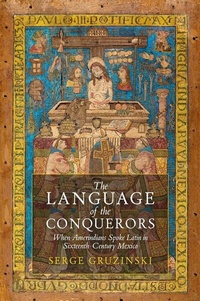
The Language of the Conquerors
Description

One of the most decisive and irreversible consequences of the Spanish conquest of the Americas was the alphabetic revolution which changed the forms of communication in indigenous societies. Writing, paper and books arrived in the Americas with the conquistadors and they were used as weapons by the Spanish to subjugate local populations and impose Christianity on them. The written word of the conquerors was a key medium of colonization: orders from the imperial metropole were written down, local resources and valuables were recorded and books conveyed knowledge coming from Europe. The children of indigenous elites, trained in humanist values, were soon more familiar with Latin and the Bible than with the beliefs of their ancestors, and the use of Latin instilled new modes of reasoning and thought. By imposing European languages and writing systems, the conquistadors also inculcated a belief in the superiority of the written word and even its holiness. And yet despite this, indigenous people were able to resist alphabetic colonization in other ways, thanks to their extraordinary creativity. By putting language, writing and printing at the centre of his analysis, Serge Gruzinski develops a fresh perspective on the colonization and conversion of the indigenous people of the Americas and enables us to observe in detail how ideas intermingle when two civilizations collide.
More details
Other editions
Additional editions
Persons
Serge Gruzinski is Director of Research at the Centre National de la Recherche Scientifique and Director of Studies at the École des hautes études en sciences sociales in Paris.
Content
Part One: An Alphabetic Unleashing
Chapter I. The "Aztec" Psalter
Chapter II. An alphabetic unleashing
Chapter III. The First Wave
Part Two: Learning to Read, Write and Sing
Chapter IV. The First Teachers
Chapter V. The First Pupils
Chapter VI. How the Apprenticeship Worked
Chapter VII. Indigenous Musicians
Part Three: What is Latin Good For?
Chapter VIII. A University for Indigenous Scholars
Chapter IX. A Prodigious Education Machine
Chapter X. "Reverende pater, nato, cujus casus est?" The Indians' Latin
Part Four: Novi homines, New Men
Chapter XI. Three Lives
Chapter XII. A Forest of Texts and Images
Chapter XIII. Humanists, Philologists, Political Activists
Chapter XIV. The Challenges of the First Globalized World
Part Five: A Psalmody for the Indians
Chapter XV. The Creators of the Psalmody
Chapter XVI. The Alchemy of the Psalter
Epilogue: "Dance, Dance or We Are Lost!"
Acknowledgements
List of Abbreviations
Bibliography
Notes
Index
