

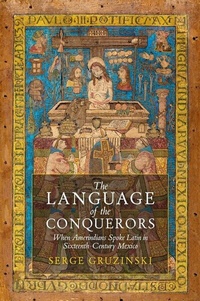
The Language of the Conquerors
Description

One of the most decisive and irreversible consequences of the Spanish conquest of the Americas was the alphabetic revolution which changed the forms of communication in indigenous societies. Writing, paper and books arrived in the Americas with the conquistadors and they were used as weapons by the Spanish to subjugate local populations and impose Christianity on them. The written word of the conquerors was a key medium of colonization: orders from the imperial metropole were written down, local resources and valuables were recorded and books conveyed knowledge coming from Europe. The children of indigenous elites, trained in humanist values, were soon more familiar with Latin and the Bible than with the beliefs of their ancestors, and the use of Latin instilled new modes of reasoning and thought. By imposing European languages and writing systems, the conquistadors also inculcated a belief in the superiority of the written word and even its holiness. And yet despite this, indigenous people were able to resist alphabetic colonization in other ways, thanks to their extraordinary creativity. By putting language, writing and printing at the centre of his analysis, Serge Gruzinski develops a fresh perspective on the colonization and conversion of the indigenous people of the Americas and enables us to observe in detail how ideas intermingle when two civilizations collide.
More details
Other editions
Additional editions
Persons
Serge Gruzinski is Director of Research at the Centre National de la Recherche Scientifique and Director of Studies at the École des hautes études en sciences sociales in Paris.
Content
Part One: An Alphabetic Unleashing
Chapter I. The "Aztec" Psalter
Chapter II. An alphabetic unleashing
Chapter III. The First Wave
Part Two: Learning to Read, Write and Sing
Chapter IV. The First Teachers
Chapter V. The First Pupils
Chapter VI. How the Apprenticeship Worked
Chapter VII. Indigenous Musicians
Part Three: What is Latin Good For?
Chapter VIII. A University for Indigenous Scholars
Chapter IX. A Prodigious Education Machine
Chapter X. "Reverende pater, nato, cujus casus est?" The Indians' Latin
Part Four: Novi homines, New Men
Chapter XI. Three Lives
Chapter XII. A Forest of Texts and Images
Chapter XIII. Humanists, Philologists, Political Activists
Chapter XIV. The Challenges of the First Globalized World
Part Five: A Psalmody for the Indians
Chapter XV. The Creators of the Psalmody
Chapter XVI. The Alchemy of the Psalter
Epilogue: "Dance, Dance or We Are Lost!"
Acknowledgements
List of Abbreviations
Bibliography
Notes
Index
1
THE "AZTEC" PSALTER
Understand in the depths of your heart that Christianity is not like the jade gemstone, or like the bracelet, or like the emerald, or like the ruby that shimmers like quetzal plumes. It is a heavenly thing, a marvelous miracle that Jesus himself, the tlatoani [sovereign] god, came here on earth to give us.
Psalmodia christiana, 1583, fol. 1 r: Prologo, Primiero psalmo = Sahagún 1993, p. 17; translated here from the French
In 1583 an exceptional book was produced on the printing presses of Mexico City: the Psalmodia christiana by the Franciscan Bernardino de Sahagún.1 The volume is hard to miss; it is in in-quarto format (13.5 × 18.5 cm) with 240 folios, in other words, approximately 500 pages.2 Laid out in letras romanas gruesas, heavy Roman characters, it is illustrated with dozens of wood engravings (see Figure 1).
The title page, which carries an illustration of Jesus on the cross flanked by the Virgin Mary and Saint John, explains that the Psalmodia has been written "in the language of the Mexica" and that it is arranged in "psalms or cantares." It is explicitly intended that this collection of songs in Náhuatl be used to accompany the dances, or areitos, that indigenous people perform in their churches on every major feast day in the church calendar.
Let us imagine Indians dancing inside the sanctuary, singing the Christian message in their native language, encouraged to do this by a book specially printed for them. Let us acknowledge that we are accustomed to more somber images of Spanish colonization: scenes of massacre and genocide against a background of inquisitorial repression and catastrophic epidemics. To tell the truth, everything here is surprising: the very existence of this book, the reason why it was created, its content, its intended public, its language, its printing in America, and the date of its publication, as well as the contributions it has elicited.
Figure 1: Psalmodia christiana, Pierre Ochart, 1583
A product of Iberian globalization
In the seventeenth century, several chroniclers drew attention to the importance of the Psalmodia. The Franciscan Juan de Torquemada praised it in Monarquia indiana,3 his history of the evangelization of the New World published in Seville. In the following century there was a change of tone: another Franciscan harshly criticized the book on the grounds that the church prohibited the dissemination of texts in people's everyday language.4 The Psalmodia was written in Náhuatl, the principal language of the Central Mexican Plateau, and, "since many Indians can read," this friar feared that, if copies of the Psalmodia were left in their hands, they would distort God's word, incorporating it into their drunken gyrations. Our censor destroyed all the copies that he managed to confiscate. For this reason only a few examples survived, estimations of their number at the end of the nineteenth century varying between three and five.5 Another three have reappeared since then.6 There may have been yet another Psalmodia in the collection of the National Library in Mexico City.7
Let us go back to the time of the book's publication. As stated, it was printed in Mexico City in 1583, the year when Montaigne, who had been elected for a second term as mayor of Bordeaux, decided to undertake further work on his Essays. That same year, Saint Teresa published her Way of Perfection and Claudio Monteverdi published his Madrigali spirituali a quattro voci in Brescia8 - two apogees of European spirituality to set against our Psalmodia. Other literary masterpieces saw the light of day soon after, Giordano Bruno's The Ash Wednesday Supper and Miguel Cervantes' La Galatea among them. The Mexican Psalmodia merits being set alongside these renowned examples of late Renaissance literature.
What was Mexico City like in 1583? More than sixty years after the Spanish conquest, the capital of New Spain was one metropolis in an empire at its peak. It was three years since Philip II had added the Portuguese crown to that of Castile. The Iberian Peninsula, a portion of Italy, the Netherlands, African coasts, a part of the American continent, some trading posts in Asia, and the Philippine Archipelago made up an empire whose growing relations with the rest of the world prefigured the globalizations to come. In Asia, between Macao and Manila, some of the subjects considered this empire so powerful that they urged Philip II to embark on the conquest of China.9 With less explicitly warlike objectives, the Jesuit Matteo Ricci also set his sights on the Celestial Empire, which he hoped to convert peacefully. These projects, each in its way, exemplified the planetary momentum of an empire ready to conquer everything in its path. In Africa, the Portuguese took control of half of Angola. On the American continent, the silver mines of Potosi unleashed a thousand European dreams.
What is a psalmody?
The Psalmodia christiana followed the liturgical calendar, taking indigenous populations right through the year. When it was first published it had a strong competitor, the Breviarium romanum (Roman Breviary), which had been devised to ensure that uniform standards were observed for a Catholic rite that must everywhere be based on the model of the Church of Rome.10 A spearhead of the Catholic reform movement, the Roman Breviary brought together daily prayers, hymns, psalms, and readings that the clergy should read out and sing during divine service. Its cornerstone was the psalter, which brought together the psalms sung at matins, lauds, and vespers.
In 1568 the pope made the use of the Roman Breviary mandatory. Three years later, continuing in this vein, he established the Congregation of the Index, which was charged with scrutinizing, for conformity and orthodoxy, any publication that Catholics might encounter. The Counter-Reformation spread across every continent, even to distant New Spain, and in 1579 in Mexico City, four years before the appearance of the Psalmodia, Pedro Balli printed The Ceremonial and General Headings with the Order of Celebration of the Mass . Taken from the New Missal of Trent.11 The stated intention was to disseminate the decrees of the Council of Trent by distributing the texts it promulgated. It was to Pedro Balli, too, that the world was indebted for the publication of Rules and Art to Facilitate the Recitation of the Divine Office . as directed by the Holy Council of Trent.12 This work was dedicated to his patron, Archbishop Pedro Moya de Contreras, who was an influential advocate of the Counter-Reformation in New Spain.
Thus our Psalmodia was in august company at the very moment when the Counter-Reformation presented itself as the implacable enemy of Protestantism and established, for centuries to come, what Rome would take to be orthodoxy. But a psalmodia is not a breviary. Our psalmodia's reassuringly humble title was probably the result of an attempt to deflect the censorship of the church. In most cases a psalmodia is little more than a selection of psalms for a specific service, unless the title is used to designate the Psalterium - the corpus of all 150 psalms to be recited throughout the various services of the week and of the liturgical calendar. The Psalmodia of 1583, however, was neither one nor the other.
The author, according to the work's title page, was a founding figure of the Mexican church: the Franciscan Bernardino de Sahagún. Having arrived in Mexico some fifty years earlier, at the time the work was published he was eighty-four. The old man had considerable experience of evangelization and was also one of the most eminent experts on the region's indigenous communities, having been responsible for an encyclopedic compilation on pre-Hispanic societies that is today known as The Florentine Codex and is considered a prime example of ethno-historical research.13
The texts that made up the Psalmodia had been edited and re-edited long before their publication; for the work had waited almost twenty years before being passed to the presses of Mexico City. During that long gestation, Sahagún did not work alone. He was surrounded by native experts and assistants to whom he did not omit to acknowledge his gratitude, but whose collaboration was long downplayed.
A word about the printer - a native of Rouen named Pierre Ochart. The Frenchman knew Mexico well, having lived there for more than thirty years. His story is as intriguing as Sahagún's. What had he been seeking in crossing to the other side of the Atlantic? How had he fared there? We shall look later at why this European printer was publishing in a non-western language and at how he worked with typographers who had familiarized themselves with indigenous languages and with proofreaders steeped in the arcana of Tridentine theology, experts in the indigenous world who had the ability to evade inquisitorial censorship.
Initially, in 1576, the Franciscan Sahagún presented this work as a collection of Cánticos y cantares (canticles and cantares). Two years later he specified that it was a Psalmodia de cantares.14 The Spanish term cantar...
