

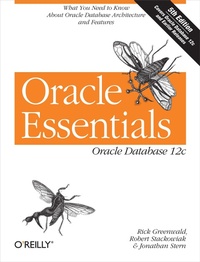
Oracle Essentials
Oracle Database 12c
5th Edition
Published on 6. September 2013
432 pages
978-1-4493-4318-7 (ISBN)
Description

Written by Oracle insiders, this indispensable guide distills an enormous amount of information about the Oracle Database into one compact volume. Ideal for novice and experienced DBAs, developers, managers, and users, Oracle Essentials walks you through technologies and features in Oracle's product line, including its architecture, data structures, networking, concurrency, and tuning.
Complete with illustrations and helpful hints, this fifth edition provides a valuable one-stop overview of Oracle Database 12c, including an introduction to Oracle and cloud computing. Oracle Essentials provides the conceptual background you need to understand how Oracle truly works.
Topics include:
- A complete overview of Oracle databases and data stores, and Fusion Middleware products and features
- Core concepts and structures in Oracle's architecture, including pluggable databases
- Oracle objects and the various datatypes Oracle supports
- System and database management, including Oracle Enterprise Manager 12c
- Security options, basic auditing capabilities, and options for meeting compliance needs
- Performance characteristics of disk, memory, and CPU tuning
- Basic principles of multiuser concurrency
- Oracle's online transaction processing (OLTP)
- Data warehouses, Big Data, and Oracle's business intelligence tools
- Backup and recovery, and high availability and failover solutions
More details
Other editions
Additional editions
Book
10/2013
1st Edition
O'Reilly
€47.00
Shipment within 10-20 days
Previous edition
E-Book
02/2004
1st Edition
O'Reilly
€26.49
Available for download
Content
- Intro
- Copyright
- Table of Contents
- Preface
- Goals of This Book
- Audience for This Book
- About the Fifth Edition (Oracle Database 12c)
- Structure of This Book
- Conventions Used in This Book
- Using Code Examples
- Safari® Books Online
- How to Contact Us
- Acknowledgments
- Chapter 1. Introducing Oracle
- The Evolution of the Relational Database
- Relational Basics
- How Oracle Grew
- The Oracle Database Family
- Summary of Oracle Database Features
- Database Application Development Features
- Database Programming
- Database Extensibility
- Database Connection Features
- Oracle Net Services
- Oracle Internet Directory
- Oracle Connection Manager
- The Role of Oracle Fusion Middleware
- Oracle's WebLogic Server
- Oracle Tuxedo
- Data Integration Tools
- Business Intelligence Tools
- WebCenter
- Identity Management
- Distributed Database Features
- Distributed Queries and Transactions
- Heterogeneous Services
- Data Movement Features
- Transportable Tablespaces
- Advanced Queuing and Oracle Streams
- Database Performance Features
- Database Parallelization
- Data Warehousing
- Managing the Oracle Database
- Oracle Enterprise Manager 12c
- Real Application Testing Option
- Pluggable Databases
- Storage Management
- High Availability
- Database Security Features
- Advanced Security Option
- Label Security Option
- Database Vault Option
- Audit Vault and Database Firewall Option
- Oracle Database Development Tools
- Oracle SQL Developer
- Oracle Application Express
- Other Oracle Databases
- Oracle MySQL
- Berkeley DB & Oracle NoSQL Database
- Oracle TimesTen
- Cloudera Distribution of Hadoop
- Chapter 2. Oracle Architecture
- Databases and Instances
- Oracle Database Structures
- Pluggable Databases
- Database Initialization
- Deploying Physical Components
- Control Files
- Datafiles
- Redo Logfiles
- Instance Memory and Processes
- Memory Structures for an Instance
- Background Processes for an Instance
- Configuration, Engineered Systems, and the Cloud
- The Data Dictionary
- Chapter 3. Installing and Running Oracle
- Installing Oracle
- Optimal Flexible Architecture
- Supporting Multiple Oracle Versions on a Machine
- Upgrading an Oracle Database
- Creating a Database
- Planning the Database
- The Value of Estimating
- Tools for Creating Databases
- Oracle Net Services and Oracle Net
- Resolving Oracle Net Service Names
- Global Data Services
- Oracle Net Manager
- Oracle Connection Pooling
- Auto-Discovery and Agents
- Oracle Net Configuration Files
- Starting Up the Database
- Shutting Down the Database
- Accessing a Database
- Server Processes and Clients
- Application Servers and Web Servers As Clients
- Oracle Net and Establishing Network Connections
- The Shared Server/Multi-Threaded Server
- Database Resident Connection Pooling
- Oracle in the Cloud
- Oracle at Work
- Oracle and Transactions
- Flashback
- A Transaction, Step by Step
- Chapter 4. Oracle Data Structures
- Datatypes
- Character Datatypes
- Numeric Datatype
- Date Datatype
- Other Datatypes
- Type Conversion
- Concatenation and Comparisons
- NULLs
- Basic Data Structures
- Tables
- Views
- Indexes
- Partitioning
- Additional Data Structures
- Sequences
- Synonyms
- Clusters
- Hash Clusters
- Extended Logic for Data
- Rules Manager
- The Expression Filter
- Data Design
- Constraints
- Triggers
- Query Optimization
- Rule-Based Optimization
- Cost-Based Optimization
- Specifying an Optimizer Mode
- Saving the Optimization
- Comparing Optimizations
- Performance and Optimization
- SQL Translation
- Understanding the Execution Plan
- SQL Advisors
- Data Dictionary Tables
- Chapter 5. Managing Oracle
- Manageability Features
- Database Advisors
- Automatic Storage Management
- Oracle Enterprise Manager
- Enterprise Manager Architecture
- Oracle Enterprise Manager Consoles
- EM Express
- Backup and Recovery
- Types of Backup and Recovery Options
- Oracle Secure Backup
- Information Lifecycle Management
- ILM in Oracle Database 12c
- Working with Oracle Support
- Reporting Problems
- Automated Patching
- Chapter 6. Oracle Security, Auditing, and Compliance
- Security
- Usernames, Privileges, Groups, and Roles
- Identity Management
- Security Privileges
- Special Roles: DBA, SYSDBA, and SYSOPER
- Policies
- Restricting Data-Specific Access
- Label Security Option
- Security and Application Roles and Privileges
- Distributed Database and Multitier Security
- Advanced Security Option
- Encryption
- Data Redaction
- Secure Backup
- Auditing
- Compliance
- Oracle Database Vault Option
- Oracle Audit Vault Server
- Flashback Data Archive
- Transparent Sensitive Data Protection
- Chapter 7. Oracle Performance
- Oracle and Resource Usage
- Oracle and Disk I/O Resources
- I/O Planning Principles for an Oracle Database
- Oracle and Parallelism
- Block-Range Parallelism
- Parallelism for Tables and Partitions of Tables
- What Can Be Parallelized?
- Partition-Based Parallelism
- Oracle and Memory Resources
- How Oracle Uses the System Global Area
- How Oracle Uses the Program Global Area
- Oracle and CPU Resources
- Performance Tuning Basics
- Defining Performance and Performance Problems
- Monitoring and Tuning the Oracle Database for Performance
- Using the Oracle Database Resource Manager
- Additional Monitoring and Tuning Available for Oracle Exadata
- A Final Note on Performance Tuning
- Chapter 8. Oracle Multiuser Concurrency
- Basics of Concurrent Access
- Transactions
- Locks
- Concurrency and Contention
- Integrity Problems
- Serialization
- Oracle and Concurrent User Access
- Oracle's Isolation Levels
- Oracle Concurrency Features
- How Oracle Handles Locking
- A Simple Write Operation
- A Conflicting Write Operation
- A Read Operation
- Concurrent Access and Performance
- Workspaces
- Workspace Implementation
- Workspace Operations
- Workspace Enhancements
- Chapter 9. Oracle and Transaction Processing
- OLTP Basics
- What Is a Transaction?
- What Does OLTP Mean?
- OLTP Versus Business Intelligence
- Transactions and High Availability
- Oracle's OLTP Heritage
- Architectures for OLTP
- Traditional Two-Tier Client/Server
- Stored Procedures
- Three-Tier Systems
- Application Servers and Web Servers
- The Grid
- OLTP and the Cloud
- Oracle Features for OLTP
- General Concurrency and Performance
- Scalability
- Real Application Clusters
- Exadata and OLTP
- High Availability
- Chapter 10. Oracle Data Warehousing and Business Intelligence
- Data Warehousing Basics
- The Evolution of Data Warehousing and Business Intelligence
- A Topology for Business Intelligence
- Data Marts
- The Operational Data Store and Enterprise Warehouse
- OLTP Systems and Business Intelligence
- Big Data and the Data Warehouse
- Data Warehouse Design
- Query Optimization
- Bitmap Indexes and Parallelism
- Optimization Provided by the Exadata Storage Server Software
- Dimensional Data and Hierarchies in the Database
- Summary Tables
- Materialized Views
- OLAP Option
- Analytics and Statistics in the Database
- Basic Analytic and Statistical Functions
- Other SQL Extensions
- Advanced Analytics Option
- Other Datatypes and Big Data
- Loading Data into the Data Warehouse
- Managing the Data Warehouse
- Business Intelligence Tools
- Oracle Business Intelligence Foundation Suite
- Business Intelligence Applications
- Data Discovery and Oracle Endeca Information Discovery
- Oracle Exalytics
- The Metadata Challenge
- Putting It All Together
- A Complete Analytics Infrastructure
- Best Practices
- Common Misconceptions
- Effective Strategy
- Chapter 11. Oracle and High Availability
- What Is High Availability?
- Measuring High Availability
- The System Stack and Availability
- Server Hardware, Storage, and Database Instance Failure
- What Is Instance Recovery?
- Phases of Instance Recovery
- Protecting Against System Failure
- Component Redundancy
- Disk Redundancy
- Automatic Storage Management
- Site and Computer Server Failover
- Oracle Data Guard and Site Failures
- Oracle Active Data Guard and Zero Data Loss
- Oracle GoldenGate and Replication
- Real Application Clusters and Instance Failures
- Oracle Transparent Application Failover
- Oracle Application Continuity
- Recovering from Failures and Data Corruption
- Developing a Backup-and-Recovery Strategy
- Taking Oracle Backups
- Using Backups to Recover
- Recovery Manager
- Read-Only Tablespaces and Backups
- Old-Fashioned Data Redundancy
- Point-in-Time Recovery
- Flashback
- Planned Downtime
- Chapter 12. Oracle and Hardware Architecture
- System Basics
- Symmetric Multiprocessing Systems and Nodes
- Clustered Solutions, Grid Computing, and the Cloud
- Disk and Storage Technology
- Oracle's Engineered Systems
- Oracle Exadata Database Machine
- Oracle Exalogic
- Oracle SuperCluster
- Oracle Database Appliance
- Other Engineered Systems
- Choosing and Defining the Right Platform
- Sizing and Planning for Growth
- Maximum Availability Architecture Considerations
- Justifying an Oracle Engineered System
- Chapter 13. Oracle Distributed Databases and Distributed Data
- Accessing Distributed Databases
- Distributed Data Across Multiple Oracle Databases
- Access to and from Non-Oracle Databases
- Two-Phase Commit
- Oracle Tuxedo
- Replication and Data Transport
- Replication Basics
- History of Oracle Replication Offerings
- Oracle GoldenGate
- Global Data Services
- Data Transport Using Database Features
- Chapter 14. Oracle Extended Datatypes
- Object-Oriented Development
- Object-Relational Features
- Java's Role and Web Services
- JavaBeans
- Extensibility Features and Options
- Oracle Multimedia
- Oracle Text
- XML DB
- Oracle Spatial and Graph Option
- The Extensibility Architecture Framework
- Chapter 15. Oracle and the Cloud
- Cloud Definitions
- Common Characteristics
- Cloud Levels
- Is the Cloud New?
- Use Cases for Cloud Computing
- Oracle Database in the Cloud
- Oracle as a DBaaS
- Oracle as a PaaS
- Consumer and Provider
- Oracle Database Cloud Service
- History of Application Express
- Architecture
- Development with the Database Cloud Service
- SQL Developer and the Database Cloud
- Implementing Provider Clouds
- Appendix A. What's New in This Book for Oracle Database 12c
- Chapter 1: Introducing Oracle
- Chapter 2: Oracle Architecture
- Chapter 3: Installing and Running Oracle
- Chapter 4: Data Structures
- Chapter 5: Managing Oracle
- Chapter 6: Oracle Security, Auditing, and Compliance
- Chapter 7: Oracle Performance
- Chapter 8: Oracle Multiuser Concurrency
- Chapter 9: Oracle and Transaction Processing
- Chapter 10: Oracle Data Warehousing and Business Intelligence
- Chapter 11: Oracle and High Availability
- Chapter 12: Oracle and Hardware Architecture
- Chapter 13: Oracle Distributed Databases and Distributed Data
- Chapter 14: Oracle Extended Datatypes
- Chapter 15: Oracle and the Cloud
- Appendix B. Additional Resources
- Web Sites
- Books and Oracle Documentation
- Chapter 1: Introducing Oracle
- Chapter 2: Oracle Architecture
- Chapter 3: Installing and Running Oracle
- Chapter 4: Data Structures
- Chapter 5: Managing Oracle
- Chapter 6: Oracle Security, Auditing, and Compliance
- Chapter 7: Oracle Performance
- Chapter 8: Oracle Multiuser Concurrency
- Chapter 9: Oracle and Transaction Processing
- Chapter 10: Oracle Data Warehousing and Business Intelligence
- Chapter 11: Oracle and High Availability
- Chapter 12: Oracle and Hardware Architecture
- Chapter 13: Oracle Distributed Databases and Distributed Data
- Chapter 14: Oracle Extended Datatypes
- Chapter 15: Oracle and the Cloud
- Index
- About the Authors
