

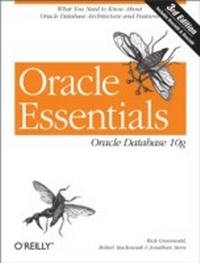
Oracle Essentials
Oracle Database 10g
1st Edition
Published on 11. February 2004
400 pages
978-0-596-55235-0 (ISBN)
Description

An enormous system comprising myriad technologies, options, and releases, Oracle's complexities have spawned numerous areas of specialization. For each area of specialization there are equally specialized how-to books and manuals. O'Reilly's Oracle Essentials claims a unique place among these books. Rather than focusing on one area, the book explains the foundational concepts of the Oracle technology and the core technical and business aspects of using it.The new edition of this classic book, Oracle Essentials, 3rd Edition: Oracle Database 10g, distills a vast amount of knowledge into an easy-to-read volume covering every aspect of the Oracle database. Readers of all levels will learn about Oracle's features and technologies, including the product line, architecture, data structures, networking, concurrency, tuning, and much more.Featuring focused text, abundant illustrations, and helpful hints, the new edition offers a valuable overview of Oracle's Database 10g--the industry's first database to support grid computing. Recent releases such as Oracle 9i and 8i are also covered. The book contains chapters on:Oracle products, options, and overall architecture for Oracle 10g and prior recent releasesInstalling and running Oracle: how to configure, start up, and shut down the database, and various networking issuesOracle data structures, datatypes, and ways of extending datatypes, with an introduction to Oracle objects (e.g., tables, views, indexes)Managing Oracle: security, the Oracle Enterprise Manager, fragmentation and reorganization, and backup and recoveryOracle performance: characteristics of disk, memory, and CPU tuningMulti-user concurrency, online transaction processing (OLTP), and high availabilityHardware architectures (e.g., SMP, MPP, NUMA) and their impact on OracleData warehousing and distributed databasesNetwork deployment: using Oracle as an Internet computing platform and for grid computingWhat's new in Oracle 10g: a summary of the database changes described in the bookOracle Essentials, 3rd Edition: Oracle Database 10g was written for anyone whose job involves managing or building systems using Oracle DBMS technology or working with staff that uses Oracle technology. This book is the perfect all-in-one source for understanding the complexities and capabilities of Oracle.
More details
Other editions
New editions
E-Book
09/2013
5th Edition
O'Reilly
€0.00
Available for download
Additional editions
Rick Greenwald | Robert Stackowiak | Jonathan Stern
Oracle Essentials, 3rd Edition: Oracle 10g
Oracle Database 10g
Book
03/2004
3rd Edition
O'Reilly
€32.00
Article exhausted; check for reprint
Content
- Intro
- Table of Contents
- Preface
- Goals of This Book
- Audience for This Book
- About the Third Edition (Oracle Database 10g)
- Structure of This Book
- Conventions Used in This Book
- How to Contact Us
- Acknowledgments
- Introducing Oracle
- The Evolution of the Relational Database
- Relational Basics
- How Oracle Grew
- The Oracle Family
- Oracle Standard Edition
- Oracle Enterprise Edition
- Oracle Personal Edition
- Oracle Lite
- Summary of Oracle Features
- Database Application Development Features
- Database Programming
- SQL
- PL/SQL
- Java features and options
- Large objects
- Object-oriented programming
- Third-generation languages (3GLs)
- Database drivers
- The Oracle Call Interface
- National Language Support
- Availability
- Database Extensibility
- Oracle Text and interMedia
- Oracle Spatial Option
- XML
- Database Connection Features
- Database Networking
- Oracle Net
- Oracle Names
- Oracle Internet Directory
- Oracle Connection Manager
- Advanced Security Option
- Label Security Option
- Availability
- Oracle Application Server
- Availability
- Distributed Database Features
- Distributed Queries and Transactions
- Heterogeneous Services
- Availability
- Data Movement Features
- Basic Replication
- Advanced Replication
- Transportable Tablespaces
- Advanced Queuing and Streams
- Extraction, Transformation, Loading
- Availability
- Performance Features
- Database Parallelization
- Availability
- Data Warehousing and Business Intelligence
- Bitmap indexes
- Star query optimization
- Materialized views
- Analytic functions
- OLAP Option
- Data Mining Option
- Availability
- Database Management Features
- Oracle Enterprise Manager
- EM2Go
- Availability
- Backup and Recovery
- Recovery Manager
- Incremental backup and recovery
- Oracle Storage Manager and Automated Disk Based Backup and Recovery
- Availability
- Database Availability
- Partitioning option
- Data Guard
- Fail Safe
- Oracle Real Application Clusters
- Data Guard and RAC
- Automated Storage Management
- Availability
- Oracle Developer Suite
- Oracle Forms Developer
- Oracle Reports Developer
- Oracle JDeveloper
- Oracle Designer
- Oracle Discoverer Administration Edition
- Oracle Portal
- Availability
- Oracle Lite
- Oracle Architecture
- Instances and Databases
- The Components of a Database
- Tablespaces
- Physical Files in an Oracle Database
- Control Files
- Control file parameters
- Multiple control files
- Datafiles
- Datafile structure
- Extents and segments
- Redo Log Files
- Multiplexing redo log files
- How Oracle uses the redo logs
- Naming conventions for redo logs
- Archived redo logs
- ARCHIVELOG mode and automatic archiving
- The Components of an Instance
- Memory Structures for an Instance
- Database buffer cache
- Shared pool
- Redo log buffer
- Background Processes for an Instance
- The Data Dictionary
- Installing and Running Oracle
- Installing Oracle
- Optimal Flexible Architecture (OFA)
- Supporting Multiple Oracle Versions on a Machine
- Upgrading an Oracle Database
- Creating a Database
- Planning the Database
- The Value of Estimating
- Tools for Creating Databases
- Configuring Oracle Net
- Resolving Oracle Net Service Names
- Oracle Net Manager
- Auto-Discovery and Agents
- Oracle Net Configuration Files
- Starting Up the Database
- Shutting Down the Database
- Accessing a Database
- Server Processes and Clients
- Server process
- Client process
- Application Servers and Web Servers as Clients
- Oracle Net and Establishing Network Connections
- The Shared Server/Multi-Threaded Server
- Session Memory for Shared Server Processes Versus Dedicated Server Processes
- Data Dictionary Information About the Shared Server
- Oracle at Work
- Oracle and Transactions
- A Transaction, Step by Step
- Data Structures
- Datatypes
- Character Datatypes
- Numeric Datatype
- Date Datatype
- Other Datatypes
- Type Conversion
- Concatenation and Comparisons
- NULLs
- Basic Data Structures
- Tables
- Views
- Indexes
- B*-tree indexes
- Reverse key indexes
- Bitmap indexes
- Function-based indexes
- Additional Data Structures
- Sequences
- Synonyms
- Clusters
- Hash Clusters
- Data Design
- Constraints
- Triggers
- Query Optimization
- Rule-Based Optimization
- Cost-Based Optimization
- Statistics
- Influencing the cost-based optimizer
- Choosing a Mode
- Why choose the cost-based optimizer?
- Why choose the rule-based optimizer?
- Saving the Optimization
- Understanding the Execution Plan
- SQL Tuning Advisor
- Data Dictionary Tables
- Managing Oracle
- Management and Enterprise Manager
- Oracle Enterprise Manager Architecture
- Oracle Enterprise Manager Consoles
- The HTML Console Interface
- EM2Go
- Oracle Database 10g Self-Tuning and Management
- Implementing Security
- Usernames, Privileges, Groups, and Roles
- Security Privileges
- The DBA Role, SYSDBA, and SYSOPER
- Auditing Security, Policies, and Policy Violations
- View-Based Security
- Fine-Grained Access Control
- Label Security Option
- Security and Application Roles and Privileges
- Distributed Database and Multi-Tier Security
- Advanced Security Option
- Fragmentation and Reorganization
- Resolving Fragmentation
- Backup and Recovery
- Types of Backup and Recovery Options
- Additional Backup Capabilities
- Working with Oracle Support
- Reporting Problems
- Automated Patching in Oracle Database 10g
- Oracle Performance
- Performance Tuning Basics
- Defining Performance Problems
- Oracle Server Performance
- Machine Resource Usage
- When All Else Fails
- A Final Note on Performance
- Oracle and Disk I/O Resources
- I/O Planning Principles for an Oracle Database
- Using RAID Disk Array Technology
- Host-based software
- Dedicated storage subsystems
- Combined host-based and I/O subsystem volume management
- Flexibility, Manageability, and Disk Arrays
- How Oracle I/O and Striped Arrays Interact
- Oracle and Parallelism
- Block-Range Parallelism
- Parallelism for Tables and Partitions of Tables
- What Can Be Parallelized?
- Controlling Oracle's Parallel Resource Usage
- Setting the degree of parallelism
- Intra-operation parallelism
- Adaptive Parallelism
- Partition-Based Parallelism
- Parallelism for partitions and subpartitions of a table
- Fast full index scans for nonpartitioned tables
- Parallel insert for nonpartitioned and partitioned tables
- Oracle and Memory Resources
- How Oracle Uses the System Global Area
- The database buffer cache
- The shared pool
- The redo log buffer
- Automatic sizing for the SGA
- How Oracle Uses the Program Global Area
- Memory for SQL statements
- Memory for sorting within the PGA
- Automatic sizing for the PGA
- Oracle and CPU Resources
- Database Resource Manager
- Monitoring
- Dynamic Performance Views
- Enterprise Manager
- Automatic Workload Repository and Diagnostics
- Real Application Clusters and Performance
- Multiuser Concurrency
- Basics of Concurrent Access
- Transactions
- Locks
- Concurrency and Contention
- Integrity Problems
- Serialization
- Oracle and Concurrent User Access
- Oracle's Isolation Levels
- Oracle Concurrency Features
- How Oracle Handles Locking
- A Simple Write Operation
- A Conflicting Write Operation
- A Read Operation
- Concurrent Access and Performance
- Workspaces
- Oracle and Transaction Processing
- OLTP Basics
- What Is a Transaction?
- What Does OLTP Mean?
- General characteristics
- Online versus batch
- OLTP Versus Decision Support
- Oracle's OLTP Heritage
- Architectures for OLTP
- Traditional Two-Tier Client/Server
- Stored Procedures
- Three-Tier Systems
- Application Servers and Web Servers
- The Grid
- Oracle Features for OLTP
- General Concurrency and Performance
- Scalability
- Multi-Threaded Server/shared server
- Database Resource Manager
- Real Application Clusters
- High Availability
- Oracle Advanced Queuing and Streams
- Advanced Queuing for System Interfaces
- Oracle and Publish-Subscribe Technology
- Object Technologies and Distributed Components
- Oracle and Data Warehousing
- Business Intelligence Basics
- The Evolution of Business Intelligence
- A Topology for Business Intelligence
- Data Marts
- Operational Data Store and Enterprise Warehouse
- Data Warehouse Design
- Query Optimization
- Bitmap Indexes
- Real Application Clusters
- Summary Tables
- Materialized Views
- Analytics, OLAP, and Data Mining in the Database
- Functions
- OLAP and Data Mining Options
- Other Capabilities
- Database Extensibility and the Data Warehouse
- interMedia
- Spatial option
- XML
- Managing the Data Warehouse
- Other Data Warehouse Software
- Extraction, Transformation, and Loading
- Reporting and Ad-Hoc Query Tools
- OLAP and OLAP Applications Building
- Data Mining
- Business Intelligence Applications
- The Metadata Challenge
- Best Practices
- Common Misconceptions
- Effective Strategy
- Oracle and High Availability
- What Is High Availability?
- Measuring and Planning Availability
- Causes of Unplanned Downtime
- System Availability Versus Component Availability
- System Crashes
- What Is Instance Recovery?
- Phases of Instance Recovery
- Rollforward
- Fast-start fault recovery and bounded recovery time
- Rollback
- Deferred rollback
- Fast-start rollback
- Protecting Against System Crashes
- Component Redundancy
- Disk redundancy
- Automatic Storage Management
- Simple Hardware Failover
- Outage duration for hardware failover
- Failover and operating system platform
- Real Application Clusters
- Real Application Clusters and hardware failover
- Node failure and Real Application Clusters
- Parallel Fail Safe / RACGuard
- Oracle Transparent Application Failover
- How TAF works
- TAF and various Oracle configurations
- Recovering from Disasters
- Developing a Backup and Recovery Strategy
- Taking Oracle Backups
- Using Backups to Recover
- Read-Only Tablespaces
- Point-in-Time Recovery
- Flashback
- Recovery Manager
- Complete Site Failure
- Oracle Data Guard: Standby Database for Redundancy
- Logical standby database
- Oracle Data Guard management
- Possible Causes of Lost Data with a Physical Standby Database
- Copying archived redo logs to a standby site
- Unarchived redo information and the role of geomirroring
- Data Redundancy Solutions
- Data Replication: Synchronous and Asynchronous
- Old-Fashioned Data Redundancy
- Oracle and Hardware Architecture
- System Basics
- Uniprocessor Systems
- Symmetric Multiprocessing Systems
- Clusters
- Massively Parallel Processing Systems
- Non-Uniform Memory Access Systems
- Grid Computing
- Disk Technology
- Disk Deployment Strategies
- Which Platform Deployment Solution?
- Platform Comparison
- Approaches to Choosing Platforms
- Distributed Databases and Distributed Data
- Accessing Multiple Databases as a Single Entity
- Distributed Data Access Across Multiple Oracle Databases
- Access to and from Non-Oracle Databases
- Two-Phase Commits
- Transaction Processing Monitors
- Moving Data Between Distributed Systems
- Advanced Replication
- Managing advanced replication
- Transportable Tablespaces
- Advanced Queuing
- Queue Creation and Management
- Publish-and-Subscribe Capabilities
- Oracle Streams
- Oracle Streams and Grid Computing
- Extending Oracle Datatypes
- Object-Oriented Development
- Object-Relational Features
- Objects in Oracle
- Other extensibility features
- Java's Role
- Enterprise JavaBeans
- Extensibility Features and Options
- Oracle Time Series
- Oracle interMedia and Oracle Text
- Oracle Spatial Option
- Using the Extensibility Framework in Oracle
- Network Deployment Models
- The Impact of the Internet
- The Oracle Database and the Internet
- Oracle HTTP Server
- Standards Support
- Java in the database
- XML
- Simplified HTML Applications Development
- Oracle Application Server
- Editions
- Installation
- Components
- HTTP Server
- Containers for J2EE (OC4J)
- TopLink
- Development tools
- Development servers
- Portal
- Wireless
- Security
- Integration
- Business intelligence
- System Services
- Management
- Caching
- Clustering and load balancing
- Grid Computing
- Features for Grid Computing
- Provisioning
- Resilience
- Integration
- Management
- A Final Thought on Grid Computing
- What's New in This Book for Oracle Database10g
- Chapter 1, Introducing Oracle
- Chapter 2, Oracle Architecture
- Chapter 3, Installing and Running Oracle
- Chapter 4, Data Structures
- Chapter 5, Managing Oracle
- Chapter 6, Oracle Performance
- Chapter 7, Multiuser Concurrency
- Chapter 8, Oracle and Transaction Processing
- Chapter 9, Oracle and Data Warehousing
- Chapter 10, Oracle and High Availability
- Chapter 11, Oracle and Hardware Architecture
- Chapter 12, Distributed Databases and Distributed Data
- Chapter 13, Extending Oracle Datatypes
- Chapter 14, Network Deployment Models
- Additional Resources
- Web Sites
- Books and Oracle Documentation
- Chap ter 1, Introducing Oracle
- Chap ter 2, Oracle Architecture
- Chap ter 3, Installing and Running Oracle
- Chap ter 4, Data Structures
- Chap ter 5, Managing Oracle
- Chap ter 6, Oracle Performance
- Chap ter 7, Multiuser Concurrency
- Chap ter 8, Oracle and Transaction Processing
- Chap ter 9, Oracle and Data Warehousing
- Chap ter 10, Oracle and High Availability
- Chap ter 11, Oracle and Hardware Architecture
- Chap ter 12, Distributed Databases and Distributed Data
- Chap ter 13, Extending Oracle Datatypes
- Chap ter 14, Network Deployment Models
- Index
