

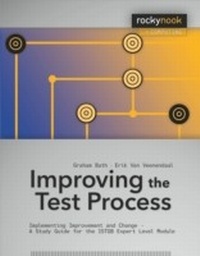
Improving the Test Process
Implementing Improvement and Change - A Study Guide for the ISTQB Expert Level Module
1st Edition
Published on 13. December 2013
434 pages
978-1-4920-0132-4 (ISBN)
Description

This book covers the syllabus for the Improving the Test Process module of the International Software Testing Qualifications Board (ISTQB) Expert Level exam.To obtain certification as a professional tester at the Expert Level, candidates may choose to take a course given by an ISTQB accredited training provider and then sit for the exam. Experience shows that many candidates who choose this path still require a reference book that covers the course. There are also many IT professionals who choose self-study as the most appropriate route toward certification. This book can be used both as a preparation guide for those planning to take the ISTQB Expert Level certification exam and as a practical guide for experienced testing professionals who want to develop their skills in improving test processes.
More details
Other editions
Additional editions
Graham Bath | Erik Van Veenendaal
Improving the Test Process
Implementing Improvement and Change - A Study Guide for the ISTQB Expert Level Module
Book
12/2013
1st Edition
Rocky Nook
€40.00
Article exhausted; check different version
Graham Bath | Erik Van Veenendaal
Improving the Test Process
Implementing Improvement and Change - A Study Guide for the ISTQB Expert Level Module
E-Book
12/2013
1st Edition
Rocky Nook
from
€54.69
Available for download
Content
- Intro
- Preface
- Acknowledgements
- 1 Introduction
- 1.1 About the Authors
- 1.1.1 Erik van Veenendaal
- 1.1.2 Graham Bath
- 1.2 Purpose of the Book
- Overview
- Completeness and Structure
- Readability
- 1.3 What Is an Expert?
- 1.4 Expectations and Business Outcomes
- Part 1: Assessing test processes
- Part 2: Implementing test process improvement
- 1.5 Career Paths for Testers
- 1.6 Syllabus Parts
- 1.7 The Certification Exam
- Pass Mark
- 1.8 Certification
- 2 The Context of Improvement
- 2.1 Why Improve Testing?
- 2.2 What Can Be Improved?
- Preconditions
- Context
- 2.3 Views on Quality
- The Product-Based Definition
- The User-Based Definition
- The Manufacturing-Based Definition
- The Value-Based Definition
- The Transcendent-Based Definition
- 2.4 The Generic Improvement Process
- 2.4.1 The Deming Cycle
- Plan
- Do
- Check
- Act
- Sustainment
- 2.4.2 The IDEAL Improvement Framework
- 2.4.3 Fundamental Concepts of Excellence
- European Foundation for Quality Management (EFQM)
- Enablers - How We Do Things
- Results - What We Target, Measure, and Achieve
- Malcolm Baldrige Model
- Six Sigma
- Define
- Measure
- Analyze
- Improve
- Control
- 2.5 Overview of Improvement Approaches
- 2.5.1 Overview of Model-Based Approaches
- 2.5.2 Overview of Analytical Approaches
- 2.5.3 Hybrid Approaches
- 2.5.4 Other Approaches to Improving the Test Process
- Test Process Improvement by Developing People's Skills
- Personal Software Process (PSP)
- People CMM
- Test Process Improvement by Using Tools
- Test Process Improvement in Different Test Approaches
- Sequential Life Cycle
- Iterative Life Cycle
- Test Closure Phase
- Exploratory Testing
- Risk-Based Testing
- Test Process Improvement Related to Adoption of Standards and Regulations
- IEEE 829 - Software and System Test Documentation standard
- IEEE 1028 - Reviews
- BS7925-2 Software Component Testing
- Test Process Improvement Focused on Specific Resources
- 2.6 Exercises
- 3 Model-Based Improvement
- 3.1 Introduction to Test Process Improvement Models
- 3.1.1 Desirable Characteristics of Test Process Improvement Models
- Model Content
- Model Design
- Formal Considerations
- 3.1.2 Using Models: Benefits and Risks
- Benefit: Structured Approach
- Benefit: Leveraging of Testing Best Practices
- Benefit: Thorough Coverage
- Benefit: Objectivity
- Benefit: Comparability
- Risk: Failure to Consider Project Context
- Risk: "Model Blindness"
- Risk: Wrong Approach
- Risk: Lack of Skills
- 3.1.3 Categories of Models
- Process Reference Models and Content Reference Models
- Continuous and Staged Representations
- 3.2 Software Process Improvement (SPI) Models
- 3.2.1 Capability Maturity Model Integration (CMMI)
- Introduction
- Structure
- Testing-Related Process Areas
- Assessments
- Benefits
- Summary
- 3.2.2 ISO/IEC 15504
- Process Dimension
- Capability Dimension
- Using ISO/IEC 15504-5 for Assessing Test Processes
- 3.2.3 Comparing CMMI and ISO/IEC 15504
- 3.3 Test Process Improvement Models
- 3.3.1 The Test Process Improvement Model (TPI NEXT)
- Introduction
- Overview of Model Structure
- Maturity Levels
- Key Areas
- Checkpoints
- Test Maturity Matrix
- Clusters
- Enablers
- Improvement Suggestions
- Using TPI NEXT: Overview
- Representing Business Objectives
- Evaluating Assessment Results
- Setting Improvement Priorities
- 3.3.2 Test Maturity Model integration (TMMi)
- Introduction
- TMMi Maturity Levels
- Level 1 - Initial
- Level 2 - Managed
- Level 3 - Defined
- Level 4 - Measured
- Level 5 - Optimization
- Structure of the TMMi
- TMMi and CMMI
- TMMi Assessments
- Improvement Approach
- 3.3.3 Comparing TPI NEXT to TMMi
- Representation
- Main Focus
- Overall Approach
- Test Methods
- Terminology
- Relationship to SPI Models
- Other Issues Not Covered in the Syllabus
- 3.3.4 Systematic Test and Evaluation Process (STEP)
- Overview of Structure
- Summary of STEP Content
- Roles
- Using STEP for Test Process Improvement
- 3.3.5 Critical Testing Processes (CTP)
- Overview of Structure
- Summary of Critical Testing Processes
- The Role of Metrics within CTP
- Using CTP for Test Process Improvement
- 3.4 Comparing Process Models and Content Models
- 3.5 Suitability of SPI Models and Test Process Improvement Models
- Level of Detail
- Scope of Improvement
- Consistency of Approach
- Marketing Considerations
- 3.6 Exercises
- 4 Analytical-Based Improvement
- 4.1 Introduction
- 4.2 Causal Analysis
- 4.2.1 Selecting Items for Causal Analysis
- Use of the Pareto Principle
- Defect Categorizations
- Analysis of Statistics
- Identifying clusters of defects
- Using statistical distributions
- Logical combinations
- Holding Project Retrospective Meetings
- 4.2.2 Gathering and Organizing the Information
- Getting Started: Select a Suitable Approach
- Cause-Effect (Ishikawa) Diagrams
- Mind Maps
- System Models
- Responsibilities
- Other Uses
- Organizing the Information: Summary of Benefits
- 4.2.3 Identifying Root Causes
- Task 1: Set Up the Ishikawa Diagram
- Task 2: Identify Individual "Mostly Likely" Causes
- Task 3: Add Information to Assist the Analysis
- Task 4: Work Top-Down through the Hierarchy of Causes
- 4.2.4 Drawing Conclusions
- 4.2.5 Causal Analysis with System Diagrams
- Benefits and Limitations
- 4.2.6 Causal Analysis during Formal Reviews
- Benefits and Limitations
- 4.2.7 Causal Analysis Lessons Learned
- The "Causes-Effect Fallacy"
- Saying "We Don't Know" Is Better Than Guessing
- "Lean and Mean" Work Groups
- Encourage Analytical Thinkers
- Step Back and Think
- 4.3 GQM Approach
- 4.3.1 Introduction
- 4.3.2 Paradigms
- GQM Paradigm
- Quality Improvement Paradigm
- 4.3.3 GQM Process
- GQM Process Steps
- Step 1: Organization and Project Characterization
- Step 2: Goal Definition
- Step 3: Developing the Measurement Program
- GQM Plan
- Measurement Plan
- Analysis Plan
- Step 4: Execution of the Measurement Program
- Step 5: Feedback Sessions
- Step 6: Packaging of Measurement Results
- GQM Definition
- GQM Interpretation
- 4.3.4 Supporting Tools and Techniques
- Goal Definition
- Measurement Goal Template
- The Seven Questions
- Abstraction Sheets
- Data Collection Tools
- Feedback Sessions
- 4.3.5 Bottom-Up Improvement
- 4.4 Analysis Using Measures, Metrics, and Indicators
- Measure
- Metric
- Indicator
- Standard Test Performance Indicators and Metrics
- 4.4.1 Test Effectiveness Metrics
- Defect Detection Percentage (DDP)
- Post-Release Defect Rate
- 4.4.2 Test Efficiency / Cost Metrics
- Cost of Quality Ratio
- Early Defect Detection
- Relative Test Effort
- Test Efficiency
- Automation Level
- Test Productivity
- 4.4.3 Lead-Time Metrics
- Test Execution Lead Time
- 4.4.4 Predictability Metrics
- Test Execution Lead-Time Slippage
- Effort Slip (or Cost)
- Test Case Slip
- 4.4.5 Product Quality Metrics
- Metrics for Quality Attributes
- Mean Time Between Failures (MTBF)
- Coverage Indicators
- Requirements Coverage
- Code Coverage
- 4.4.6 Test Maturity Metrics
- Test Maturity
- 4.5 Exercises
- 5 Selecting Improvement Approaches
- 5.1 Selecting Test Process Improvement Approaches
- 5.2 Process Models
- A Test Process Already Exists
- Comparisons or Benchmarking is Required Between Similar Projects
- Compatibility with Software Process Improvement Models is Required
- Company Policy is to Attain a Specific Maturity Level (e.g., TMMi Level 3)
- A Well-Defined Starting Point with a Predefined Path of Improvement is Desired
- A Measure of Test Maturity is Needed (e.g., for Marketing Purposes)
- Process Models are Respected and Accepted in the Organization
- 5.3 Content Models
- A Test Process Needs to be Established
- An Assessment to Identify Costs and Risks Associated with the Current Test Process is Needed
- Improvements Need to be Implemented in the Order Determined by Business Needs
- Tailoring is Required to Ensure That the Test Process Fits the Company's Specific Context
- Discontinuous, Rapid Improvements and Changes to the Existing Test Process are Desired
- 5.4 Analytical Approaches
- Specific Problems Need to be Targeted
- Measures and Metrics are Available or can be Established and Taken
- Evidence for the Need of a Test Process is Required
- Agreement is Needed About the Reasons for Change
- The Root Cause of the Problem is not Necessarily Within the Control of the Test Process Owner
- A Small-Scale Evaluation or Improvement Pilot is Required/Budgeted For
- A Pilot is Required to See Whether a Larger-Scale Investigation is Needed
- There is a Need to Test Hypotheses about the Causes, Symptoms, and Effects of Problems
- The Organizational Culture Values/Trusts Internally Developed Analysis Based on Local Evidence
- Stakeholders from Many Areas are to be Involved Personally in the Analysis
- The Team has Control of the Analysis
- 5.5 Mixed Approaches
- 5.6 Analytical Approaches and Improvement Models
- 5.6.1 Analytical-Based Improvement with CMMI
- 5.6.2 Analytical-Based Improvement with TPI NEXT
- 5.6.3 Analytical-Based Improvement with TMMi
- 5.6.4 Analytical-Based Improvement with CTP and STEP
- 5.7 Exercises
- 6 Process for Improvement
- 6.1 Introduction
- 6.1.1 IDEAL Process Improvement Framework
- 6.1.2 Test Policy
- 6.2 Initiating the Improvement Process
- 6.2.1 Identify Stimulus for Change
- 6.2.2 Set Objectives for Test Improvement
- Establishing a General Vision for the Future
- Setting Specific Objectives
- Aligning Testing Improvements to the Organization
- Corporate Dashboard
- Balanced Scorecard
- Learning and Growth
- Customer
- Internal Business Processes
- Financial
- 6.2.3 Set Context
- 6.2.4 Build Sponsorship
- 6.2.5 Charter Infrastructure
- 6.3 Diagnosing the Current Situation
- High Level Overview
- Characterize Current and Desired States
- Develop Recommendations
- Detailed Tasks
- 6.3.1 Planning the Assessment
- 6.3.2 Assessment Preparation
- 6.3.3 Performing Interviews
- 6.3.4 Giving Feedback
- 6.3.5 Analyzing Results
- 6.3.6 Performing Solution Analysis
- 6.3.7 Recommending Improvement Actions
- Preliminary Stage
- Final Stage
- The Assessment Report
- Tips
- 6.4 Establishing a Test Improvement Plan
- 6.4.1 Set Priorities
- 6.4.2 Develop an Implementation Approach
- 6.4.3 Planning the Improvements
- 6.5 Acting to Implement Improvement
- Create Solution
- Tip: Process Documentation Structure
- 6.5.1 Selecting and Executing a Pilot
- Pilot/Test Solution
- Refine Solution
- 6.5.2 Manage and Control the Implementation
- 6.6 Learning from the Improvement Program
- Analyze and Validate
- Propose Future Actions
- 6.7 Exercises
- 7 Organization, Roles, and Skills
- 7.1 Organization
- 7.1.1 The Test Process Group (TPG)
- TPG Scope
- TPG Organization
- Services Provided
- TPG Skills
- What Can Go Wrong?
- 7.1.2 Test Improvement with Remote, Offshore, and Outsourced Teams
- Mitigating the Risks
- 7.2 Individual Roles and Staffing
- 7.2.1 The Test Process Improver
- Tasks and expectations
- Desired skills and qualifications
- Desired experience
- 7.2.2 The Lead Assessor
- Tasks and expectations
- Required skills and qualifications
- Required experience
- 7.2.3 The Co-Assessor
- Tasks and expectations
- Required skills and qualifications
- Required experience
- 7.3 Skills of the Test Process Improver/Assessor
- 7.3.1 Interviewing Skills
- Asking Good Questions
- Applying Transactional Analysis
- Getting Started, Keeping the Interview on Track, and Closing the Interview
- Avoiding Codependent Behavior
- Ability to Apply Emotional Intelligence
- 7.3.2 Listening Skills
- Active Listening
- Analyze Messages
- 7.3.3 Presentation and Reporting Skills
- Knowing Your Audience
- Summarizing Information
- Developing Your Presentation Skills
- Developing Your Reporting Skills
- Developing Your Email Skills
- 7.3.4 Analytical Skills
- 7.3.5 Note-Taking Skills
- 7.3.6 Skills of Persuasion
- The 30-Second Message
- The "Push" Approach
- The "Pull" Approach
- 7.3.7 Management Skills
- 7.3.8 Summary
- 7.4 Exercises
- 8 Managing Change
- 8.1 Introduction
- 8.2 Overview
- 8.2.1 The Fundamental Change Process
- 8.2.2 The Satir Model
- 8.2.3 Tipping Points and Change
- The Basic Concepts
- The Champions of Change
- 8.3 Prepare for Change
- 8.3.1 Establish the Need for Improvement
- Disaster Strikes
- You Receive Stakeholder Feedback
- You See the Need Yourself
- It's Your Policy
- 8.3.2 Create a Sense of Urgency
- 8.3.3 Establish the Improvement Team
- Identify Champions of Change
- Identify Adopters of Change
- 8.4 Decide What to Change
- 8.4.1 Establish a Vision of the Future
- 8.4.2 Set Specific Objectives and Align to Business Goals
- 8.4.3 Decide on an Implementation Strategy
- 8.4.4 Balance Short-Term and Longer-Term Benefits
- 8.5 Making Change Happen
- 8.5.1 Communicating for Buy-In and Understanding
- 8.5.2 Anticipating Chaos
- 8.5.3 Managing the Chaos
- 8.5.4 Handling Resistance to Change
- 8.5.5 Climbing Out of Chaos: Developing Transforming Ideas
- 8.6 Making Change Stick
- 8.6.1 Rollout of New Ideas and Practices
- Influence of Communication and Personality Types
- Influence of Different Learning Styles
- Influence of the Test Improvement Team
- 8.6.2 Provide Lasting Support
- 8.6.3 Create a New Culture of Improvement
- 8.6.4 Practice Continuous Improvement Principles
- 8.7 Data Privacy
- 8.8 Exercises
- 9 Critical Success Factors
- 9.1 Critical Success Factors
- 9.1.1 Getting Started
- 9.1.2 Getting the Job Done
- 9.1.3 Critical Success Factors: A Case Study
- Top-Down Approach: Test Policy
- Top-Down Approach: Leadership
- Bottom-Up Approach: The Test Managers' Meeting
- Bottom-Up Approach: Everyone Involved
- 9.2 Setting a Culture for Improvement
- 9.2.1 Defining "Improvement Culture"
- 9.2.2 Aspects of Improvement Culture
- Management Culture
- Geographical Location
- Attitude Toward Improvement
- Organizational Relationships
- Life Cycle Model
- Test Strategy
- Summary
- 9.2.3 Test Process Improvement Manifesto
- Flexibility over Detailed Processes
- Best Practices over Templates
- Deployment Orientation over Process Orientation
- Peer Reviews over Quality Assurance (Departments)
- Business-Driven over Model-Driven
- 9.3 Exercises
- 10 Adapting to Different Life Cycle Models
- 10.1 Test Process Improvement with Different Life Cycles
- Influence of Iterative and Agile Life Cycle Models on Improvement Context
- Influence of Sequential Life Cycle Models on Improvement Context
- Other Factors That Influence the Context of Improvement
- Management Culture
- Test Strategies Used and Their Influence on the Context of Improvement
- Concluding Remarks
- 10.2 Exercises
- Appendix A: Glossary
- Appendix B: Literature and References
- B.1 Books/Journals
- B.2 ISTQB Publications
- B.3 Standards
- B.4 Web References
- Appendix C: The Syllabus Parts
- Part 1: Assessing test processes
- Part 2: Implementing test process improvement
- Appendix D: The Exam
- D.1 General Exam Aspects
- Multiple-choice question component
- Essay question component
- Rules affecting time available
- D.2 Part 1 Exam: "Assessing Test Processes"
- The multiple-choice component
- The essay component
- D.3 Part 2 Exam: "Implementing Test Process Improvement"
- The multiple-choice component
- The essay component
- D.4 Tips
- D.5 Common Problems
- Appendix E: Summary of Cognitive Levels (K-Levels)
- Appendix F: Answers
- A
- B
- C
- D
- E
- F
- G
- H
- I
- L
- M
- O
- P
- Q
- R
- S
- T
- V
- W
- Index
