

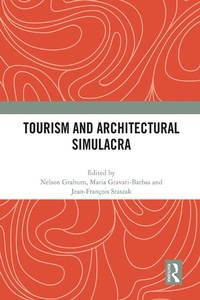
Tourism and Architectural Simulacra
1st Edition
Published on 5. July 2021
124 pages
978-1-000-40419-7 (ISBN)
Description

Since its beginnings, tourism has inspired built environments that have suggested reinvented relationships with their original architectural inspirations. Copies, reinterpretations, and simulacra still constitute some of the most familiar and popular tourist attractions in the world.
Some reinterpret archetypes such as the ancient palace, the Renaissance villa, or the Mediterranean village. Others duplicate the cities in which we lived in the past or we still live today. And others realise perceptions of utopias such as Shangri-La, Eden, or Paradise. Replicas - duplitecture - and simulacra can have symbolic meaning for tourists, as merely inspiring an atmosphere or as truly authentic, and their relationship to original functions, for worship, accommodation, leisure, or shopping.
Tourism and Architectural Simulacra questions and rethinks the different environments constructed or adapted both for and by tourism exploring the relationship between the architectural inspiration and its reproduction within the tourist bubble. The wide range of geographical areas, eras, and subjects in this book show that the expositions of simulacra and hyper reality by Baudrillard, Deleuze, and Eco are surpassed by our complex world. Adopting an interdisciplinary approach they offer original insights of the complex relationship between tourism and architecture.
The chapters in this book were originally published as a special issue of the Journal of Tourism and Cultural Change.
Some reinterpret archetypes such as the ancient palace, the Renaissance villa, or the Mediterranean village. Others duplicate the cities in which we lived in the past or we still live today. And others realise perceptions of utopias such as Shangri-La, Eden, or Paradise. Replicas - duplitecture - and simulacra can have symbolic meaning for tourists, as merely inspiring an atmosphere or as truly authentic, and their relationship to original functions, for worship, accommodation, leisure, or shopping.
Tourism and Architectural Simulacra questions and rethinks the different environments constructed or adapted both for and by tourism exploring the relationship between the architectural inspiration and its reproduction within the tourist bubble. The wide range of geographical areas, eras, and subjects in this book show that the expositions of simulacra and hyper reality by Baudrillard, Deleuze, and Eco are surpassed by our complex world. Adopting an interdisciplinary approach they offer original insights of the complex relationship between tourism and architecture.
The chapters in this book were originally published as a special issue of the Journal of Tourism and Cultural Change.
More details
Edition
1. Auflage
Language
English
Place of publication
London
United Kingdom
Publishing group
Taylor & Francis Ltd
Target group
College/higher education
ISBN-13
978-1-000-40419-7 (9781000404197)
Copyright in bibliographic data and cover images is held by Nielsen Book Services Limited or by the publishers or by their respective licensors: all rights reserved.
Schweitzer Classification
Other editions
Additional editions
Nelson Graburn | Maria Gravari-Barbas | Jean-Francois Staszak
Tourism and Architectural Simulacra
Book
09/2023
1st Edition
Routledge
€52.07
Shipment within 15-20 days
Nelson Graburn | Maria Gravari-Barbas | Jean-Francois Staszak
Tourism and Architectural Simulacra
Book
07/2021
1st Edition
Routledge
€179.81
Shipment within 15-20 days
Persons
Nelson Graburn was educated at Cambridge (1958), McGill (1960), and Chicago (PhD, 1963). He has taught at UC Berkeley for 54 years and served as Curator of the Hearst Museum and chair of Tourism Studies. He also taught in Canada, France, UK, Japan, and Brazil and China, and researched Canadian Inuit (1959-2014) Japan (since 1974) and China (since 1991). His work includes Ethnic and Tourist Arts (1976), Japanese Domestic Tourism (1983), Anthropology of Tourism (1983), Multiculturalism in the New Japan (2008), Anthropology in the Age of Tourism (2009), Tourism and Glocalization (2010), Tourism Imaginaries: Anthropological Approaches (2014), Tourism Imaginaries at the Disciplinary Crossroads (2016), Tourism in (Post)Socialist Eastern Europe (2017), and Cultural Tourism Movements (2018).
Maria Gravari-Barbas has a degree in Architecture and Urban Design (University of Athens, 1985) and a PhD in Geography and Planning (Paris IV - Sorbonne, 1991). She was Fellow at the Urban Program of Johns Hopkins University, Baltimore, USA (1990). She is the director of the EIREST, a multidisciplinary research team dedicated to tourism studies, with main focus on cultural heritage, development, and urban-tourism evolutions. From 2008 to 2017 she was the director of the Institute for Research and High Studies on Tourism (Institut de Recherches et d'Etudes Superieures du Tourisme, IREST) of Paris 1 Pantheon-Sorbonne University. Since 2009 she is the director of the UNESCO Chair of Paris 1 Pantheon-Sorbonne University and the coordinator of the UNITWIN network 'Tourism, Culture, Development'. She is the author of several books and papers related to tourism, culture, and heritage.
Jean-Francois Staszak received his PhD in Geography at the Sorbonne University. After serving as Associate Professor in the Universities of Amiens (Northern France) and Pantheon-Sorbonne (Paris), he became full Professor at the Geography Department of the University of Geneva (Switzerland). His early research focused on the history and epistemology of Geography, and then on economic and cultural Geography. His most recent work addresses geographical imaginaries in the fields of art and tourism, analysing the geographical othering process and especially the exotic. His understanding of the articulation of geographical representations, practices, and realities owes much to deconstructionist theories and to postcolonial and gender studies. Among his recent books: Quartier reserve. Bousbir, Casablanca Geneve, Georg (2020), Simuler le monde. Panoramas, parcs a theme et autres dispositifs immersifs, Geneve, Metispresse (2019), Frontieres en tous genres. Cloisonnement spatial et constructions identitaires, Rennes, PUR (2017), Cliches exotiques. Le Tour du Monde en photographies 1860-1890, Paris, De Monza (2015).
Maria Gravari-Barbas has a degree in Architecture and Urban Design (University of Athens, 1985) and a PhD in Geography and Planning (Paris IV - Sorbonne, 1991). She was Fellow at the Urban Program of Johns Hopkins University, Baltimore, USA (1990). She is the director of the EIREST, a multidisciplinary research team dedicated to tourism studies, with main focus on cultural heritage, development, and urban-tourism evolutions. From 2008 to 2017 she was the director of the Institute for Research and High Studies on Tourism (Institut de Recherches et d'Etudes Superieures du Tourisme, IREST) of Paris 1 Pantheon-Sorbonne University. Since 2009 she is the director of the UNESCO Chair of Paris 1 Pantheon-Sorbonne University and the coordinator of the UNITWIN network 'Tourism, Culture, Development'. She is the author of several books and papers related to tourism, culture, and heritage.
Jean-Francois Staszak received his PhD in Geography at the Sorbonne University. After serving as Associate Professor in the Universities of Amiens (Northern France) and Pantheon-Sorbonne (Paris), he became full Professor at the Geography Department of the University of Geneva (Switzerland). His early research focused on the history and epistemology of Geography, and then on economic and cultural Geography. His most recent work addresses geographical imaginaries in the fields of art and tourism, analysing the geographical othering process and especially the exotic. His understanding of the articulation of geographical representations, practices, and realities owes much to deconstructionist theories and to postcolonial and gender studies. Among his recent books: Quartier reserve. Bousbir, Casablanca Geneve, Georg (2020), Simuler le monde. Panoramas, parcs a theme et autres dispositifs immersifs, Geneve, Metispresse (2019), Frontieres en tous genres. Cloisonnement spatial et constructions identitaires, Rennes, PUR (2017), Cliches exotiques. Le Tour du Monde en photographies 1860-1890, Paris, De Monza (2015).
Content
Introduction: Simulacra, architecture, tourism and the Uncanny
Nelson Graburn, Gravari-Barbas Maria and Staszak Jean-Francois
1. Copysites: tourist attractions in the age of their architectural reproducibility
Bauer Bernhard and Canestrini Duccio
2. What makes Paris being Paris? Stereotypes, simulacra and tourism imaginaries
Maria Gravari-Barbas
3. Tropical and Eastern Paris: architecture, representation and tourism in Brazil and China
Felipe Loureiro and Roberto Bartholo
4. Simulacra heritagization: the Minyuan stadium in Wudadao, Tianjin
Lu Yue, Gravari-Barbas Maria and Guinand Sandra
5. Seeing is believing: miniature and gigantic architectural models of second temple
Yael Padan
6. The Musee de la Grande Guerre du Pays de Meaux - a simulacrum of the 1914-1918 war?
Bertram M. Gordon
7. Simulacra architecture in relation to tourism: Charles Rennie Mackintosh in Glasgow and Antoni Gaudi in Barcelona
Yasmin Buchrieser
Nelson Graburn, Gravari-Barbas Maria and Staszak Jean-Francois
1. Copysites: tourist attractions in the age of their architectural reproducibility
Bauer Bernhard and Canestrini Duccio
2. What makes Paris being Paris? Stereotypes, simulacra and tourism imaginaries
Maria Gravari-Barbas
3. Tropical and Eastern Paris: architecture, representation and tourism in Brazil and China
Felipe Loureiro and Roberto Bartholo
4. Simulacra heritagization: the Minyuan stadium in Wudadao, Tianjin
Lu Yue, Gravari-Barbas Maria and Guinand Sandra
5. Seeing is believing: miniature and gigantic architectural models of second temple
Yael Padan
6. The Musee de la Grande Guerre du Pays de Meaux - a simulacrum of the 1914-1918 war?
Bertram M. Gordon
7. Simulacra architecture in relation to tourism: Charles Rennie Mackintosh in Glasgow and Antoni Gaudi in Barcelona
Yasmin Buchrieser
