

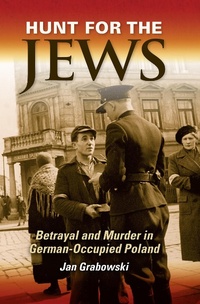
Hunt for the Jews
Betrayal and Murder in German-Occupied Poland
Published on 1. November 2018
320 pages
978-0-253-01087-2 (ISBN)
Description

A revealing account of Polish cooperation with Nazis in WWII-a "grim, compelling [and] significant scholarly study" (
Kirkus Reviews).
Between 1942 and 1943, thousands of Jews escaped the fate of German death camps in Poland. As they sought refuge in the Polish countryside, the Nazi death machine organized what they called Judenjagd, meaning hunt for the Jews. As a result of the Judenjagd, few of those who escaped the death camps would survive to see liberation. As Jan Grabowski's penetrating microhistory reveals, the majority of the Jews in hiding perished as a consequence of betrayal by their Polish neighbors.
Hunt for the Jews tells the story of the Judenjagd in Dabrowa, Tarnowska, a rural county in southeastern Poland. Drawing on materials from Polish, Jewish, and German sources created during and after the war, Grabowski documents the involvement of the local Polish population in the process of detecting and killing the Jews who sought their aid. Through detailed reconstruction of events, "Grabowski offers incredible insight into how Poles in rural Poland reacted to and, not infrequently, were complicit with, the German practice of genocide. Grabowski also, implicitly, challenges us to confront our own myths and to rethink how we narrate British (and American) history of responding to the Holocaust" ( European History Quarterly).
Between 1942 and 1943, thousands of Jews escaped the fate of German death camps in Poland. As they sought refuge in the Polish countryside, the Nazi death machine organized what they called Judenjagd, meaning hunt for the Jews. As a result of the Judenjagd, few of those who escaped the death camps would survive to see liberation. As Jan Grabowski's penetrating microhistory reveals, the majority of the Jews in hiding perished as a consequence of betrayal by their Polish neighbors.
Hunt for the Jews tells the story of the Judenjagd in Dabrowa, Tarnowska, a rural county in southeastern Poland. Drawing on materials from Polish, Jewish, and German sources created during and after the war, Grabowski documents the involvement of the local Polish population in the process of detecting and killing the Jews who sought their aid. Through detailed reconstruction of events, "Grabowski offers incredible insight into how Poles in rural Poland reacted to and, not infrequently, were complicit with, the German practice of genocide. Grabowski also, implicitly, challenges us to confront our own myths and to rethink how we narrate British (and American) history of responding to the Holocaust" ( European History Quarterly).
More details
Other editions
Additional editions
Book
10/2013
Indiana University Press
€34.50
Shipment within 10-20 days
Person
Jan Grabowski is Professor of History at the University of Ottawa and a founding member of the Polish Center for Holocaust Research. He is author (with Barbara Engelking) of The Contour of a Landscape: Rural Poland and the Extermination of the Jews, 1942-1945 (in Polish).72
Content
Acknowledgments
List of Abbreviations
Introduction
1. Dbrowa Tarnowska
2. Jews and Poles in Dbrowa Tarnowska Before 1939
3. First Years of Occupation
4. The Destruction of Dbrowa Tarnowska
5. Judenjagd - Hunt for the Jews
6. Rural Society and the Jews in Hiding
7. In the Dulcza Forest
8. The German Police
9. The Polish "Blue" Police
10. Baudienst
11. Last Months of War
12. Different Kinds of Help
13. The Righteous
Conclusion
Documents & Tables
Bibliography
