

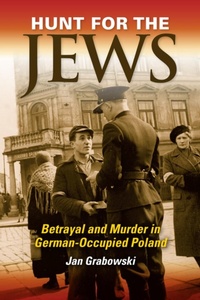
Hunt for the Jews
Betrayal and Murder in German-Occupied Poland
Published on 9. October 2013
Book
Hardback
320 pages
978-0-253-01074-2 (ISBN)
Description
Judenjagd, hunt for the Jews, was the German term for the organized searches for Jews who, having survived ghetto liquidations and deportations to death camps in Poland in 1942, attempted to hide "on the Aryan side." Jan Grabowski's penetrating microhistory tells the story of the Judenjagd in Dabrowa Tarnowska, a rural county in southeastern Poland, where the majority of the Jews in hiding perished as a consequence of betrayal by their Polish neighbors. Drawing on materials from Polish, Jewish, and German sources created during and after the war, Grabowski documents the involvement of the local Polish population in the process of detecting and killing the Jews who sought their aid. Through detailed reconstruction of events, this close-up account of the fates of individual Jews casts a bright light on a little-known aspect of the Holocaust in Poland.
Reviews / Votes
...[A] grim, compelling work of research...The author followed the fates of 337 Jews who tried to survive in the county, of which 51 managed to hide until liberation, while 286 died between 1942 and 1945. Grabowski breaks down each group with meticulous research.(Kirkus Reviews) Eschewing facile generalizations about latent or active anti-Semitism, Grabowski considers the motivations of both those who aided Jews and those who attacked them...Grabowski's highly detailed reconstruction challenges the conventional wisdom of dividing the population into victims, perpetrators, and bystanders...Recommended for all serious Holocaust collections.
(Library Journal) This important, often disturbing, exploration of how genocides happen is on par with works from Hannah Arendt and Gitta Sereny and is enriched by the author's clear compassion for those who were compromised or lost.
(ForeWord Reviews) Now, in path-breaking research, Jan Grabowski . . . reveals what happened to those Jews who tried to hide in rural Poland after the Nazis violently emptied the ghettos.
(Maclean's) Here is an absolutely essential addition to any Holocaust library or a read for anyone interested in Polish-Jewish relations.
(AJL Reviews) One concludes from Grabowski's important study that without the often unforced, and sometimes enthusiastic, support of non-German volunteers and helpers, the Germans would not have succeeded as completely as they did during the Holocaust. . . . Recommended.
(Choice) This book is a significant contribution to the scholarly and public debate on Polish-Jewish relations during the Holocaust. . . . All in all, Hunt for the Jews should become required reading for scholars
and students of Polish-Jewish relations.
(Slavic Review) Grabowski has amassed an admirable amount of original research and presented to the reader a study that explains much about the mechanisms of destruction and how the Germans used local Poles in the Nazi extermination campaign against the Jews. Hunt for the Jews is one of a growing number of studies coming out of Poland that are puncturing the myth of Polish innocence during the Holocaust.
(Journal of Modern History) Grabowski offers incredible insight into how Poles in rural Poland reacted to and, not infrequently, were complicit with, the German practice of genocide. Grabowski also, implicitly, challenges us to confront our own myths and to rethink how we narrate British (and American) history of responding to the Holocaust.
(European History Quarterly) Hunt for the Jews is a must-read for all those interested in Polish-Jewish relations and Holocaust studies.
(American Historical Review)
More details
Language
English
Place of publication
Bloomington, IN
United States
Target group
Professional and scholarly
Product notice
Paper over boards
Illustrations
1 map, 21 b&w illus.
Dimensions
Height: 235 mm
Width: 164 mm
Thickness: 30 mm
Weight
588 gr
ISBN-13
978-0-253-01074-2 (9780253010742)
Copyright in bibliographic data and cover images is held by Nielsen Book Services Limited or by the publishers or by their respective licensors: all rights reserved.
Schweitzer Classification
Other editions
Additional editions
E-Book
11/2018
Indiana University Press
€18.18
Available for download
Person
Jan Grabowski is Professor of History at the University of Ottawa and a founding member of the Polish Center for Holocaust Research. He is author (with Barbara Engelking) of The Contour of a Landscape: Rural Poland and the Extermination of the Jews, 1942-1945 (in Polish).72
Content
Acknowledgments
List of Abbreviations
Introduction
1. Dabrowa Tarnowska
2. Jews and Poles in Dabrowa Tarnowska Before 1939
3. First Years of Occupation
4. The Destruction of Dabrowa Tarnowska
5. Judenjagd - Hunt for the Jews
6. Rural Society and the Jews in Hiding
7. In the Dulcza Forest
8. The German Police
9. The Polish "Blue" Police
10. Baudienst
11. Last Months of War
12. Different Kinds of Help
13. The Righteous
Conclusion
Documents & Tables
Bibliography
List of Abbreviations
Introduction
1. Dabrowa Tarnowska
2. Jews and Poles in Dabrowa Tarnowska Before 1939
3. First Years of Occupation
4. The Destruction of Dabrowa Tarnowska
5. Judenjagd - Hunt for the Jews
6. Rural Society and the Jews in Hiding
7. In the Dulcza Forest
8. The German Police
9. The Polish "Blue" Police
10. Baudienst
11. Last Months of War
12. Different Kinds of Help
13. The Righteous
Conclusion
Documents & Tables
Bibliography